好的,我现在需要帮用户总结一篇文章的内容,控制在100个字以内。用户已经给出了文章的英文内容,我需要先通读并理解文章的主要信息。 文章主要讲的是设备代码钓鱼攻击利用OAuth 2.0的设备授权流程来劫持账户的情况急剧增加。攻击者发送设备授权请求,获取代码后诱骗受害者输入,从而获得访问令牌。这种攻击方式在2020年被记录,但最近几年被恶意利用,并且有多个钓鱼工具包被发现,如EvilTokens等。文章还提到防御措施,比如禁用设备授权流程和监控日志。 接下来,我需要将这些要点浓缩成100字以内的中文摘要。要确保涵盖攻击方式、增长情况、工具包以及防御建议。同时,避免使用“这篇文章”或“总结”等开头词。 可能的结构是:先说明攻击类型和增长情况,然后简述攻击过程和工具包的存在,最后提到防御措施。这样既全面又简洁。 检查字数是否符合要求,并确保语言流畅自然。 </think> 设备代码钓鱼攻击利用OAuth 2.0的设备授权流程劫持账户,今年激增37倍。攻击者通过伪装请求获取代码,并诱骗受害者输入,从而获得访问令牌。该技术于2020年被记录,近年来被恶意利用,并出现多个钓鱼工具包如EvilTokens等。防御建议包括禁用设备授权流程和监控异常登录活动。 2026-4-4 14:30:18 Author: www.bleepingcomputer.com(查看原文) 阅读量:14 收藏

Device code phishing attacks that abuse the OAuth 2.0 Device Authorization Grant flow to hijack accounts have surged more than 37 times this year.
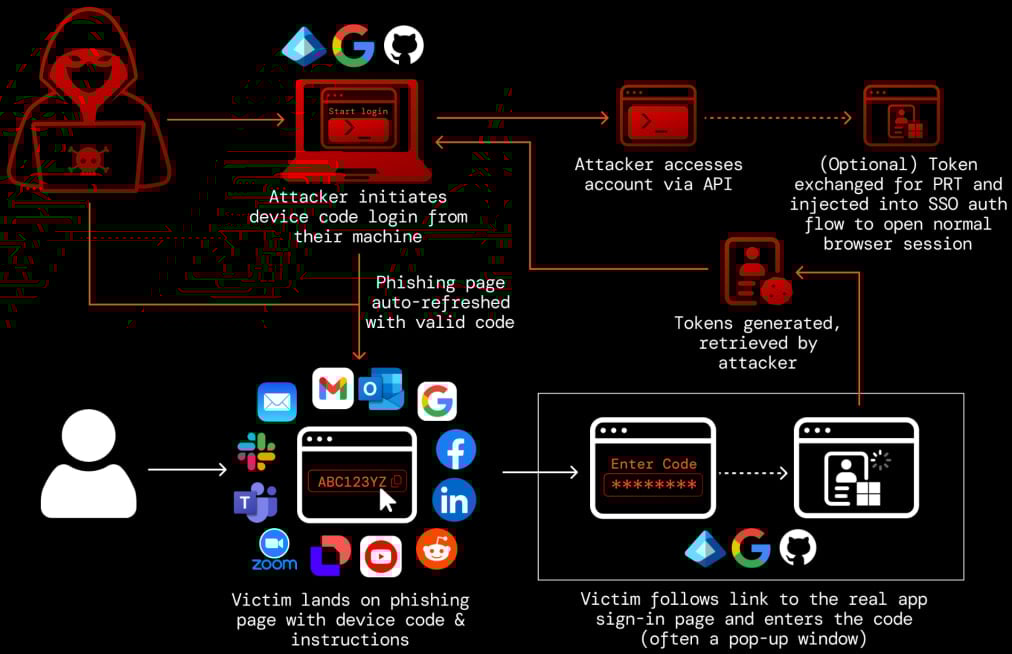
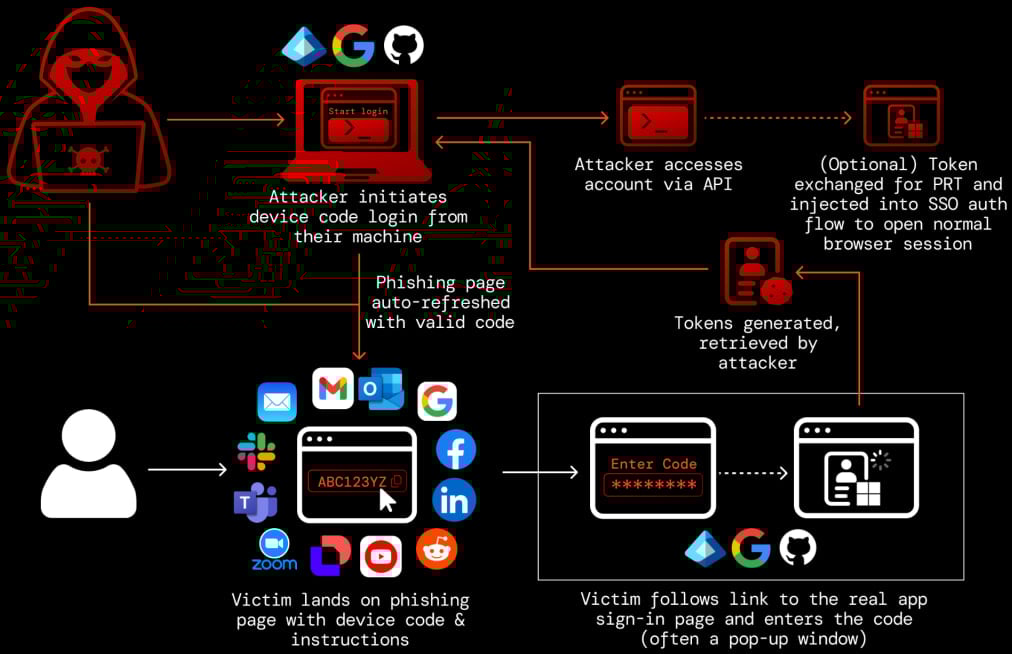
In this type of attack, the threat actor sends a device authorization request to a service provider and receives a code, which is sent to the victim under various pretexts.
Next, the victim is tricked into entering the code on the legitimate login page, thus authorizing the attacker's device to access the account through valid access and refresh tokens.
This flow was designed to simplify connecting devices that do not have accessible input options (e.g., IoT devices, printers, streaming devices, and smart TVs).
Source: Push Security
The device code phishing technique was first documented in 2020, but malicious exploitation was recorded a few years later, and has been used by both state-hackers and financially-motivated ones [1, 2, 3, 4].
Researchers at Push Security observed a massive increase in the use of these attacks, warning that they have been widely adopted by cybercriminals.
“At the start of March (2026), we’d observed a 15x increase in device code phishing pages detected by our research team this year, with multiple kits and campaigns being tracked — with the kit now identified as EvilTokens the most prominent. That figure has now risen to 37.5x.” - Push Security
Earlier this week, threat detection and response company Sekoia published research on the EvilTokens phishing-as-a-service (PhaaS) operation. The researchers underline that it is a prominent example of a phishing kit that “democratizes” device code phishing, making it available to low-skilled cybercriminals.
Push agrees that EvilTokens has been a major driver of the technique's mainstream adoption, but notes that there are several other platforms competing on the same market, which could become more prominent in the event of law enforcement disrupting EvilTokens:
- VENOM - A closed-source PhaaS kit offering both device code phishing and AiTM capabilities. Its device code component appears to be an EvilTokens clone.
- SHAREFILE - A kit themed around Citrix ShareFile document transfers, using node-based backend endpoints to simulate file sharing and trigger device code flows.
- CLURE - A kit using rotating API endpoints and an anti-bot gate, with SharePoint-themed lures and backend infrastructure on DigitalOcean.
- LINKID - A kit leveraging Cloudflare challenge pages and self-hosted APIs, using Microsoft Teams and Adobe-themed lures.
- AUTHOV - A workers.dev-hosted kit using popup-based device code entry and Adobe document-sharing lures.
- DOCUPOLL - A kit hosted on GitHub Pages and workers.dev that mimics DocuSign workflows, including injected replicas of real pages.
- FLOW_TOKEN - A workers.dev-hosted kit using Tencent Cloud backend infrastructure, with HR and DocuSign-themed lures and popup-based flows.
- PAPRIKA - An AWS S3–hosted kit using Microsoft login clone pages with Office 365 branding and a fake Okta footer.
- DCSTATUS - A minimal kit with generic Microsoft 365 “Secure Access” lures and limited visible infrastructure markers.
- DOLCE - A Microsoft PowerApps-hosted kit with Dolce & Gabbana–themed lures, likely a one-off or red-team-style implementation rather than widely used.
Push Security also published a video showing how the DOCUPOLL kit works. The threat actor uses DocuSign branding and a lure for an alleged contract, asking the victim to sign into the Microsoft Office application.
In total, there are at least 11 phishing kits offering cybercriminals this type of attack, all using realistic SaaS-themed lures, anti-bot protections, and abusing cloud platforms for hosting.
To block device-code phishing attacks, Push Security suggests that users disable the flow when not needed by setting conditional access policies on their accounts.
It is also recommended to monitor logs for unexpected device code authentication events, unusual IP addresses, and sessions.

Automated Pentesting Covers Only 1 of 6 Surfaces.
Automated pentesting proves the path exists. BAS proves whether your controls stop it. Most teams run one without the other.
This whitepaper maps six validation surfaces, shows where coverage ends, and provides practitioners with three diagnostic questions for any tool evaluation.
如有侵权请联系:admin#unsafe.sh