好的,我现在需要帮用户总结一篇文章,控制在100字以内。用户已经提供了文章内容,我先快速浏览一下。 文章主要讲的是美国通过《芯片安全法案》,目的是防止先进AI芯片被走私到中国。法案的核心是位置验证机制,要求出口的芯片必须有技术手段持续确认其位置。此外,法案还要求出口许可持有者及时报告芯片被转移的情况,并提到司法部已经起诉了走私者。 接下来,我需要提炼这些关键点:法案名称、目的、核心机制、涉及的公司(如Nvidia)、以及执行情况。还要注意不要超过100字。 可能的结构是:美国通过法案,防止AI芯片走私到中国,使用位置验证技术,涉及Nvidia等公司,并有相关执法案例。 现在开始组织语言: 美国通过《芯片安全法案》,旨在防止先进AI芯片被走私到中国。该法案要求出口的AI芯片必须具备位置验证功能,确保其未被非法转移。涉及Nvidia等公司的高端芯片,并已有相关执法案例。 这样大概在80字左右,符合要求。 </think> 美国通过《芯片安全法案》,旨在防止先进AI芯片被走私到中国。该法案要求出口的AI芯片必须具备位置验证功能,确保其未被非法转移。涉及Nvidia等公司的高端芯片,并已有相关执法案例。 2026-3-27 11:4:9 Author: thecyberexpress.com(查看原文) 阅读量:43 收藏
DeepSeek changed the calculation. When the House Select Committee on China concluded in early 2025 that the Chinese AI company had trained its flagship model on restricted Nvidia AI chips that should never have reached it, Congress stopped treating chip smuggling as an enforcement failure and started treating it as a legislative emergency — one that arrived on the House Foreign Affairs Committee’s desk, this week.
The House Foreign Affairs Committee passed the Chip Security Act with bipartisan support on Thursday, advancing legislation to curb the smuggling of American semiconductors to foreign adversaries. The bill was introduced in May 2025 as a direct response to concerns raised by the Select Committee on China in its report on DeepSeek, which concluded the company used advanced Nvidia chips restricted from export to China to develop its AI model.
Here’s What the AI Chip Security Act Is
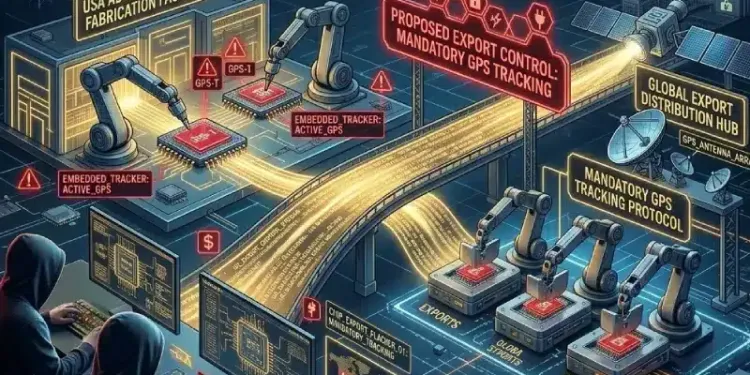
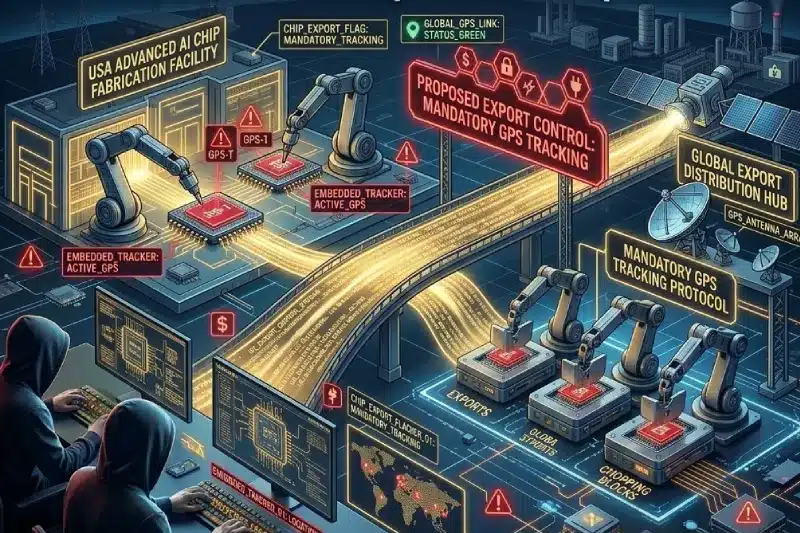
The core mechanism the Chip Security Act puts forward is location verification — the requirement that advanced AI chips exported from the United States carry a technical security mechanism, whether implemented in software, firmware, or hardware, that continuously confirms where the device physically sits.
The bill requires the Secretary of Commerce to mandate, within 180 days of enactment, that any covered integrated circuit product be outfitted with chip security mechanisms implementing location verification before it is exported, reexported, or transferred to a foreign country. Covered products include chips classified under Export Control Classification Numbers 3A090, 3A001.z, 4A090, and 4A003.z — the precise classifications that cover Nvidia’s H100 and equivalent advanced AI accelerators.
The bill also requires any person who received a license to export a covered chip to promptly report to the Under Secretary of Industry and Security if they obtain credible information that the product has been diverted to an unauthorized end-user or location. Mandatory reporting closes a gap that currently allows diversion to go unreported until investigators stumble across it independently — sometimes years after the fact.
The bill arrives with enforcement urgency already established on its behalf. Earlier this week, the Justice Department charged three individuals for conspiring to smuggle billions of dollars’ worth of advanced AI chips to China through Thailand.

Read: Three Individuals Charged for Trying to Smuggle ‘America-Made’ AI Tech Worth $170M
In November 2025, the DOJ had also indicted three Chinese nationals for smuggling high-tech chips through Thailand and Malaysia to China. Both cases used the trans-shipment model — routing restricted chips through a third country to obscure China as the final destination — demonstrating that existing export controls fail at the physical enforcement layer precisely where location verification would apply.
The broader legislative push sits in deliberate tension with the Trump administration. The White House AI czar, David Sacks, in January retweeted criticism of the Chip Security Act, suggesting it handicaps Trump’s ability to strategically position the U.S. favorably against China. House Foreign Affairs Committee Chairman Brian Mast pushed back directly, saying the talking points amplified by Sacks matched those he had heard from Nvidia. Nvidia CEO Jensen Huang has repeatedly argued to lawmakers that U.S. chip sales to China entrench American technology as the global standard — a position congressional China hawks view as commercially motivated reasoning that ignores military end-use risk.
The Trump administration approved the export of higher-tier H200 chips to China in January 2026, walking back the previous administration’s blanket restrictions. That decision prompted fierce backlash on Capitol Hill, where lawmakers have been seeking congressional control over export licensing — authority that currently belongs entirely to the Department of Commerce.
The Chip Security Act represents Congress’s attempt to build a verification infrastructure capable of surviving executive policy oscillations by embedding accountability into the hardware itself rather than relying solely on licensing decisions made at the administrative level.
Industry groups including the Information Technology and Innovation Council have warned that a government chip-tracking mandate creates the impression of deepening U.S. government control over the American AI stack, potentially pushing countries that should be core customers toward alternative suppliers. Whether that concern outweighs the demonstrated reality of $170 million AI chip smuggling conspiracies routed through Southeast Asian shell companies is now a question for the full House floor.
如有侵权请联系:admin#unsafe.sh