嗯,用户让我帮忙总结一下这篇文章的内容,控制在一百个字以内。首先,我需要仔细阅读文章,抓住主要信息。 文章是关于Gcore发布的Q3-Q4 2025的报告,主要讨论DDoS攻击的趋势。攻击数量从2024年的51.2万增加到2025年的130万,增长显著。攻击规模也增加了六倍,达到12 Tbps。网络层攻击占了82%,而且持续时间变短,大部分不到一分钟。应用层攻击则持续时间更长。技术行业是主要目标,占34%。地理位置上,拉丁美洲尤其是墨西哥和巴西是主要来源。 接下来,我需要把这些要点浓缩到100字以内。要包括攻击数量、规模、类型变化、目标行业和地理位置这些关键点。 可能的结构是:Gcore报告指出DDoS攻击数量和规模激增,网络层攻击占比高且持续时间短,应用层攻击时间长,技术行业受影响最大,拉丁美洲是主要来源。 检查一下字数是否合适,确保不超过限制。同时要避免使用“文章内容总结”这样的开头。 </think> Gcore报告指出DDoS攻击数量和规模激增,网络层攻击占比达82%,持续时间缩短至一分钟内;应用层攻击时长增加至10分钟以上;技术行业受攻击最多(34%),拉丁美洲为主要来源地。 2026-3-24 08:1:5 Author: securityboulevard.com(查看原文) 阅读量:7 收藏
Luxembourg, Luxembourg, March 24th, 2026, CyberNewswire
Gcore data highlights a threat landscape defined by newfound automated attack capabilities, scale, and frequency
Gcore, the global infrastructure and software provider for AI, cloud, network, and security solutions, today announced the findings of its Q3-Q4 2025 Gcore Radar report DDoS attack trends. The report reveals growing attack volumes, increasingly sophisticated tactics, and changes in attack locations driven by evolving botnet infrastructure.
The DDoS attack landscape is at a clear inflection point: threats are not just growing; they are accelerating and diversifying. To prevent disruption, businesses must act quickly and adopt integrated solutions capable of detecting intent, analysing behaviour, and responding to threats across multiple attack surfaces.
Key insights from Q3-Q4 2025
- Total number of attacks grew to 1300K in Q4 2025 from 512K in Q4 2024, reinforcing the view that DDoS activity is entering a new phase of scale and frequency
- Attack volumes surged to 12 Tbps in Q4, representing a sixfold increase and highlighting unprecedented growth in attack capabilities.
- 75% of network-layer attacks lasted less than one minute, while application-layer attacks showed a shift toward longer durations
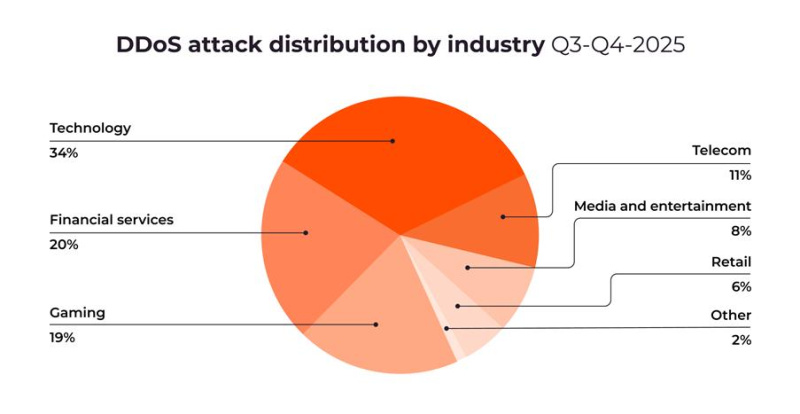
- Technology remains the most targeted sector, accounting for 34% of attacks, followed by financial services (20%) and gaming (19%).
- Geographic patterns show a strong concentration of attack sources in Latin America, with Mexico and Brazil together accounting for 55% of observed activity.

Andrey Slastenov, Head of Security, Gcore, commented: ‘‘The latest Radar report is a call to action for business across industries. Attacks are becoming more frequent and more sophisticated because organising them is now cheaper and easier than ever. Businesses and organisations that previously felt unaffected are now being targeted. Effective protection strategies do exist, but understanding what is happening and being prepared has never been more important.’’
New drivers of DDoS attack growth and intensity
DDoS attack volumes and scale have reached new levels, with the sixfold increase from 2.2 Tbps to 12 Tbps, reflecting the rapid escalation of attack capabilities.  Several structural factors are causing DDoS attack numbers to grow:
- Broader access to attack tools
- Expansion of insecure IoT ecosystems
- Geopolitical and economic instability
- Increasing sophistication of attack techniques
Network-layer attacks continue to increase
Network-layer attacks accounted for 82% of all observed incidents in the current period, a significant 20% increase from the last report. This surge reflects the economics of cybercrime: network-layer attacks are cheaper and easier to execute, making them an attractive option for attackers who simply want to cause disruption.
Recent data reveals shifts in attack duration and sophistication
Network-layer DDoS attacks became noticeably shorter in duration, with most attacks (75%) lasting less than one minute. Only 2% of attacks extended beyond ten minutes, indicating a continued shift toward highly intense, short-lived bursts designed to overwhelm targets quickly before mitigation measures fully engage. At the same time, application-layer DDoS attacks followed an opposite trajectory, with medium-duration attacks becoming significantly more common as 64% of attacks exceeded 10 minutes.
Attackers also increasingly relied on automation to execute large-scale campaigns. This shift reflects a broader transition from opportunistic abuse toward more deliberate, business-impact-focused attacks, including account takeover attempts, scraping, and direct manipulation of application workflows.
Attackers target digitally intensive sectors for maximum disruption
Attacks concentrated around several key sectors, including technology (34%), financial services (20%), and gaming (19%). These sectors are favoured targets because service availability is critical, and disruption can generate immediate operational or financial impact. The continued growth of attacks targeting the technology sector reflects its foundational role in today’s digital economy. As digital ecosystems become increasingly interconnected and cloud-dependent, attackers appear to prioritise infrastructure-layer targets capable of generating the broadest possible disruption.
 The Americas dominate geographical distribution of attack sources
The geographic distribution of attack sources shows a strong concentration in the Americas, with Mexico accounting for 31% of network-layer observed traffic, followed by Brazil (24%) and the United States (20%). The US remains prevalent for application layer attacks as well, at 23% representation. The likely culprit for the American dominance of network-layer attacks is the AISURU botnet, which disproportionately affects networks and device ecosystems in these countries.
In today’s sophisticated attack environment, the data reveals why it’s critical to mitigate attacks as close to their source as possible, rather than near the target. Effective protection requires globally distributed capacity, not only in regions with high traffic demand, but also in regions that are frequent sources of attack activity – which are often not the same.
To access the full report, users can visit https://gcore.com/resources/gcore-radar-attack-trends-q3-q4-2025.
About Gcore
Gcore is a global infrastructure and software provider for AI, cloud, network, and security solutions. Headquartered in Luxembourg, Gcore operates its own sovereign infrastructure across six continents, delivering ultra-low latency and compliance-ready performance for mission-critical workloads. Its AI-native cloud stack combines software innovation with hyperscaler-grade functionality, enabling enterprises and service providers to build, train, and scale AI everywhere—across public, private, and hybrid environments. By integrating AI, compute, networking, and security into a single platform, Gcore accelerates digital transformation and empowers organizations to unlock the full potential of AI-driven services.
Users can learn more at gcore.com.
Contact
PR Manager
Kira Kurepina
Gcore
[email protected]
如有侵权请联系:admin#unsafe.sh