嗯,用户让我用中文总结一下这篇文章,控制在100个字以内,而且不需要用“文章内容总结”或者“这篇文章”这样的开头,直接写描述。好的,首先我需要通读整篇文章,抓住主要信息。 文章主要讲的是Common Mark Certificates(CMC),它允许品牌在支持的邮箱中显示经过验证的标志,使用的是BIMI标准。DMARC策略必须设置为p=quarantine或p=reject才能使用CMC。CMC不需要注册商标,但标志需要公开使用至少一年。文章还提到了几个主要的CMC提供商,比如DigiCert、Sectigo、Entrust、GlobalSign和SSL.com,每个提供商都有不同的验证速度、定价和管理工具。最后,文章提到实施CMC可以提升品牌信任度、可见度、送达率和防钓鱼能力。 现在我需要把这些信息浓缩到100字以内。要包括CMC的作用、DMARC的要求、不需要商标但需公开使用一年、主要提供商以及带来的好处。 可能的结构:介绍CMC的功能,DMARC要求,无需商标但需公开使用一年,推荐提供商及其特点,以及带来的好处。 这样组合起来的话: “Common Mark Certificates(CMC)允许品牌在支持的邮箱中显示经过验证的标志,并基于BIMI标准。需设置严格的DMARC策略(p=quarantine或p=reject),且标志需公开使用至少一年。推荐提供商包括DigiCert、Sectigo等,可提升品牌信任度和防钓鱼能力。” 这样大约100字左右。 </think> Common Mark Certificates (CMC) 允许品牌在支持的邮箱中显示经过验证的标志,并基于BIMI标准。需设置严格的DMARC策略(p=quarantine或p=reject),且标志需公开使用至少一年。推荐提供商包括DigiCert、Sectigo等,可提升品牌信任度和防钓鱼能力。 2026-3-17 09:11:40 Author: securityboulevard.com(查看原文) 阅读量:17 收藏
Key Takeaways
- Common Mark Certificates (CMC) allow brands to display verified logos in supported inboxes using the BIMI standard.
- DMARC enforcement (p=quarantine or p=reject) is mandatory before a CMC can function.
- CMC does not require a registered trademark, but the logo must show at least 12 months of public use.
- Top CMC providers include DigiCert, Sectigo, Entrust, GlobalSign, and SSL.com, each offering different validation speed, pricing, and management tools.
- Implementing CMC improves email trust, brand visibility, deliverability, and phishing protection across supported mailbox providers.
Modern email depends on two things: security and a clear brand identity. The Common Mark Certificate (CMC) merges these needs by letting your company place its official logo in supported inboxes. This process relies on the Brand Indicators for Message Identification (BIMI) standard. A CMC proves you own the rights to your brand mark once you set your DMARC record to a strict level of p=quarantine or p=reject. Startups often favor this path because it requires only twelve months of public logo use instead of a costly government trademark.
A trusted certificate authority is a vital partner in this transition. These providers manage the complex validation and cryptographic steps that make your logo compatible with email apps like Yahoo and Apple Mail. Leaders in this space, such as DigiCert and GlobalSign, offer different balances of cost and validation speed. By securing a CMC, your brand builds a shield against phishing while it makes every sent message a professional touchpoint.
What to Look for in a CMC Provider
A choice of certificate authority (CA) demands a close look at technical skills. To keep your logo visible and your domain safe, focus on these critical areas:
DMARC Enforcement Requirements
Your CMC serves no purpose unless your DMARC record is set to p=quarantine or p=reject. This rule blocks unauthorized senders from your domain.
- Dashboard access: Choose a partner with a clear DMARC monitor.
- Risk reduction: Use tools that find legitimate mail flows so you reach enforcement without a loss of data.
- Policy guidance: Reliable vendors help you move from a weak policy to a strong one.
Use our free DMARC Checker tool to check your current DMARC compliance status.
Note: Plan ahead: many authorities require your DMARC enforcement to be active for at least 30 days before they will finalize your certificate issuance.
BIMI Support
The provider must issue certificates that meet the exact BIMI technical rules. This is the only path to ensure your brand appears in Apple Mail or Yahoo.
- SVG Tiny P/S check: A good CA confirms your logo file follows the required secure profile.
- Cryptographic standards: If the certificate lacks the right format, your investment yields no visual result.
- Compatibility: Confirm the provider stays current with the latest mailbox provider updates.
Note: While CMCs are widely supported, some platforms like Apple Mail may have additional internal ‘reputation’ checks before displaying a non-trademarked logo.
Issuance and Validation Process
CMC validation looks at your history of logo use instead of a government trademark search.
- Timeline clarity: Seek a vendor with a predictable schedule for verification.
- The 12-month rule: Be ready to show your logo was in public use for at least one year.
- Required proof: Top CAs ask for snapshots from the web or notarized ID papers.
- No delays: Clear instructions from the start prevent gaps in your marketing plan.
Customer Support and Documentation
BIMI setup involves a mix of DNS records and secure file hosting. This complexity makes expert help a requirement.
- Guide variety: Look for step-by-step text and video tutorials.
- DNS help: Expert support is vital when you push your records live.
- Troubleshoot access: Real-time help can fix a broken setup before it affects your brand image.
You can also use PowerDMARC’s one-click hosted BIMI service for maximum convenience.
Pricing and Renewal Terms
Annual costs and renewal rules vary between authorities. You need a price that fits your budget without a drop in security quality.
- Rate types: Some vendors use flat rates while others bill per domain.
- Automated alerts: Do not let a certificate lapse. Choose a CA that sends multiple reminders.
- Management tools: A central console helps you track every expiration date in one place.
Top Common Mark Certificate Providers
The following list highlights the leading providers in the BIMI ecosystem. These organizations offer the infrastructure necessary to secure your brand identity.
The Top Common Mark Certificate (CMC) Providers
Common Mark Certificates help your brand stand out in a crowded inbox. They allow your logo to show up next to your emails, even if you do not have a registered trademark yet. Here are the best companies to help you get this set up.
1. GlobalSign
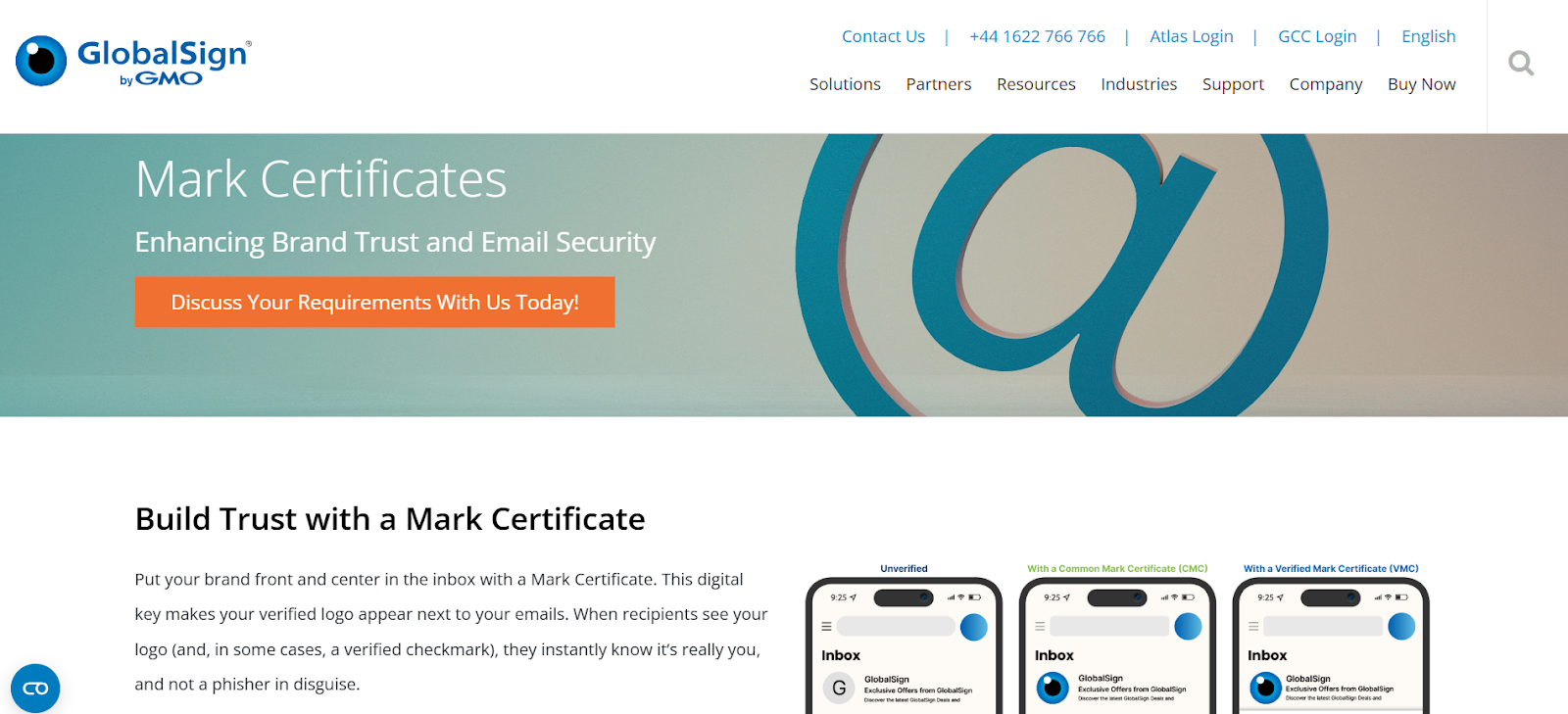
GlobalSign is a premier choice for businesses that value speed and high-scale security. As one of the world’s most established Certificate Authorities, they offer a highly structured path to BIMI for brands that lack a registered trademark.
Key Benefits and Features
- The “Prior Use” Specialist: While most providers focus on legal paperwork, GlobalSign specializes in the CMC “Prior Use Mark”. This allows you to qualify based on twelve months of active logo use on your website, verified through tools like the Wayback Machine.
- Rapid Issuance: They maintain one of the fastest validation cycles in the industry. Once you provide proof of logo use, your certificate is often ready in five to ten business days.
- Infrastructure for Growth: Their certificates are built on a high-scale Public Key Infrastructure (PKI). This means that as your company grows, you can easily upgrade from a CMC to a full Verified Mark Certificate (VMC) within the same ecosystem.
- Global Compatibility: GlobalSign ensures your logo meets the strict SVG Tiny PS standards required for display in major providers like Gmail, Yahoo, and Apple Mail.
The PowerDMARC Advantage Getting a certificate is only half the battle; the technical setup is where most brands get stuck. PowerDMARC removes this hurdle through a direct partnership with GlobalSign. Instead of you managing two different vendors, PowerDMARC acts as a single point of contact. They assist with:
- Initial Application: Gathering the “prior use” evidence GlobalSign needs.
- Hosted BIMI: Hosting your logo and certificate files on secure, HTTPS-ready servers.
- DNS Automation: Handling the complex task of creating and installing your BIMI DNS records to ensure your logo appears correctly across all supported mailboxes.
2. Sectigo
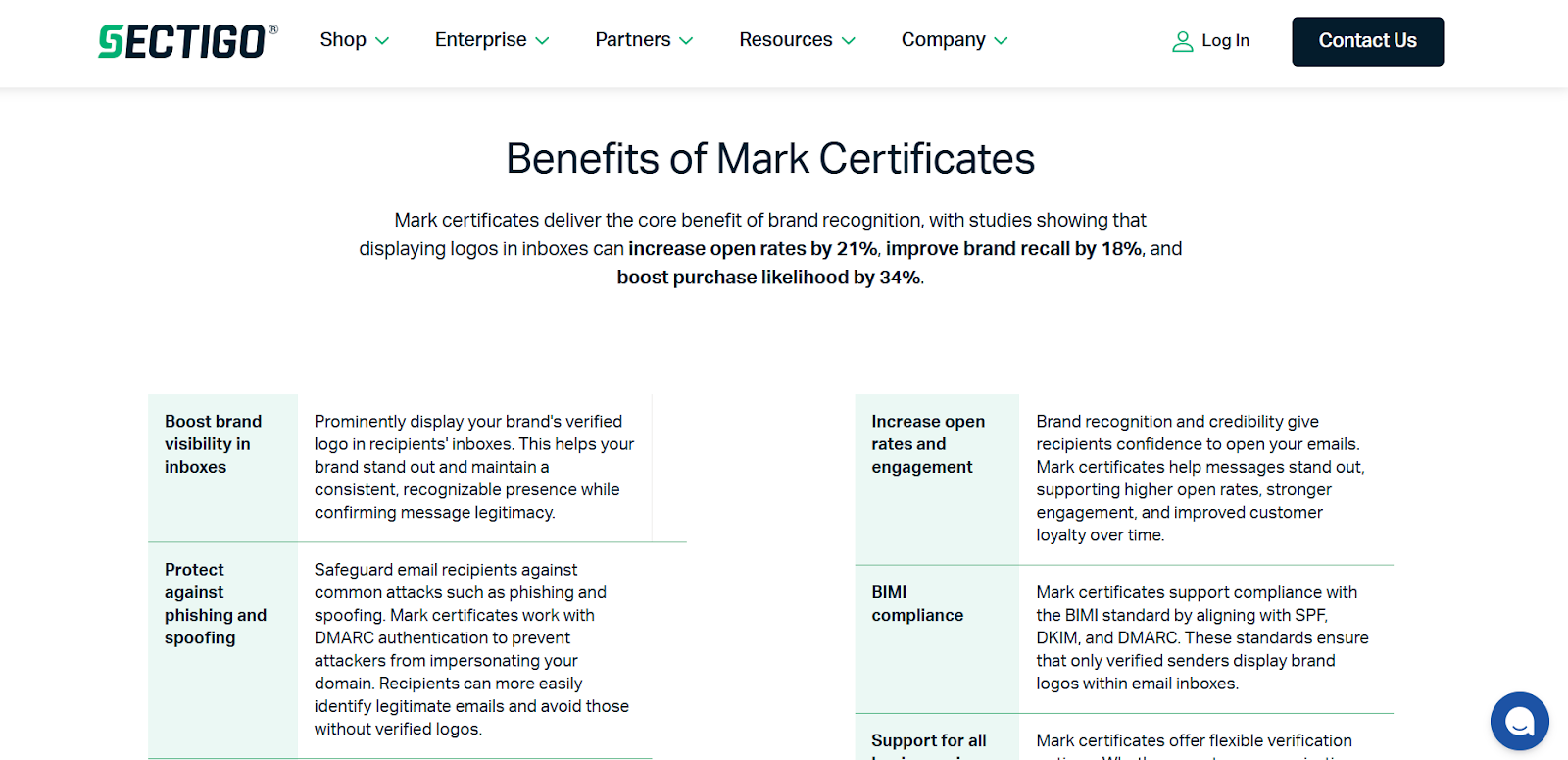
Sectigo is a top choice for companies that want a straightforward path to BIMI without a huge price tag. They focus on automation to help smaller teams handle the technical side of identity verification.
Key Benefits and Features
- Step-by-Step Setup Wizard: Most people get stuck on logo formats. Sectigo’s wizard checks your file for you. It ensures your logo matches the SVG Tiny 1.2 standard before you submit it, which saves you from failed applications.
- Quick Identity Checks: Instead of a long paper trail, Sectigo uses a Video ID process. You use your smartphone for a short “liveness” check to prove you are a real person authorized to represent the brand. This speeds up the whole approval window.
- Budget-Friendly Pricing: Sectigo offers some of the best rates in the industry for CMCs. Their multi-year plans drop the price even further, making it an affordable long-term option for startups and mid-sized brands.
- All-in-One Dashboard: If you already use Sectigo for website security, you can manage your CMC through the same Sectigo Certificate Manager. You get a single place to track your renewals so your logo never accidentally disappears from the inbox.
3. DigiCert
DigiCert is the heavy hitter in the world of digital security. They are usually the first choice for large companies that need a high level of trust and a platform that can handle thousands of domains at once. While they are famous for the “blue checkmark” VMCs, their CMC products are just as robust.
Key Benefits and Features
- CertCentral® Platform: This is their standout feature. It is a massive dashboard that lets you see every certificate your company owns. If you have multiple brands or sub-domains, you can manage, renew, and track all your CMCs from one screen.
- Automated Logo Hosting: Most providers leave the hosting up to you, but DigiCert can host your certificate and logo files on their own global network. This ensures your logo always loads fast when an email hits a recipient’s inbox.
- Elite Technical Support: Because they deal with high-stakes enterprise clients, their support team is top-tier. You get access to experts who actually understand the technical side of DNS and DMARC, rather than just basic customer service.
- Pre-Validation Tools: Before you even pay, their system can scan your current setup. This helps you find and fix issues with your DMARC policy or your logo file format so the application goes through without a hitch.
4. SSL.com
SSL.com is the “utility player” of the group. They are known for being much more flexible than the bigger corporations. If you have a unique business structure, like a non-profit or a government-affiliated group, they are often the easiest to work with.
Key Benefits and Features
- Flexible Pricing: They offer some of the lowest entry points for CMCs. They also have multi-year “loyalty” plans that can save you a lot of money if you plan to keep your BIMI setup for a long time.
- Niche Entity Support: Many providers have strict rules about what counts as a “company.” SSL.com is much better at validating non-standard organizations, including those that fall outside the typical corporate box.
- DMARC Compliance Checks: They provide a built-in tool that checks your domain’s “p=quarantine” or “p=reject” status. This prevents you from buying a certificate you can’t use yet.
- No-Frills Interface: Their site is straightforward. You won’t get lost in a maze of enterprise features you don’t need; you just get the certificate and move on.
5. Entrust
Entrust is a “founding father” of the BIMI standard. They helped write the rules for how mark certificates work, so their products are built on a very deep technical foundation. They are the best choice for high-security industries like finance or healthcare.
Key Benefits and Features
- Robust Security: Their verification process is very thorough. They focus on “High Assurance,” which means they do extra work to make sure no one can ever spoof your brand identity.
- Protocol Leadership: Because Entrust sits on the board of the AuthIndicators Working Group, their technical guides are accurate. If the BIMI rules change, Entrust is usually the first to update.
- Scale: Their systems are built for “lifecycle automation.” If you need to issue certificates for 500 different brand logos across a global corporation, their API can handle it automatically.
CMC vs VMC: How to Choose?
The primary difference between CMC and VMC is the trademark requirement. A VMC requires a registered trademark with a recognized government office. In contrast, a CMC allows you to use a logo that has been in active use for over a year, even without a formal trademark registration.
Quick Selection Guide
Pro-tip: Combine CMC implementation with a DMARC platform like PowerDMARC. This ensures your logo displays correctly while you improve your overall email deliverability and brand protection.
How to Choose the Right CMC Provider
To make the best choice, you must match specific provider features to your brand goals. Use these tips to find the right long-term value:
Evaluate DMARC and BIMI Compliance Support
A certificate is only part of the job. Look for a partner that helps you audit your DMARC status. You need a policy of p=quarantine or p=reject at 100% enforcement before you buy. PowerDMARC, for example, offers “White Glove” service for companies that don’t want to handle the DNS work themselves.
Assess Logo Validation Expertise
BIMI needs a specific SVG Tiny P/S file that must be less than 32KB. Choose a provider with a logo checker or manual help to verify your brand image file.
Check Proof of Use Requirements
Since CMCs skip the trademark, the CA checks “prior use.” Ensure they have a clear path for this, like a check of the Internet Archive to prove your logo has a twelve-month history.
Review Issuance Speed and Cost
Most top CAs, like DigiCert or GlobalSign, finish in 5 to 10 days. Make sure the price is clear and covers the whole year.
Benefits of Using a Trusted CMC Provider
A certificate from a reputable authority delivers several high-value rewards for your brand. These advantages strengthen your security posture and your market presence.
Visual Recognition
The most obvious gain is the visual change in the inbox. Your official logo appears next to the sender’s name under the BIMI standard.
- Higher Engagement: Verified logos help your emails stand out in a crowded list of messages.
- Trust Factor: Recipients feel more secure when they see a familiar brand mark.
- Open Rates: Better visibility leads to more clicks and views for your content.
Improved Deliverability
A CMC relies on a foundation of strict email authentication. When you reach the required DMARC enforcement levels, mailbox providers view your traffic as legitimate.
- Spam Filter Avoidance: Proper records help your mail stay out of the junk folder.
- Inbox Placement: Major providers like Yahoo and Gmail prioritize mail that meets these high security standards.
- Consistent Delivery: Authentication ensures that your messages reach the primary folder on a regular basis.
Phishing Defense
Verification makes it much harder for criminals to spoof your domain successfully.
- Logo Authenticity: An attacker cannot replicate your verified CMC without the private keys.
- Fraud Alerts: Users quickly learn that a lack of a logo on an “official” email is a red flag.
- Brand Protection: You shield your reputation by making your domain a difficult target for identity theft.
Marketing Impact
A CMC turns every message into a free brand impression. This reinforces your identity in the mind of the customer with every send.
- Brand Awareness: Consistent logo exposure builds familiarity over time.
- Professional Edge: This setup gives your emails a premium look that competitors might lack.
- Loyalty: Constant, secure contact helps foster a long-term bond with your audience.
Summing Up: Strengthen Your Brand with a CMC
A Common Mark Certificate is more than just a security tool. It is a bridge that connects your technical authentication to your visual brand identity. By meeting the DMARC enforcement standards and choosing a reputable CA, you ensure your logo reaches your audience with total integrity.
For organizations ready to secure their domain and elevate their email presence, PowerDMARC offers a streamlined path to purchase and implement these vital certificates. Our platform simplifies the technical hurdles of BIMI and provides expert guidance at every step of the validation journey. Explore our solutions and buy CMC through PowerDMARC today!
Frequently Asked Questions
What is the main difference between a CMC and a VMC?
The big difference is the trademark. A VMC requires a government-registered trademark. A CMC only requires proof that you have used your logo for at least one year.
Will a CMC get me the Gmail blue checkmark?
No. Currently, the Gmail blue checkmark is a perk exclusive to VMC holders. However, a CMC still allows your logo to appear in many inboxes, which is a huge step up from a blank icon.
Do I really need DMARC to get a CMC?
Yes. You cannot skip this part. Your DMARC policy must be at a level of “quarantine” or “reject.” Without this, the certificate will not function, and mail clients will not show your logo.
How long does the setup take?
Validation for a CMC usually takes between five and ten business days. This depends on how quickly you can provide proof of your logo’s history.
What happens if I change my logo?
If you update your brand logo, you must apply for a new certificate. The CMC is cryptographically tied to the specific image file you validate during the application process.
*** This is a Security Bloggers Network syndicated blog from PowerDMARC authored by Milena Baghdasaryan. Read the original post at: https://powerdmarc.com/common-mark-certification-providers/
如有侵权请联系:admin#unsafe.sh