
If you run security at any reasonably complex organization, your validation stack probably looks something like this: a BAS tool in one corner. A pentest engagement, or maybe an automated pentesting product, in another. A vulnerability scanner feeding an attack surface management platform somewhere else. Each tool gives you a slice of the picture. None of them talks to each other in any meaningful way.
Meanwhile, adversaries do not attack in silos. A real intrusion might chain together an exposed identity, a cloud misconfiguration, a missed detection opportunity, and an unpatched vulnerability in a single operation. Attackers understand that your environment is an interconnected system. Unfortunately, most validation programs are still treating it as a set of disparate, disconnected parts.
This isn't a minor inefficiency. It's a structural blind spot. And it's lasted for years because the market has treated every validation discipline as a separate category, with its own vendors, consoles, and its own separate, and very limited risk assessments.
As autonomous AI agents become capable of planning, executing, and reasoning across complex workflows, security validation must enter a new phase. The emerging discipline of Agentic Exposure Validation points toward something far more coordinated and capable than today's fragmented, manual validation cycles. It promises continuous, context-aware, autonomous validation that better matches how modern threats usually unfold.
What Security Validation Actually Means Today
For years, security validation has been treated primarily as an attack simulation. You deployed agents, ran scenarios, and got a report showing what was blocked and what wasn't. Today, that's no longer enough.
Modern security validation spans three distinct perspectives. Taken together, they give defenders a much more realistic view of their holistic security posture.
- The Adversarial Perspective asks, "How can an attacker actually get into our environment?" This involves automated pentesting and attack path validation, which focuses on identifying exploitable vulnerabilities and mapping the easiest routes to critical assets.
- The Defensive Perspective asks, "Can we actually stop them?" This includes security control validation and detection stack validation, which ensure that your firewalls, EDR, IPS, WAF, SIEM rules, and alerting systems perform as expected against real threats.
- The Risk Perspective asks, "Does this exposure actually matter?" This involves exposure prioritization, guided by compensating controls, which filter out theoretical risks and focus remediation on the vulnerabilities that are genuinely exploitable in your specific environment.
Any one of these perspectives on its own leaves dangerous gaps. The next evolution of security validation will be defined by its convergence into a unified validation discipline.
Agentic AI is a Game Changer for Defenders
Today, almost every cybersecurity vendor claims to be AI-powered. In many cases, that simply means a language model has been added to a dashboard to summarize findings or generate reports. And while "AI-assisted" may be useful, it's definitely not transformative.
Agentic AI is a fundamentally different proposition.
An AI wrapper is basically a simple app that calls an AI model and presents the output. It might format, summarize, or repackage the response, but it doesn't actually manage the task itself. Agentic AI, on the other hand, takes ownership of the entire task from start to finish. It figures out what needs to be done, carries out the steps, evaluates the results, and adjusts if necessary without a human needing to direct each step along the way.
In security validation, the difference is both massive and immediate.
Consider what happens today when a critical threat makes the news. Someone on the team reads the advisory, determines which of the organization's systems might be exposed, builds or adapts test scenarios, runs them, reviews the results, and then decides what needs remediation. Even in strong teams, this can take days. If the threat is complex, it can stretch into weeks.
Agentic AI can compress that workflow into minutes.
Not because someone wrote a faster script, but because an autonomous agent handled the full sequence. It analyzed the threat, mapped it to the environment, selected relevant assets and controls, ran the right validation workflows, interpreted the results, and surfaced what mattered most.
This is how agentic AI balances the scales. It's not just about speed. It's about replacing disconnected, human-driven validation steps with autonomous, coordinated, end-to-end reasoning.
The Real Constraint Isn't the Model. It's the Data.
This is where a lot of the AI discussion goes wrong.
Agentic systems are only as strong as the environment they can reason over. An autonomous agent that runs generic attack simulations against a generic model will produce generic results. That may look impressive in a demo, but it doesn't help a security team make confident decisions in production.
The real differentiator is context.
This is why the underlying data architecture matters more than the model alone. To make agentic validation useful, organizations need a unified security data layer that continuously reflects what exists, what's exposed, and what's actually working.
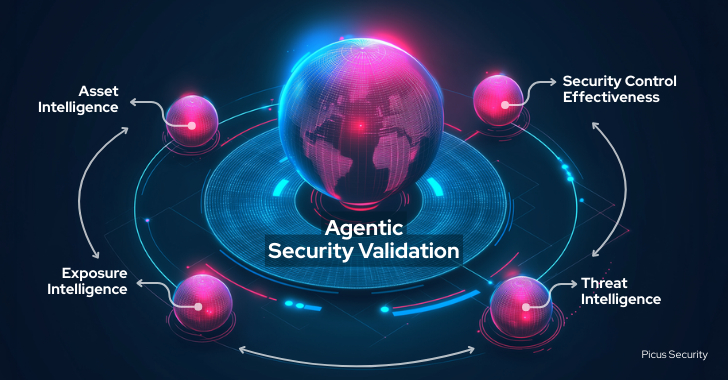
You can think of this as a Security Data Fabric, built from three essential dimensions.
- Asset Intelligence covers the full inventory of your environment: servers, endpoints, users, cloud resources, applications, and containers, as well as their relationships. Because you can't validate what you can't see.
- Exposure Intelligence encompasses vulnerabilities, misconfigurations, identity risks, and other weaknesses across your attack surface. This is the raw material that attackers work with.
- Security Control Effectiveness is the dimension that most organizations are missing entirely. It is not enough to know that you've deployed a firewall or an EDR agent. You need to know, with evidence, whether these controls will actually block the specific threats that are targeting your specific assets.
When these dimensions come together, the result is more than an asset database or vulnerability feed. It becomes a living model of the organization's minute-to-minute security reality. That model changes as the environment changes. New assets appear. New vulnerabilities are disclosed. Controls are reconfigured. New threats emerge.
And that is exactly the context the agentic AI needs.
With a rich security data fabric behind it, an agentic AI is no longer running one-size-fits-all tests. It can tailor validation to actual topology, your organization's actual crown jewels, its actual control coverage, and actual attack paths.
That is the difference between hearing "this CVE is critical" and learning "this CVE is critical on this server, your controls don't block exploitation, and there's a validated path to one of your most sensitive business systems."
Where Security Validation Is Headed
The future of security validation is clear. Periodic testing is becoming continuous validation. Manual effort is evolving into autonomous operation. Point products are consolidating into unified platforms. And reporting problems is morphing into enabling better security decisions.
Agentic AI is the catalyst, but it only works with the right foundation. Autonomous agents need real context: an accurate, connected view of the environment, not a fragmented set of tools and findings.
When agentic workflows, rich context, and unified validation come together, the result is a fundamentally different model. Instead of waiting for someone to ask whether the organization is protected, the system continuously answers that question with evidence grounded in how even the latest attacks are actually happening.
The market is already validating this shift. In Frost & Sullivan's Frost Radar: Automated Security Validation, 2026, Picus Security was named the Innovation Index Leader, with its agentic capabilities and CTEM-native architecture highlighted as key differentiators.
Get your demo today to discover how Picus helps organizations unify adversarial, defensive, and risk validation in a single platform.
Note: This article was written by Huseyin Can YUCEEL, Security Research Lead at Picus Security.
Found this article interesting? This article is a contributed piece from one of our valued partners. Follow us on Google News, Twitter and LinkedIn to read more exclusive content we post.