Let’s start this article by stating that the launch of Claude Code Security is good news for the industry.
Not because it replaces traditional application security.
Not because it suddenly makes AI-generated code safe.
But because it validates something many security leaders already know: AI coding introduces new risks that require AI-native, agentic application security.
In an era where code is increasingly written by AI assistants, security cannot remain an afterthought bolted on after commit. If vulnerabilities are discovered only after the AI coding phase, it’s already too late.
Velocity and scale have increased, risk has compounded, and exposure scales faster than remediation.
Claude’s announcement acknowledges this reality. And that’s a positive step forward.
A New Way to Think About Detection
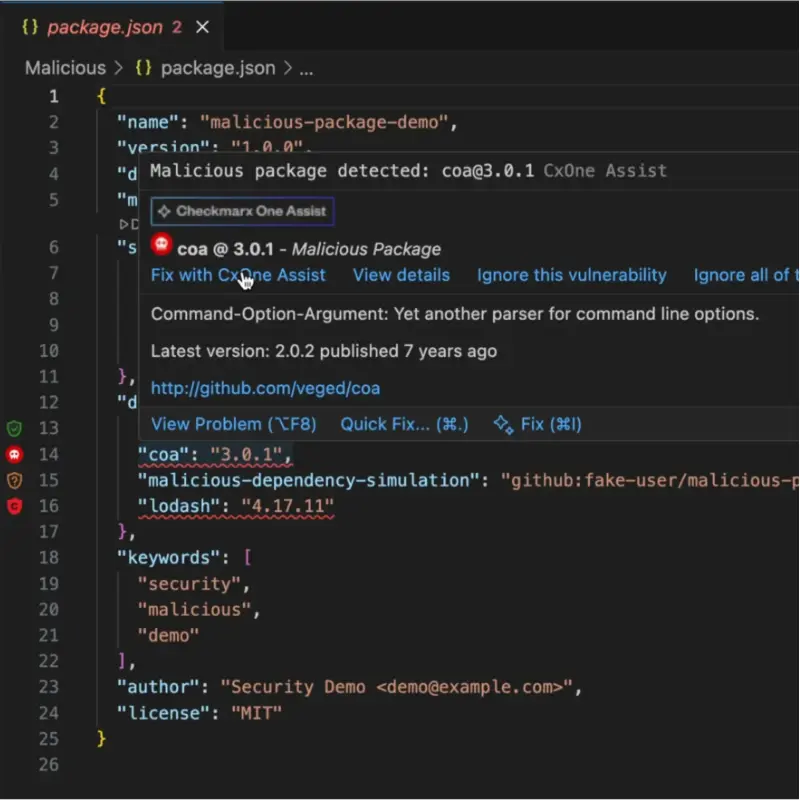
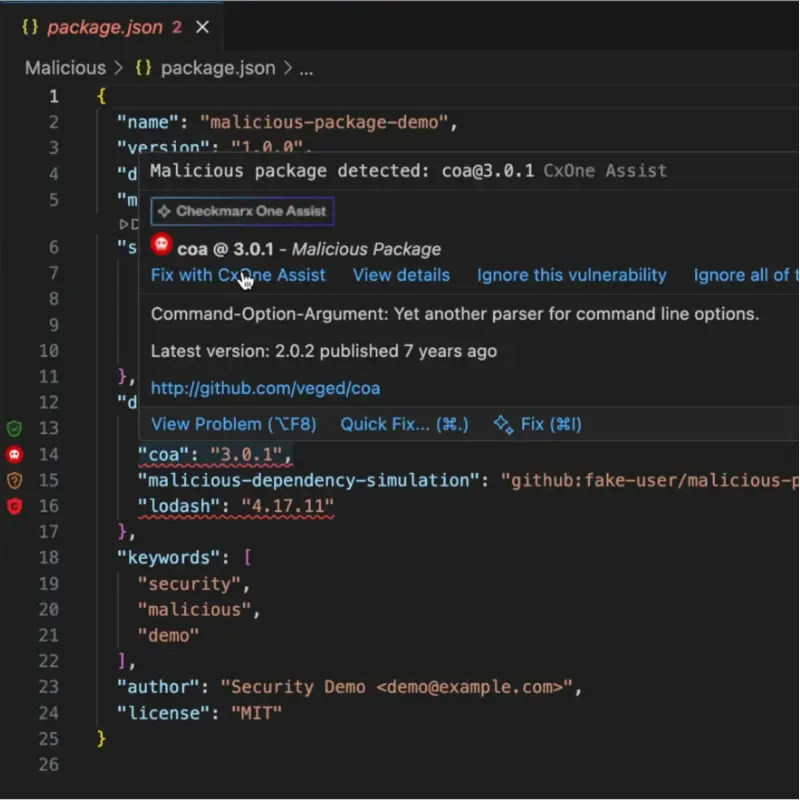
At first glance, Claude Code Security and Checkmarx Developer Assist may look similar. Both live in the IDE. Both surface vulnerabilities. Both suggest fixes.
But the philosophies differ.
Claude Code Security reasons about code the way a human security researcher might: mapping data flows, understanding component interactions, and identifying logical flaws that don’t match known signatures and predefined security rules. This reasoning-first approach allows it to uncover subtle, context-dependent vulnerabilities that traditional rule-based scanners often miss.
That’s meaningful progress. However, it is only in early preview and covers a very specific angle across the entire Agentic AppSec lifecycle.
Checkmarx Developer Assist, part of the broader Checkmarx Assist family and a complete Agentic AppSec platform, takes a complementary but enterprise-proven approach. It provides real-time feedback in the IDEs (Cursor, Windsurf, VSCode, AWS Kiro, JetBrains) across:
- SAST vulnerabilities
- Open source and malicious packages (SCA)
- Secrets exposure
- Infrastructure-as-Code misconfigurations
- Container security risks
It is fast, comprehensive, and powered by years of curated security intelligence and proven rule libraries, built to operate at true enterprise scale. Unlike Claude Code Security, which focuses primarily on identifying and remediating issues at the pre-commit stage, Checkmarx goes further. With its unique Safe Refactor capability, we validate that security fixes do not introduce regressions, break dependencies, or disrupt the build, ensuring remediation is both secure and production-ready
In simple terms:
- Claude Code Security is deep and novel.
- Developer Assist is broad, fast, and supply-chain aware.
Both matter, but they solve different layers of the problem.
Scope Matters in the AI Era
Claude Code Security currently focuses on reasoning over the application code itself.
But modern risk doesn’t live only in application logic.
It lives in:
- AI-generated dependencies
- LLM models, MCPs, Offensive Agents, IDE extensions, SDKs, etc.
- Malicious packages
- Container images
- Infrastructure misconfigurations
- Exposed credentials
- Policy violations across pipelines
- Runtime environments
AI coding doesn’t just produce insecure code.
It accelerates insecure ecosystems.
This is where a unified, enterprise-grade platform becomes critical.
Checkmarx One integrates Developer Assist with broader capabilities including policy enforcement, compliance reporting, ASPM, and auditability, providing visibility across the entire AI supply chain, not just inside a single file in an IDE.
In large enterprises, security isn’t just about catching clever bugs.
It’s about governance, consistency, and control across thousands of developers and millions of lines of code.
Remediation: Human-in-the-Loop, but at Scale
Claude Code Security introduces an interesting concept: attempting to disprove its own findings before surfacing them. This aims to reduce false positives at the source, an important improvement over pushing noise downstream.
Developer Assist, meanwhile, uses agentic AI remediation, initiating an AI session enriched with contextual intelligence and proprietary databases to generate safe, actionable fixes directly in the IDE. Developers can accept, refine, or interact with the agent to tailor the resolution.
The difference is operational scale and ecosystem integration.
Enterprise Readiness Is Not an Afterthought
Claude Code Security is currently in limited research preview.
Developer Assist, by contrast, is generally available and integrated natively into modern AI-powered IDEs. It is architected with enterprise data handling in mind, minimizing data exposure and ensuring sensitive source code remains protected.
For regulated industries, large enterprises, and global development organizations, these distinctions matter.
Innovation is exciting.
Operational maturity is essential.
The developer assist agent as stated in this article is one of many agents that Checkmarx Assist offers. It joins the Triage and Remediation Assist agents that operate at the post-commit phase of the agentic development lifecycle (ADLC), offering an agentic-based cleanup solution for any missed or ignored security true positives that can slip into production. That second layer of defense, which is also part of the Checkmarx platform, ensures continuous autonomous AI coding across a large scale of repositories and applications.
This Isn’t Replacement — It’s Evolution
Market reactions often jump to “disruption.” But even financial analysts have noted that this is not a direct replacement scenario today.
The more honest framing is this:
Claude Code Security highlights a long-term shift in how vulnerabilities will be discovered, toward reasoning-based, AI-native analysis.
And that shift reinforces the broader truth:
AI-generated code requires AI-native AppSec (Agentic AppSec).
But AI reasoning alone does not replace enterprise-grade coverage across the supply chain, runtime, policy enforcement, compliance, and governance.
The Bigger Opportunity
Claude’s move validates the future.
It acknowledges that traditional static scanning models are not sufficient in an AI-driven development lifecycle.
What it does not yet deliver is a unified, enterprise-ready Agentic Application Security platform spanning:
- IDE prevention
- Post-commit triage and remediation
- AI supply chain visibility
- Runtime validation
- Centralized governance and risk assessment
That broader vision is where the real transformation lies. If you’re attending the RSAC conference, come by the Checkmarx booth to learn more about this platform.
The future of security isn’t defensive.
It’s embedded.
It’s agentic.
It’s platform-driven.
And most importantly, it evolves as fast as the AI writing the code.
The era of AI coding has begun.
Now AI-native AppSec must scale with it.