好的,我现在需要帮用户总结一篇文章,控制在100字以内。首先,我得仔细阅读文章内容,理解其主要观点。 文章主要讲的是自主智能体和AI助手在企业中的应用,特别是OpenClaw等工具的普及带来的安全挑战。CISO们需要新的治理方法来应对这些风险。OneClaw作为一个安全工具被介绍,它能够提供对企业范围内OpenClaw部署的可见性,帮助识别潜在风险,比如影子代理的扩散和数据外泄。 接下来,我需要提炼关键点:自主AI工具的普及、带来的安全风险、OneClaw的作用以及它如何帮助企业应对这些挑战。然后,用简洁的语言把这些点整合起来,确保在100字以内。 可能会遇到的问题是如何在有限的字数内涵盖所有重要信息而不遗漏关键点。因此,我需要选择最核心的内容进行总结,比如OpenClaw的风险、OneClaw的功能和目标受众(CISO)。 最后,检查语言是否流畅,是否符合用户的要求:直接描述内容,不使用特定的开头语句。 </think> 自主智能体和AI助手如OpenClaw在企业中广泛应用,带来安全风险。OneClaw提供可见性和分析工具,帮助CISO识别和管理这些风险,确保合规与数据安全。 2026-2-18 16:4:42 Author: www.sentinelone.com(查看原文) 阅读量:64 收藏
Autonomous agents and personal AI assistants are moving from experimentation to enterprise reality. Tools like OpenClaw (formerly Moltbot and Clawdbot), Nanobot and Picoclaw are being embedded across development environments, cloud workflows, and operational pipelines. They install quickly, evolve dynamically, and often operate with deep system-level access. For CISOs and security leaders, this presents a new governance challenge: How do you secure what you can’t see?
OneClaw, built by Prompt Security from SentinelOne®, was created to answer that question. It is a lightweight discovery and observability tool built to help secure AI usage by providing broad, organization-wide visibility into OpenClaw deployments without disrupting workflows or slowing down innovation. Where agent sprawl is accelerating faster than policy frameworks can adapt, OneClaw restores clarity, accountability, and executive oversight where it matters most.
Understanding The Risks Behind OpenClaw
While most security programs assume that AI applications and agents are vetted, IT sanctioned, registered, and monitored, OpenClaw agents can be:
- Installed directly by developers
- Extended through public skills and plugins
- Granted persistent memory and tool access
- Configured to run autonomously, and
- Connected to external services and API.
They can also operate quietly in local environments, call tools automatically, schedule tasks via cron jobs, and access sensitive systems – all outside of most application inventory controls. What manifests is two main concerns:
- Shadow Agent Proliferation – How many OpenClaw instances are running across the enterprise?
- Data Egress & External Exposure – Where are agents sending information, and to whom?
Without that centralized observability, these risks persist. As assistants such as OpenClaw, Nanobot, Picoclaw and other autonomous agents continue to emerge every day, OneClaw is designed to eliminate the opacity of the inherent risks they bring to businesses.
OpenClaw is only the beginning of a much larger shift toward autonomous agents and personal AI assistants embedded across the enterprise. In addition to OpenClaw, OneClaw already supports visibility coverage for emerging frameworks such as Nanobot and Picoclaw, extending the same discovery and observability capabilities across multiple agent ecosystems.
For CISOs, this future-proof approach is critical. Rather than deploying point solutions for each new tool that appears, OneClaw establishes a unified oversight layer for the entire category of new assistants, copilots, and autonomous workflows that continue to surface. The goal is not simply to manage one platform, but to provide lasting control over a rapidly expanding attack surface, ensuring that as agent adoption accelerates, security visibility and accountability keep pace.
Empowering Teams with Observability
OneClaw provides structured delivery and observability across OpenClaw deployments leveraging a scanner that automatically detects supported CLIs and inspects the local .openclaw directory within user environments. It parses session logs, configuration files, and runtime artifacts to summarize meaningful usage patterns and surface critical operational details. OneClaw also captures browser activity performed by agents to deliver visibility into external interactions and potential data exposure paths.
From this data, OneClaw then summarizes active skills and installed plugins, recent tool and application usage, scheduled cron jobs, configured communication channels, available nodes and AI models, security configurations, and autonomous execution settings.
OneClaw outputs are structured in JSON format, making it flexible for integration into existing security ecosystems. Organizations can conduct local reviews, inject into SIEM platforms, feed centralized monitoring systems, and correlate with identity, endpoint, and cloud telemetry. For security leaders invested in unified visibility, this ensures that agent observability does not become siloed.
For CISOs, this transforms AI agent behavior from invisible background activity into auditable telemetry that is integrated into broader enterprise security and risk management discussions.
From Raw Telemetry to Executive Intelligence
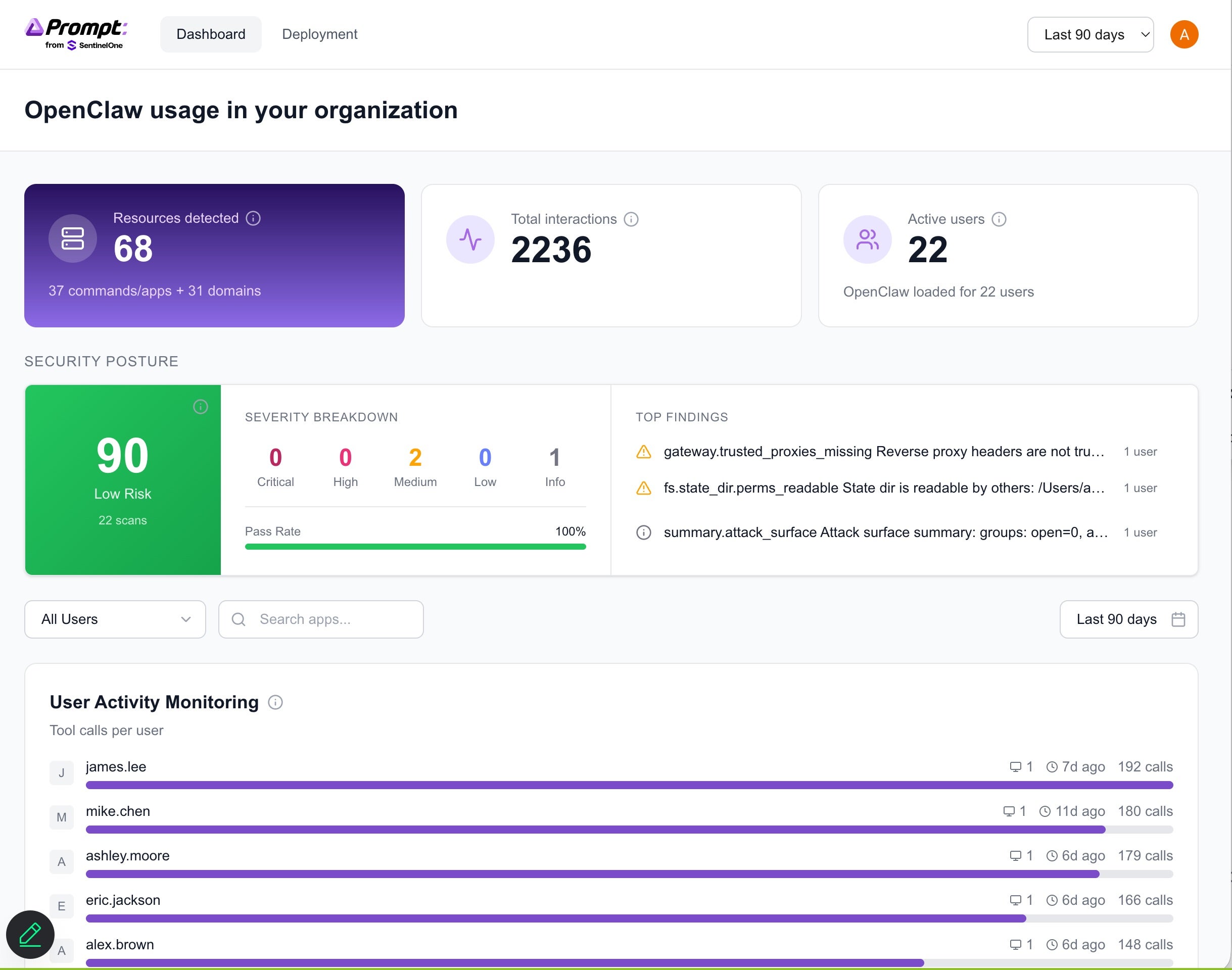
Though many tools generate logs, very few of them translate them into governance-ready insights. OneClaw provides a fully centralized dashboard that aggregates reports across all employees. Rather than just reviewing isolated endpoint-level findings, security leaders get visualized deployment trends, risk heatmaps, organization-wide exposure mapping, and skill usage distribution.
In a matter of minutes, the tool can be deployed via Jamf, Intune, Kandji or SentinelOne Remote Ops.
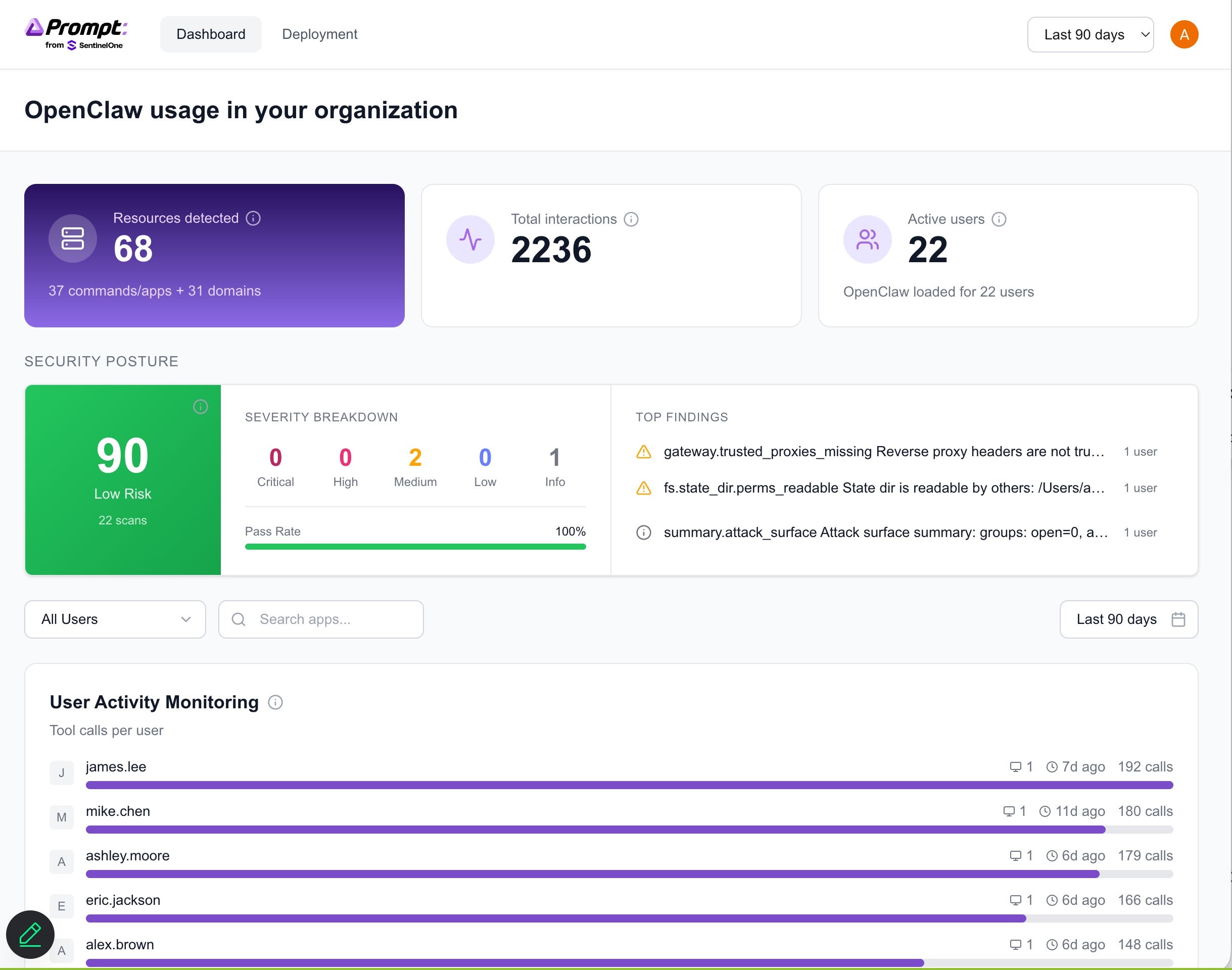
This elevates the conversation from technical detail to strategic oversight, which is critical as CISOs are now being asked for AI agent inventories, and whether the agents are operating within policy, can access sensitive systems, and are transmitting data externally.
With OneClaw, CISOs can gain visibility into:
- How many OpenClaw agents are deployed enterprise-wide
- What percentage is configured for autonomous execution
- Which teams are installing high-risk skills
- Where agents are making outbound connections
- How has agent adoption changes day to day
This level of structured visibility empowers security leaders to build the foundational layer for proactive governance for agentic AI security and have effective conversations about the short and long-term risks from OpenClaw adoption in their organization.
Security-Focused Behavioral Analysis
OneClaw does not assume all autonomy is dangerous. Instead, it surfaces where autonomy exists so that leaders can make informed, balanced policy decisions and strengthen controls with precision. For example, security teams may determine that autonomous execution is appropriate within a sandboxed development environment but requires approvals in production systems. They may allow specific, vetted skills while restricting newly installed public plugins pending review. They also may decide that outbound communication to approved internal APIs is acceptable, while flagging unknown external domains for investigation.
By making these conditions visible, OneClaw enables proportionate governance rather than blanket restrictions. Teams can confidently approve safe automation, enforce guardrails where needed, and document oversight for executive and regulatory reporting. The result is not reduced innovation, but safer acceleration where autonomous agents operate within clearly defined boundaries, and security leaders remain firmly in control of how and where that autonomy is trusted.
Transparency Without Disruption
OneClaw was designed to deliver visibility into autonomous activity without interrupting the work those agents (and the teams deploying them) are meant to accelerate. Rather than creating friction into development pipelines or altering how OpenClaw, Nanobot, or Picoclaw operate, it acts as an observability layer that security teams can deploy quietly across the environment.
The approach matters: Security leaders are not looking to slow down innovation, but they are accountable for what happens if agent behavior crosses policy boundaries or introduces risk. OneClaw gives the context needed for CISOs to act decisively using the cybersecurity controls they already trust. It does not replace prevention capabilities, it makes them smarter by ensuring autonomous activity is no longer invisible.
By surfacing where agents exist, how they are configured, and what they are interacting with, OneClaw allows organizations to distinguish between productive automation and risk behavior that warrants intervention. Security teams can then enforce standards through existing controls without imposing blanket restrictions that only frustrate developers.
The result? This is a model aligned with how modern security actually operates – observe first, contextualize risk, and then apply controls proportionately. OneClaw makes transparency a force multiplier for the security stack, and empowers CISOs to have confidence that autonomous innovation continues under a watchful, informed oversight instead with blind trust.
Chaos to Clarity | Why This Matters Now
Agentic AI discovery is no longer optional. OpenClaw’s rapid growth and decentralized infrastructure is creating a large, and often unmanaged attack surface. With skills being frequently installed from public repositories and agents being granted deep permissions, configuration drift is occurring silently. Agent ecosystems can fall to exploitation through malicious skills and supply chain manipulation.
OneClaw supports how CISOs defend against OpenClaw-related risks by providing deep visibility and observability of agentic AI use and autonomous behavior, detecting risky configurations early on, and quantifying the exposures before incidents occur.
As adoption increases and autonomy deepens, OneClaw works to restore visibility while allowing powerful agents to accelerate development pipelines. CISOs have the clarity needed to govern autonomous systems responsibly, while getting structured discovery, centralized reporting, and security-focused analysis.
Start getting visibility into agent activity and security insights into OpenClaw deployments across your organization here. To learn more about securing your OpenClaw agents, register for our upcoming webinar happening Tuesday, March 3, 2026.
SentinelOne AI & Intelligence Leaders Discuss How to Secure OpenClaw Agents on March 3, 2026 at 10:00AM PST / 1:00PM EST
如有侵权请联系:admin#unsafe.sh