
好的,我现在需要帮用户总结一篇文章的内容,控制在100字以内。首先,我得仔细阅读用户提供的文章,理解其主要内容。 文章主要讲的是一个名为Keenadu的新安卓恶意软件,它嵌入了多个设备品牌的固件中,能够控制所有安装的应用程序,并对感染设备进行无限制的控制。Kaspersky的研究人员指出,Keenadu有多种传播机制,包括通过OTA更新、系统应用、第三方应用商店等途径传播。此外,Keenadu的不同变种功能各异,其中最强大的版本是固件集成版。截至2026年2月,已有13,000台设备被感染,主要分布在俄罗斯、日本、德国、巴西和荷兰等地。研究人员还提到,Keenadu与之前发现的Triada恶意软件类似,并且在某些情况下会停止运行,比如检测到设备语言或时区与中国相关时。 接下来,我需要将这些信息浓缩到100字以内。重点包括:Keenadu是什么类型的恶意软件、它的传播方式、感染数量及地区分布、以及它的功能和潜在威胁。 然后,我需要确保语言简洁明了,避免使用复杂的术语或冗长的句子。同时,要直接描述内容,不需要以“文章内容总结”等开头。 最后,检查字数是否符合要求,并确保所有关键信息都被涵盖。 </think> 一种新型安卓恶意软件Keenadu被发现嵌入多品牌设备固件中,可控制所有应用并完全接管受感染设备。该恶意软件通过多种途径传播,包括OTA更新和第三方应用商店。截至2026年2月已感染13,000台设备。其功能包括数据窃取和广告欺诈,并可绕过部分安全机制。 2026-2-17 14:15:17 Author: www.bleepingcomputer.com(查看原文) 阅读量:1 收藏

A newly discovered and sophisticated Android malware called Keenadu has been found embedded in firmware from multiple device brands, enabling it to compromise all installed applications and gain unrestricted control over infected devices.
According to a report from cybersecurity company Kaspersky, Keenadu has multiple distribution mechanisms, including compromised firmware images delivered over-the-air (OTA), via other backdoors, embedded in system apps, modified apps from unofficial sources, and even through apps on Google Play.
There are multiple variants of Keenadu, each with its own set of capabilities, the most potent of them being the firmware-based version.

As of February 2026, Kaspersky has confirmed 13,000 infected devices, many located in Russia, Japan, Germany, Brazil, and the Netherlands.
The security researchers compare Keenadu to Triada, another Android malware family they spotted in counterfeit Android devices last year, mostly low-cost phones that go through shady supply chain routes.
In its firmware-integrated variant, Keenadu does not activate if the language or timezone is associated with China, which may represent a potential clue about its origin. The malware also stops if the Google Play Store and Play Services are not found on the device.
Although its operators are currently focused on ad fraud operations, Kaspersky notes that the malware’s capabilities go far beyond, as it is capable of broad-range data theft and risky actions on the compromised device.
.png)
“Keenadu is a fully functional backdoor that provides the attackers with unlimited control over the victim’s device,” Kaspersky told BleepingComputer.
“It can infect every app installed on the device, install any apps from APK files, and give them any available permissions.”
“As a result, all information on the device, including media, messages, banking credentials, location, etc. can be compromised. The malware even monitors search queries that the user inputs into the Chrome browser in incognito mode,” the researchers said.
The Keenadu variant embedded in system apps is more limited in functionality. However, its elevated privileges allow it to install any app without alerting the user.
Kaspersky researchers found the malware embedded in a system app for facial recognition, typically used for unlocking the device and various authorization and authentication actions.
The researchers also found the malware on Google Play, in smart home camera apps that had 300,000 downloads, which are no longer available in the official Android store.
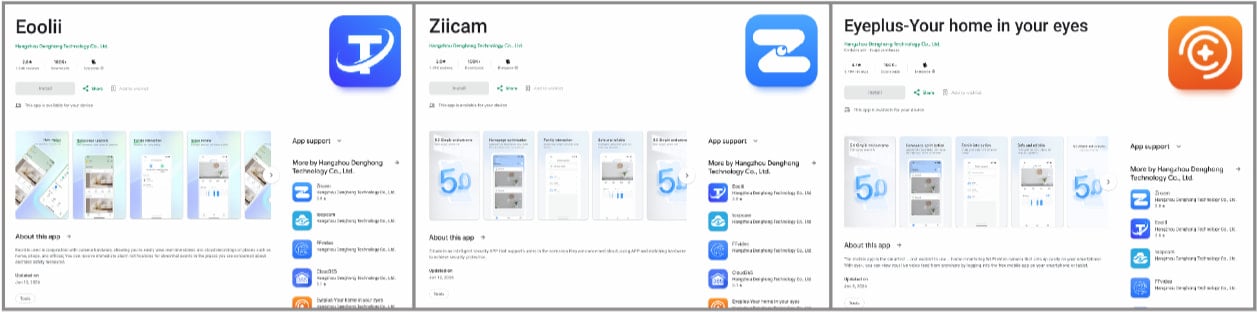
Source: Kaspersky
When opened, the apps launched invisible web browser tabs within the host app, which navigated to websites in the background. Kaspersky notes that this resembles similar activity to APKs discovered by Dr.Web earlier this year.
According to the researchers, Keenadu is present in the firmware of Android tablets from multiple makers. On one product, the Alldocube iPlay 50 mini Pro (T811M) tablet, the malicious firmware was dated August 18, 2023.
After a customer in March 2024 stated that Alldocube's OTA server had been compromised and a threat actor inserted malware in the firmware, the company acknowledged "a virus attack through OTA software" but did not provide information on the type of threat.
Kaspersky published a detailed technical analysis for the Keenadu backdoor, explaining how the malware compromised the libandroid_runtime.so component, a core library in the Android system, which allows the malware to operate "within the context of every app on the device."
The researchers warn that because the malware is embedded so deeply in the firmware, it is impossible to remove it using standard Android OS tools. They recommend users to find and install a clean firmware version for their device.
An alternative is to install firmware from a reputable third-party, although this comes with the potential risk of bricking the device in case of incompatibility.
One of the safest options is to stop using the device and replace it with a product from trusted vendors and authorized distributors.

The future of IT infrastructure is here
Modern IT infrastructure moves faster than manual workflows can handle.
In this new Tines guide, learn how your team can reduce hidden manual delays, improve reliability through automated response, and build and scale intelligent workflows on top of tools you already use.
如有侵权请联系:admin#unsafe.sh