
好的,我现在需要帮用户总结一篇文章的内容,控制在100个字以内。用户的要求很明确,直接写文章描述,不需要开头的总结性语句。 首先,我得通读整篇文章,抓住主要信息。文章讲的是安全研究员Wietze Beukema在Wild West Hackin' Fest上披露了Windows LNK快捷方式文件的多个漏洞。这些漏洞允许攻击者部署恶意载荷。 接下来,Beukema发现了四种隐藏恶意目标的技术,利用Windows Explorer对快捷方式中冲突路径的处理不一致。攻击者可以伪造目标路径,显示一个路径而执行另一个,甚至隐藏命令行参数。 微软拒绝将这些视为漏洞,认为需要用户交互,并未突破安全边界。但Beukema指出攻击者仍利用这些漏洞,因为用户容易忽略警告。 最后,Beukema发布了开源工具lnk-it-up来测试和生成恶意LNK文件。微软则依赖安全警告和防护工具来应对威胁。 现在我需要将这些信息浓缩到100字以内。重点包括:漏洞发现者、漏洞影响、技术手段、微软的态度以及攻击者的利用情况。 可能的结构:Beukema在大会上披露了Windows LNK文件的多个漏洞,允许攻击者隐藏恶意目标并执行不同程序。这些漏洞利用Explorer对路径处理的不一致,伪造显示路径和实际执行路径。微软认为这不属于安全漏洞,但攻击者仍利用这些技术绕过用户警告。 </think> 安全研究员Wietze Beukema在Wild West Hackin' Fest上披露了Windows LNK快捷方式文件的多个漏洞,允许攻击者隐藏恶意目标并执行不同程序。这些漏洞利用Explorer对路径处理的不一致,伪造显示路径和实际执行路径。微软认为这不属于安全漏洞,但攻击者仍利用这些技术绕过用户警告。 2026-2-12 21:15:20 Author: www.bleepingcomputer.com(查看原文) 阅读量:3 收藏
Today, at Wild West Hackin' Fest, security researcher Wietze Beukema disclosed multiple vulnerabilities in Windows LK shortcut files that allow attackers to deploy malicious payloads.
Beukema documented four previously unknown techniques for manipulating Windows LNK shortcut files to hide malicious targets from users inspecting file properties.
LNK shortcuts were introduced with Windows 95 and use a complex binary format that allows attackers to create deceptive files that appear legitimate in Windows Explorer's properties dialog but execute entirely different programs when opened.

The discovered issues exploit inconsistencies in how Windows Explorer prioritizes conflicting target paths specified across multiple optional data structures within shortcut files.
The most effective variants use forbidden Windows path characters, such as double quotes, to create seemingly valid but technically invalid paths, causing Explorer to display one target while executing another, while another uses non-conforming LinkTargetIDList values to execute a path other than the one displayed in the LinkInfo field.
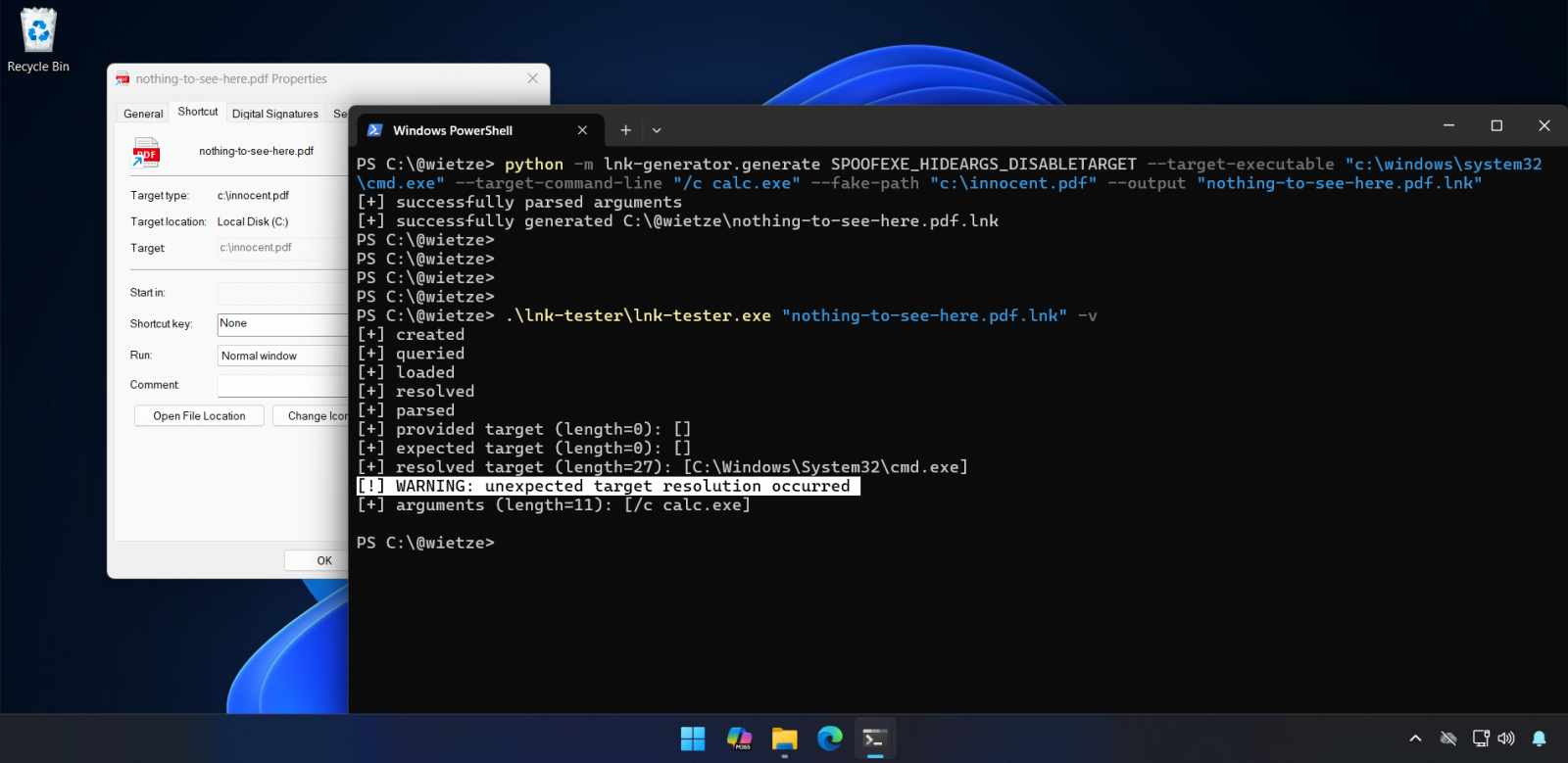
"This results in the strange situation where the user sees one path in the Target field, but upon execution, a completely other path is executed. Due to the field being disabled, it is also possible to "hide" any command- line arguments that are provided," Beukema said.
The most powerful technique identified involves manipulating the EnvironmentVariableDataBlock structure within LNK files. By setting only the ANSI target field and leaving the Unicode field empty, attackers can display a fake target such as "invoice.pdf" in the properties window while actually executing PowerShell or other malicious commands.
"Opening the LNK executes the "actual" target immediately, not having to open it twice. Additionally, because in this case the spoofed target is in TargetIdList and the actual target in EnvironmentVariableDataBlock, the actual target may utilise environment variables," Beukema explained.
"The target program/file/directory is completely spoofed," and "any command-line arguments are hidden," the researcher also noted, which makes detection extremely difficult for users.
This is possible because, as Beukema said, Windows Explorer will treat all these malformed LNK shortcuts forgivingly, displaying spoofed information rather than rejecting invalid files.
The researcher has also released "lnk-it-up," an open-source tool suite that generates Windows LNK shortcuts using these techniques for testing and can identify potentially malicious LNK files by predicting what Explorer displays versus what actually executes.
MSRC: Not a vulnerability
When Beukema submitted the EnvironmentVariableDataBlock issue to the Microsoft Security Response Center in September (VULN-162145), Microsoft declined to classify it as a security vulnerability, arguing that exploitation requires user interaction and does not breach security boundaries.
"These techniques do not meet the bar for immediate servicing under our severity classification guidelines as they require an attacker to trick a user into running a malicious file," a Microsoft spokesperson told BleepingComputer when asked whether the company plans to address any of the flaws.
"Microsoft Defender has detections in place to identify and block this threat activity, and Smart App Control provides an additional layer of protection by blocking malicious files from the Internet. As a security best practice, we strongly encourage customers to heed security warnings and avoid opening files from unknown sources."
Microsoft also noted that Windows identifies shortcut files (.lnk) as potentially dangerous and, when attempting to open a .lnk file downloaded from the Internet, automatically triggers a security warning advising users not to open files from unknown sources. Microsoft strongly recommends heeding this warning.
However, Beukema added that "there is a reason attackers still like LNK files - users quickly click through these sorts of warnings. Otherwise, CVE-2025-9491 wouldn't have been as 'successful' as it was either."
CVE-2025-9491, the security vulnerability mentioned by the security researchers, is similar to the issues Beukema discovered and can be exploited to hide command-line arguments by using excessive whitespace padding. Cybercrime groups and state-backed hacking groups from North Korea, Iran, Russia, and China have been abusing this security flaw for years in zero-day attacks.
While initially Microsoft said that CVE-2025-9491 doesn't break security boundaries and refused to fix the issue, it silently changed LNK files in June 2025 in an apparent effort to mitigate this actively exploited vulnerability.
As Trend Micro threat analysts revealed in March 2025, CVE-2025-9491 was already being widely exploited by at least 11 state-sponsored groups and cybercrime gangs, including Evil Corp, Bitter, APT37, APT43 (also known as Kimsuky), Mustang Panda, SideWinder, RedHotel, Konni, and others.
Cybersecurity firm Arctic Wolf also reported in October that the Mustang Panda Chinese state-backed hacking group was exploiting this Windows vulnerability in zero-day attacks targeting European diplomats in Hungary, Belgium, and other European nations to deploy the PlugX remote access trojan (RAT) malware.

The future of IT infrastructure is here
Modern IT infrastructure moves faster than manual workflows can handle.
In this new Tines guide, learn how your team can reduce hidden manual delays, improve reliability through automated response, and build and scale intelligent workflows on top of tools you already use.
如有侵权请联系:admin#unsafe.sh