嗯,用户让我帮忙总结一篇文章,控制在100字以内,而且不需要特定的开头。首先,我得通读文章,抓住主要内容。 文章主要讲金融欺诈的生命周期,分为准备、用户旅程、交易和洗钱四个阶段。传统检测多在交易阶段,但作者建议“向左移”,即提前到用户旅程甚至准备阶段检测。 文章还提到使用威胁情报和欺诈风险套件来提高检测率,减少误报,并符合隐私保护。最后强调这种方法能减少受害者、降低运营负担,提升客户体验和合规性。 总结时要涵盖这些要点:四个阶段、向左移策略、技术手段带来的好处。确保在100字以内,简洁明了。 </think> 文章探讨金融欺诈的生命周期,并提出“向左移”策略,从交易阶段提前至用户旅程和准备阶段进行检测。通过威胁情报和欺诈风险套件,银行可更早识别风险信号,提高检测率并减少误报。该方法不仅提升客户体验和合规性,还能降低运营负担并减少受害者数量。 2026-2-12 09:48:23 Author: www.threatfabric.com(查看原文) 阅读量:19 收藏
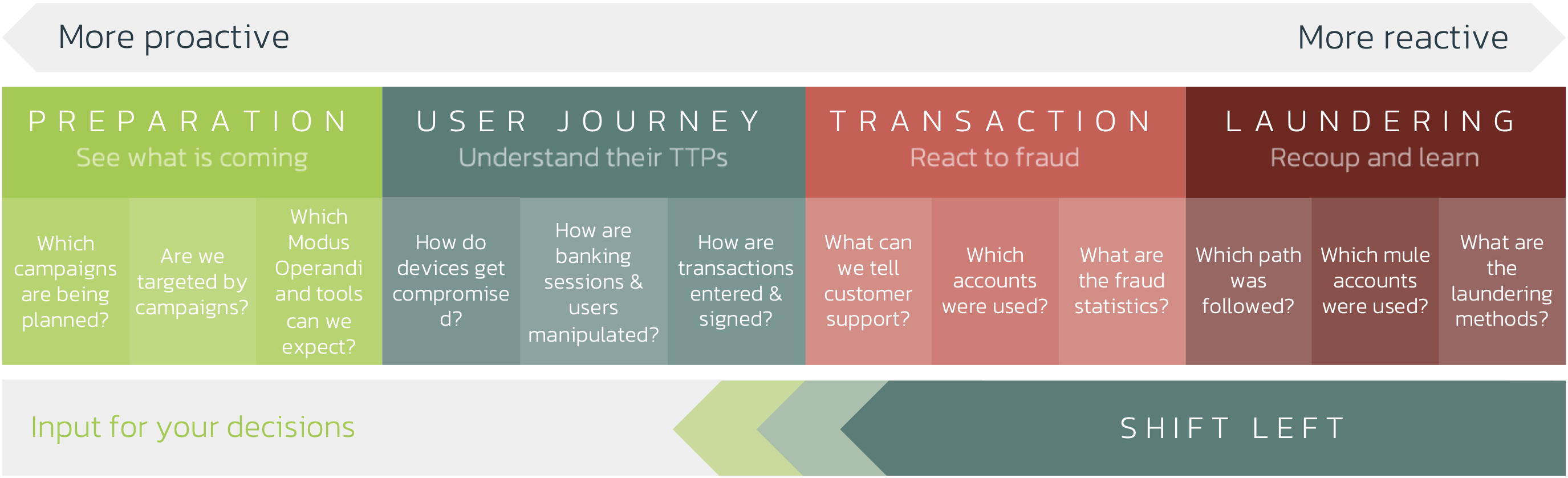
The Problem: Fraud doesn’t Start with a Transaction, it ends with one Financial fraud and scams don’t occur at a single moment in time—they unfold across a predictable lifecycle. Often, fraud and scam detection starts at the right‑most end of that lifecycle: the transaction stage. Most steps in the criminal process go overlooked. By the time a fraudulent payment is initiated and signed, attackers have already prepared, manipulated the victim, compromised devices, or orchestrated mule accounts. Acting only at this late stage reduces detection accuracy, increases customer friction, and increases operational workload. When a customer alerts you to a scam, speed and clarity are critical. What exactly happened? Is the transaction still in flight? Have the funds already been moved or laundered? Effective fraud management relies on immediate, high‑quality data to reconstruct events, support the customer, trigger automated follow‑up, and feed insights back into Detection and Fraud Intelligence teams. Even when fraud is discovered post‑transaction, insights from earlier stages of the lifecycle dramatically improve your decision‑making, accelerate response, and strengthen feedback loops to prevent future cases. Learn more on how we 'Shift Left on Fraud' with our products by downloading a detailed brochure: Attackers organize campaigns, set up infrastructure, distribute malware, refine social engineering scripts, and prepare mule networks. Key questions answered at this stage include: During the victim’s interaction with digital banking channels, early indicators of fraud surface: In this phase, the transactional and financial observables are taken into account. This is the phase where money is being moved to an account under control, or accessible by a criminal. It offers fraud managers detection opportunities, like: While the transaction phase is where fraudulent money transfers are being attempted, 80 percent of the criminal process is performed in the previous stages. Money is moved through mule accounts and obfuscation paths. Shifting left aims to detect before this stage even begins. User Journey Intelligence is the richest – but often underutilized – source of pre‑transaction risk signals. Fraud and Scam Risk visibility throughout the entire journey dramatically boosts early detection. ThreatFabric FRS offers key detection opportunities: Detect Social Engineering Before Payment: Call‑intelligence signals (e.g., risky call duration, concurrent voice calls with login attempts) offer early indications of scam behaviour. Detect Device & Malware Threats Before They Trigger Fraud: Behavioural Analytics as Early Identity Risk: Behaviour deviating from a user’s established pattern – or matching a known fraudster model – reveals high‑risk sessions even when credentials are correct. Fully Privacy‑Preserving Signal Collection: FRS and behavioural indicators are GDPR‑aligned and processed without needing personal content. With User Journey Intelligence, banks shift from “spotting a bad payment” to “spotting a bad session”. This pre-empts many fraud attempts. Threat Intelligence (TI) – especially Mobile Threat Intelligence – helps banks understand and anticipate attacks before they even appear in their own environments. ThreatFabric’s MTI provides actionable, tactical, and strategic intelligence that is directly operationalizable. Key opportunities: Anticipate Campaigns Before They Hit Your Bank: TI reveals campaigns, distribution methods, malware capabilities, and command‑and‑control behaviour in advance. Understand Emerging TTPs: Preparation‑phase TTPs indicate how fraudsters will manipulate user journeys, enabling pre‑emptive defense tuning. Strengthen Threat Protection & Device Risk: TI insights feed not only fraud detection engines but also mobile‑app protection layers, related to Malware, RATs and Device Risk. Build a Closed Feedback Loop: With Threat Intelligence you build a feedback loop with FRS Fraud Metrics. TI creates an intelligence‑reinforcing cycle for continuous improvement. FRS User Journey Intelligence can be used in any Risk or Decisioning engine. It adds fidelity and depth to risk signals, and offers traceability from transaction ID’s into the User Journey and its risk signals: Together, TI + FRS form the technical backbone needed to truly shift left. Based on the combined insights across your events, shifting detection earlier yields: ✅ Higher detection rates & fewer false positives Earlier signals enable stronger contextual scoring and more confident decisions. ✅ Lower operational impact on fraud cases Preventing fraud at the journey level avoids costly investigations and recoveries. ✅ Compliance with consumer‑protection regulation (PSD2/PSD3/PSR) Early‑risk identification aligns with regulatory pushes for scam prevention and strong customer protection. ✅ Privacy‑preserving detection Behavioural and device‑risk indicators follow strict privacy‑by‑design principles, based on consumer protection, minimizing PII processing, ISO Certification, and Model Transparency. Fraud prevention shouldn’t just be about asking “Was this payment fraudulent?”. It’s about asking “Was this session risky, and why?” and “Is this campaign coming to our Online Channels?”. Banks that shift left—from Transaction to User Journey to Preparation—transform their approach from reactive fraud management into pre-emptive, intelligence‑driven fraud prevention. By combining Threat Intelligence and the Fraud Risk Suite, organizations gain the earliest possible visibility into attacker behavior, user manipulation patterns, and device‑based threats. This leads to: Shifting left isn’t just a strategy—it’s a competitive advantage in the future of fraud defense.
GET BROCHURE
The Four Phases of Online Fraud
1. Preparation
2. User Journey
3. Transaction
4. LaunderingOpportunities in Focusing on User Journey Intelligence
Opportunities in Focusing on Threat Intelligence
Technology: Leveraging TI & FRS for Pre‑emptive Detection
How to Leverage Threat Intelligence (TI) in Detection:
How to Leverage Fraud Risk Suite (FRS) in Detection
Benefits of Shifting Left
Conclusion
Brochure
如有侵权请联系:admin#unsafe.sh