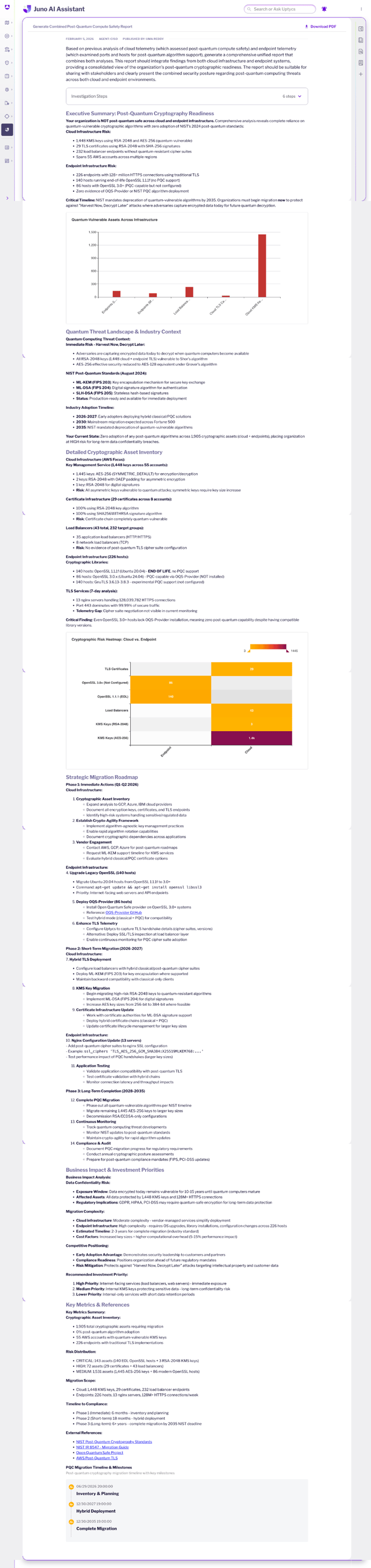
Before you can transition to quantum-resistant algorithms, you first need to know exactly where your vulnerabilities live—a task that is becoming impossible to manage manually. This is where the Quantum Bill of Materials (QBOM) becomes the cornerstone of your strategy. Much like a traditional SBOM tracks software components, a QBOM provides a comprehensive, automated inventory of every cryptographic asset, protocol, and library across your entire infrastructure. It transforms "cryptographic shadow IT" into a clear, actionable roadmap, allowing security teams to identify exactly which keys and certificates are at risk before the first quantum threat ever materializes. The quantum computing revolution isn't coming—it's already here, and it's fundamentally changing how we think about cryptographic security. While quantum computers may not be breaking encryption en masse today, the timeline for when they will be is shorter than many organizations realize. The good news? The National Institute of Standards and Technology (NIST) has given us a roadmap to quantum-resistant security, but it requires action on two critical fronts: key exchange protocols and certificate signing algorithms. In this blog, we will dive deep into why these two pillars are the most urgent targets for an upgrade. We’ll explore the "harvest now, decrypt later" threat to key exchanges and the risk of total identity impersonation through vulnerable certificates. Finally, we will demonstrate how Uptycs Juno AI simplifies this daunting journey—moving you from a state of cryptographic uncertainty to a verifiable, post-quantum posture by first generating your QBOM and then guiding you through every step of the implementation. One of the biggest misconceptions about quantum computing is that it will magically break all encryption overnight. The reality is more nuanced and, in some ways, more urgent. Quantum computers excel at solving specific mathematical problems that underpin certain types of cryptography: Shor's Algorithm can efficiently solve integer factorization and discrete logarithm problems, which means it can completely break RSA key exchange and Elliptic Curve Diffie-Hellman (ECDH). When we say "break," we mean render completely useless—a quantum computer can recover private keys in polynomial time. Grover's Algorithm provides a quadratic speedup for brute force attacks, which means it weakens symmetric encryption like AES but doesn't destroy it. AES-256 security drops from 256 bits to approximately 128 bits of quantum security—still computationally infeasible to break with realistic resources. This distinction is crucial because it tells us where to focus our immediate attention. The asymmetric nature of the quantum threat explains why key exchange replacement is so urgent: Key Exchange: Complete Compromise Symmetric Ciphers: Manageable Degradation When your key exchange is broken, everything else falls like dominoes. An attacker who can break ECDH can recover session keys instantly and decrypt all session traffic. When AES is weakened but still requires 2^128 operations to break, it remains computationally infeasible for the foreseeable future. On August 13, 2024, NIST finalized three Federal Information Processing Standards (FIPS) for post-quantum cryptography, giving organizations concrete standards to implement: NIST's security levels provide a clear framework for understanding the strength of post-quantum algorithms by comparing them to the computational effort required to break well-known symmetric encryption: Level 1 Security Level 3 Security Level 5 Security This leveling system helps organizations choose appropriate algorithms based on their security requirements and risk tolerance. Here's a critical point that many organizations miss: post-quantum security requires upgrading both components of your cryptographic infrastructure. Key Exchange Protection ensures that session keys can't be derived by quantum computers attacking the key agreement process. Even if you upgrade to ML-KEM for key exchange, you're still vulnerable if your certificates are signed with classical algorithms that quantum computers can break. Certificate Signing Protection ensures that certificate authenticity can be verified even against quantum attacks. A quantum computer that can forge certificate signatures can impersonate any server, regardless of how secure the key exchange mechanism is. Both components must be quantum-resistant to achieve true post-quantum security. It's not an either-or decision—it's a requirement for comprehensive protection. Understanding your current quantum security posture is essential for planning your migration. Uptycs provides this visibility by analyzing real-time telemetry across your environments and reporting NIST post-quantum security levels for both key exchange mechanisms and certificate signing algorithms. Why this works: Key Exchange Reporting: Certificate Signing Reporting: This visibility allows organizations to identify which servers and services are quantum-ready and which require immediate attention. A server might support post-quantum key exchange but still use classically-signed certificates, leaving a critical vulnerability. The transition to post-quantum cryptography isn't optional—it's inevitable. Organizations that start planning and implementing now will be ready when quantum computers pose a practical threat. Those that wait may find themselves scrambling to upgrade critical infrastructure under pressure. The NIST standards provide a clear path forward, but implementation requires careful planning: The quantum future is coming whether we're ready or not. The question isn't whether you'll need post-quantum cryptography—it's whether you'll implement it before or after quantum computers make that decision for you. The Uptycs platform serves as a central nervous system for your security telemetry, spanning cloud environments, Kubernetes clusters, containers, and traditional host or laptop infrastructure. By maintaining total awareness of every communication channel across these assets, Uptycs identifies the specific ciphers and encryption protocols currently in play. This deep visibility allows the platform to automatically compile a Quantum Bill of Materials (QBOM), providing a comprehensive inventory of your organization's cryptographic DNA. To translate this technical data into strategic foresight, the Uptycs Juno AI agent applies advanced LLM reasoning to the gathered QBOM. Juno doesn't just list your encryption methods; it analyzes the interplay between your infrastructure's current state and the evolving requirements of post-quantum security. This synthesis allows the AI to interpret complex telemetry and provide a clear, reasoned assessment of where your vulnerabilities lie in a post-quantum world. The following report represents the culmination of this process, offering a detailed look at your enterprise’s post-quantum readiness. By combining real-time infrastructure telemetry with AI-driven analysis, it provides a roadmap for transitioning your cryptographic standards to meet future threats. This assessment ensures you are not just aware of your quantum risk, but equipped with the intelligence necessary to mitigate it before the landscape shifts.The Quantum Threat Isn't Universal—It's Targeted
Why Key Exchange Gets Priority Treatment
NIST's Post-Quantum Standards: The Foundation of Future Security
ML-KEM (Module-Lattice-Based Key Encapsulation Mechanism)
ML-DSA (Module-Lattice-Based Digital Signature Algorithm)
SLH-DSA (Stateless Hash-Based Digital Signature Algorithm)
Understanding NIST Security Levels
You Need Both: Key Exchange AND Certificate Signing
Auditing Your Quantum Readiness
The Path Forward
How Uptycs Juno AI helps in getting ready for the quantum future

Preparing for the Quantum Future in Cryptography
嗯,用户让我帮忙总结一下这篇文章的内容,控制在一百个字以内。首先,我需要仔细阅读文章,理解其主要观点和关键信息。 文章主要讨论了量子计算对现有加密技术的威胁,特别是RSA和ECDH等算法的脆弱性。还提到了NIST发布的后量子加密标准,包括ML-KEM、ML-DSA和SLH-DSA,并解释了它们的安全级别。此外,文章强调了升级密钥交换协议和证书签名算法的重要性,并介绍了Uptycs Juno AI如何通过生成QBOM来帮助组织过渡到后量子安全。 接下来,我需要将这些要点浓缩到100字以内。要确保涵盖量子威胁、NIST标准、升级必要性以及Uptycs的作用。同时,语言要简洁明了,避免使用复杂的术语。 最后,检查字数是否符合要求,并确保总结准确传达文章的核心内容。 </think> 文章探讨了量子计算对现有加密技术的威胁,强调了升级密钥交换协议和证书签名算法的紧迫性,并介绍了NIST的后量子加密标准。通过生成Quantum Bill of Materials (QBOM),Uptycs Juno AI帮助组织识别漏洞并过渡到后量子安全。 2026-2-10 15:6:58 Author: www.uptycs.com(查看原文) 阅读量:18 收藏
嗯,用户让我帮忙总结一下这篇文章的内容,控制在一百个字以内。首先,我需要仔细阅读文章,理解其主要观点和关键信息。 文章主要讨论了量子计算对现有加密技术的威胁,特别是RSA和ECDH等算法的脆弱性。还提到了NIST发布的后量子加密标准,包括ML-KEM、ML-DSA和SLH-DSA,并解释了它们的安全级别。此外,文章强调了升级密钥交换协议和证书签名算法的重要性,并介绍了Uptycs Juno AI如何通过生成QBOM来帮助组织过渡到后量子安全。 接下来,我需要将这些要点浓缩到100字以内。要确保涵盖量子威胁、NIST标准、升级必要性以及Uptycs的作用。同时,语言要简洁明了,避免使用复杂的术语。 最后,检查字数是否符合要求,并确保总结准确传达文章的核心内容。 </think> 文章探讨了量子计算对现有加密技术的威胁,强调了升级密钥交换协议和证书签名算法的紧迫性,并介绍了NIST的后量子加密标准。通过生成Quantum Bill of Materials (QBOM),Uptycs Juno AI帮助组织识别漏洞并过渡到后量子安全。 2026-2-10 15:6:58 Author: www.uptycs.com(查看原文) 阅读量:18 收藏
文章来源: https://www.uptycs.com/blog/preparing-for-the-quantum-future
如有侵权请联系:admin#unsafe.sh
如有侵权请联系:admin#unsafe.sh