嗯,用户让我总结这篇文章的内容,控制在100字以内,而且不需要特定的开头。首先,我得快速浏览文章内容。文章主要讲的是2025年11月发生的一次创纪录的DDoS攻击,达到了31.4 Tbps,持续了35秒,被Cloudflare拦截。攻击者使用了AISURU/Kimwolf僵尸网络,涉及大量物联网设备和移动设备。此外,文章还提到攻击的目标主要是电信和云服务提供商,并且攻击规模在2025年显著增加。 接下来,我需要把这些关键点浓缩到100字以内。要确保包含攻击的时间、规模、持续时间、拦截方、僵尸网络名称以及受影响的目标和攻击规模的增长情况。同时,语言要简洁明了,避免冗余。 可能的结构是:时间+事件+规模+持续时间+拦截方+僵尸网络+影响目标+攻击规模增长情况。这样就能在有限的字数内涵盖所有重要信息。 最后,检查一下是否符合用户的要求:中文总结,控制在100字以内,没有特定开头。确保没有遗漏关键信息,并且表达清晰。 </think> 2025年11月,AISURU/Kimwolf僵尸网络发起创纪录的31.4 Tbps DDoS攻击,仅持续35秒即被Cloudflare拦截。该攻击利用受感染设备生成超大规模流量,主要针对电信和云服务提供商。2025年第四季度DDoS攻击规模激增700%,成为有史以来最大公开披露的DDoS事件之一。 2026-2-6 15:5:29 Author: securityaffairs.com(查看原文) 阅读量:0 收藏
Record-breaking 31.4 Tbps DDoS attack hits in November 2025, stopped by Cloudflare
 Pierluigi Paganini
 February 06, 2026

AISURU/Kimwolf botnet hit a record 31.4 Tbps DDoS attack lasting 35 seconds in Nov 2025, which Cloudflare automatically detected and blocked.
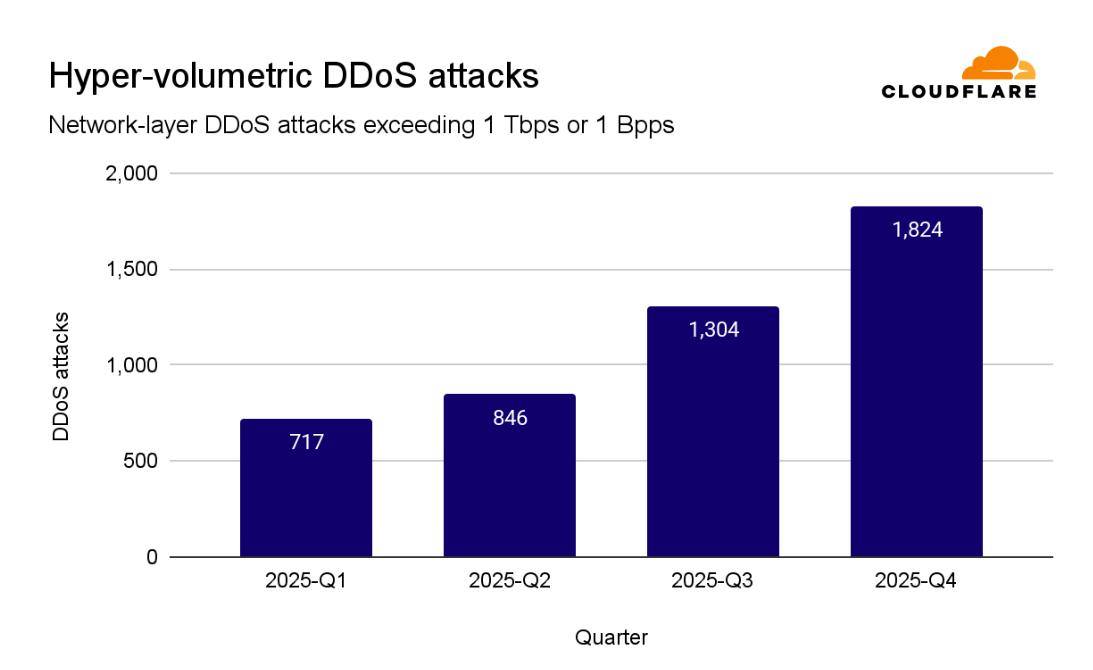
The AISURU/Kimwolf botnet was linked to a record-breaking DDoS attack that peaked at 31.4 Tbps and lasted just 35 seconds. Cloudflare said the November 2025 incident was part of a surge in hyper-volumetric HTTP DDoS attacks observed in late 2025, all automatically detected and mitigated.
“Throughout 2025, Cloudflare observed a continuous increase in hyper-volumetric DDoS attacks. In 2025 Q4, hyper-volumetric attacks increased by 40% compared to the previous quarter.” reads the report published by Cloudflare. “As the number of attacks increased over the course of 2025, the size of the attacks increased as well, growing by over 700% compared to the large attacks seen in late 2024, with one reaching 31.4 Tbps in a DDoS attack that lasted just 35 seconds. The graph below portrays the rapid growth in DDoS attack sizes as seen and blocked by Cloudflare — each one a world record, i.e. the largest ever disclosed publicly by any company at the time.”

Acting as a DDoS-for-hire service, Aisuru avoids government and military targets, but broadband providers faced serious disruptions from attacks exceeding 1.5Tb/sec from infected customer devices.
Like other TurboMirai botnets, Aisuru incorporates additional dedicated DDoS attack capabilities and multi-use functions, enabling operators to carry out other illicit activities, including credential stuffing, artificial intelligence (AI)-driven web scraping, spamming, and phishing.
Attacks use UDP, TCP, and GRE floods with medium-sized packets and randomized ports/flags. Over 1Tb/sec traffic from compromised CPEs disrupts broadband, and 4gpps+ floods have caused router line card failures.
Kimwolf is a newly discovered Android botnet linked to the Aisuru botnet that has infected over 1.8 million devices and issued more than 1.7 billion DDoS attack commands, according to XLab.
The Kimwol Android botnet primarily targets TV boxes, compiled using the NDK and equipped with DDoS, proxy forwarding, reverse shell, and file management functions. It encrypts sensitive data with a simple Stack XOR, uses DNS over TLS to hide communication, and authenticates C2 commands with elliptic curve digital signatures. Recent versions even incorporate EtherHiding to resist takedowns via blockchain domains.
Kimwolf follows a naming pattern of “niggabox + v[number]”; versions v4 and v5 have been tracked. By taking over one C2 domain, researchers observed around 2.7 million IPs interacting over three days, indicating a likely infection scale exceeding 1.8 million devices. Its infrastructure spans multiple C2s, global time zones, and versions, making it hard to estimate the total number of infections.
The botnet borrows the code from the Aisuru family, however, operators redesigned it to evade detection. Its primary function is traffic proxying, though it can execute massive DDoS attacks, as seen in a three-day period issuing 1.7 billion commands between November 19 and 22.
In Q4 2025, the largest DDoS attacks mainly targeted Cloudflare customers in the Telecommunications, Service Providers, and Carriers sector, followed by Gaming and Generative AI services. Cloudflare’s own infrastructure was also attacked using HTTP floods, DNS attacks, and UDP floods. Globally, China, the United States, Germany, and Brazil remained among the most targeted countries, while Hong Kong and especially the United Kingdom saw sharp increases in attacks.
Regarding attack origins, Bangladesh became the top source of DDoS traffic, overtaking Indonesia, with notable rises also seen from Ecuador and Argentina.
Most DDoS attacks in Q4 2025 originated from IPs linked to major cloud platforms like DigitalOcean, Microsoft, Tencent, Oracle, and Hetzner, mostly in the U.S. Telcos in Asia-Pacific also contributed. Attacks are global, using thousands of source networks. Cloudflare offers a free DDoS Botnet Threat Feed, with 800+ networks collaborating to identify and shut down abusive IPs.
“DDoS attacks are rapidly growing in sophistication and size, surpassing what was previously imaginable. This evolving threat landscape presents a significant challenge for many organizations to keep pace.” concludes the report. “Organizations currently relying on on-premise mitigation appliances or on-demand scrubbing centers may benefit from re-evaluating their defense strategy.”
Follow me on Twitter: @securityaffairs and Facebook and Mastodon
(SecurityAffairs – hacking, DDoS)
如有侵权请联系:admin#unsafe.sh