嗯,用户让我帮忙总结一篇文章,控制在100字以内,而且不需要特定的开头。首先,我需要通读文章内容,抓住主要信息。 文章讲的是VMware ESXi的一个漏洞CVE-2025-22225被用于勒索软件攻击。CISA确认了这一点,这个漏洞允许攻击者逃逸沙盒,获得内核权限。VMware在2025年3月发布了补丁,修复了三个零日漏洞。Huntress的研究显示,攻击者利用被黑的 SonicWall VPN 分发工具包,并且这个工具包可能早在一年前就被开发出来了。 所以,我需要把这些关键点浓缩到100字以内:漏洞名称、用途、CISA确认、攻击机制、补丁时间、相关零日漏洞、攻击者手法和工具包的时间线。 可能的结构是:勒索软件利用VMware ESXi漏洞CVE-2025-22225进行攻击,CISA确认了这一点。该漏洞允许沙盒逃逸和内核权限获取。VMware在3月修复了三个零日漏洞。Huntress发现攻击者使用被黑的VPN分发工具包,并且该工具包开发时间早于公开披露。 最后检查一下字数,确保不超过限制。 </think> 勒索软件团伙利用VMware ESXi漏洞CVE-2025-22225进行攻击,该漏洞允许沙盒逃逸和内核权限获取。CISA确认该漏洞被用于活跃攻击。VMware于3月修复了三个零日漏洞。研究人员发现攻击者通过被黑SonicWall VPN分发工具包,并利用早期开发的零日技术实施长期隐蔽攻击。 2026-2-4 22:2:30 Author: securityaffairs.com(查看原文) 阅读量:0 收藏
CVE-2025-22225 in VMware ESXi now used in active ransomware attacks
 Pierluigi Paganini
 February 04, 2026

Ransomware groups now exploit VMware ESXi vulnerability CVE-2025-22225, patched by Broadcom in March 2025.
The U.S. Cybersecurity and Infrastructure Security Agency (CISA) confirms that ransomware gangs are exploiting the VMware ESXi sandbox escape flaw CVE-2025-22225.
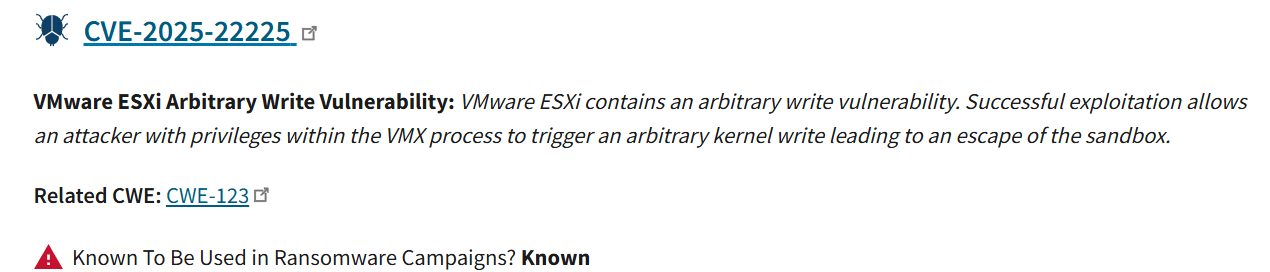
The vulnerability is an arbitrary write issue in VMware ESXi. An attackers with privileges within the VMX process may trigger an arbitrary kernel write leading to an escape of the sandbox.
At the time, the virtualization giant confirmed that it had information suggesting that the exploitation of the flaw in attacks in the wild.
“A malicious actor with privileges within the VMX process may trigger an arbitrary kernel write leading to an escape of the sandbox.” reads the advisory.
VMware’s March 2025 advisory VMSA‑2025‑0004 fixed three zero‑days actively exploited in the wild that enable ESXi VM escape and code execution:
- CVE-2025-22226 (CVSS 7.1): An out-of-bounds read in HGFS that allows leaking memory from the VMX process
- CVE-2025-22224 (CVSS 9.3): A TOCTOU vulnerability in VMCI leading to an out-of-bounds write, allowing code execution as the VMX process
- CVE-2025-22225 (CVSS 8.2): An arbitrary write vulnerability in ESXi that allows escaping the VMX sandbox to the kernel
In January, Huntress researchers reported that Chinese-speaking attackers were seen abusing a hacked SonicWall VPN to deliver a toolkit targeting VMware ESXi.
The exploit chain included a sophisticated VM escape and appears to have been developed more than a year before the related VMware flaws were publicly disclosed. Analysis of attacks observed in December 2025 suggests the group had early knowledge of three ESXi zero-day vulnerabilities later revealed in March 2025, indicating long-term, covert exploitation of unknown flaws.
In December 2025, Huntress researchers detected an intrusion that led to the deployment of a VMware ESXi exploit toolkit, with initial access attributed to a compromised SonicWall VPN.
Evidence such as simplified Chinese strings and build paths suggests the toolkit was likely developed as a zero-day more than a year before VMware publicly disclosed the flaws, pointing to a well-resourced Chinese-speaking actor.
The attackers laterally moved using Domain Admin credentials, performed reconnaissance, modified firewall rules to block external access while preserving internal movement, and staged data for exfiltration. The toolkit targeted up to 155 ESXi builds and enabled VM escape via disabled VMCI drivers and unsigned kernel drivers, potentially paving the way for ransomware. The attack was ultimately stopped before impact.
The threat actors rely on an orchestrator called MAESTRO to manage a full VMware ESXi VM escape. It disables VMCI drivers, loads an unsigned exploit driver via BYOD techniques, and coordinates exploitation. The driver leaks VMX memory to bypass ASLR, abuses HGFS and VMCI flaws, writes shellcode into the VMX process, and escapes to the ESXi kernel. It then deploys a stealthy VSOCK-based backdoor (VSOCKpuppet), enabling persistent remote control of the hypervisor from guest VMs while evading traditional network monitoring and restoring drivers to reduce detection.
Huntress researchers found evidence that the exploit chain may have been used since at least February 2024.
“The exploit binaries contain PDB paths that offer insight into the development environment.” reads the report published by Huntress.
CISA has updated the CVE-2025-22225 entry in the KEV catalog, confirming the flaw is being exploited in ransomware attacks.
Follow me on Twitter: @securityaffairs and Facebook and Mastodon
(SecurityAffairs – hacking, CISA)
如有侵权请联系:admin#unsafe.sh