
嗯,用户让我用中文总结一篇文章,控制在100字以内,而且不需要特定的开头。首先,我需要理解文章内容。文章讲的是最近针对Citrix NetScaler基础设施的侦察活动,使用了数万个家用代理IP进行扫描,主要目标是登录面板和版本枚举。GreyNoise监测到超过6万IP发起了11万次会话,大部分来自家用代理,伪装成合法ISP地址,避开过滤。这表明是针对特定基础设施的预攻击侦察。 接下来,我需要将这些信息浓缩到100字以内。要抓住关键点:时间、目标、规模、来源、手法和目的。可能的结构是:时间+目标+规模+手法+来源+目的。 然后检查是否符合要求:不使用特定开头,直接描述内容;控制在100字内;用中文。 最后,确保语言简洁明了,没有冗余信息。 </think> 过去一周针对Citrix NetScaler基础设施的侦察活动使用数万个家用代理IP进行扫描,主要针对登录面板和版本枚举。GreyNoise监测到超6.3万IP发起了11.8万次会话,其中79%针对Citrix Gateway蜜罐,64%来自家用代理。攻击者通过伪装合法ISP地址避开过滤,并使用老旧Chrome 50用户代理。活动表明为特定基础设施预攻击侦察。 2026-2-3 20:30:19 Author: www.bleepingcomputer.com(查看原文) 阅读量:0 收藏

A coordinated reconnaissance campaign targeting Citrix NetScaler infrastructure over the past week used tens of thousands of residential proxies to discover login panels.
The activity was observed between January 28 and February 2, and it also focused on enumerating versions of the product, indicating an organized discovery effort.
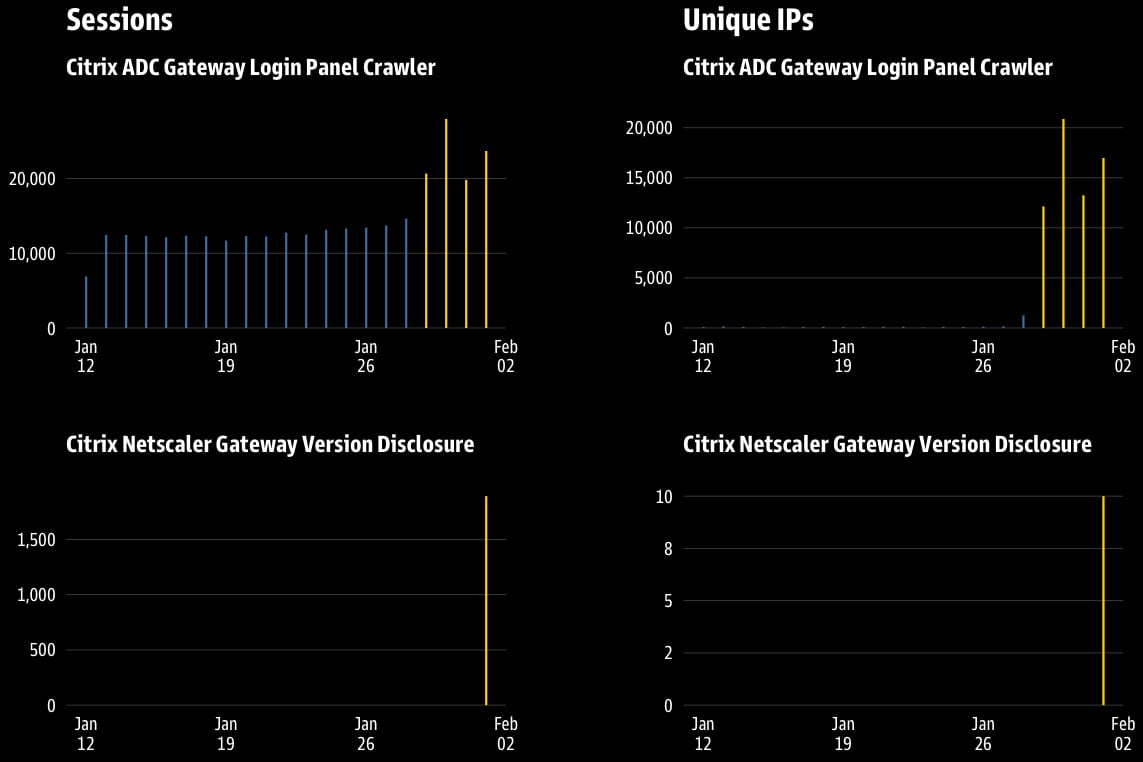
Threat monitoring platform GreyNoise traced the source of the scanning traffic to more than 63,000 distinct IPs that launched 111,834 sessions. According to the researchers, 79% of the traffic was aimed at Citrix Gateway honeypots.
Roughly 64% of the traffic came from residential proxies, with IPs spread across the globe, appearing as legitimate consumer ISP addresses and bypassing reputation-based filtering. The remaining 36% came from a single Azure IP address.
The activity strongly indicates pre-exploitation infrastructure mapping, rather than random internet scanning, GreyNoise says.
"The specific targeting of the EPA [Endpoint Analysis] setup file path suggests interest in version-specific exploit development or vulnerability validation against known Citrix ADC weaknesses."
Source: GreyNoise
The two indicators of malicious intent are obvious, with the most active one generating 109,942 sessions from 63,189 unique IPs and targeting the authentication interface at ‘/logon/LogonPoint/index.html’ to identify exposed Citrix login panels at scale.
The second indicator, observed on February 1st, was a six-hour sprint with 10 IPs launching 1,892 sessions focused on the URL path ‘/epa/scripts/win/nsepa_setup.exe’ to enumerate Citrix versions via EPA artifacts.
GreyNoise notes that the attacker employed a user agent for Chrome 50, released in early 2016. Targeting the EPA setup file may indicate an "interest in version-specific exploit development or vulnerability validation against known Citrix ADC weaknesses."
“The rapid onset and completion suggest a targeted scanning sprint that may have been triggered by discovery of vulnerable EPA configurations or intelligence about deployment windows,” GreyNoise says.
The most recent critical-severity flaws impacting Citrix products are CVE-2025-5777, aka ‘CitrixBleed 2,’ and CVE-2025-5775, a remote code execution vulnerability that was exploited as a zero-day.
GreyNoise lists several detection opportunities for this latest activity, including:
- Monitoring for the blackbox-exporter user agent originating from non-authorized sources
- Alerting on external access to /epa/scripts/win/nsepa_setup.exe
- Flagging rapid enumeration of /logon/LogonPoint/ paths
- Watching for HEAD requests against Citrix Gateway endpoints
- Tracking outdated browser fingerprints, specifically Chrome 50 (circa 2016)
Additionally, the researchers recommend that system administrators review the necessity of internet-facing Citrix Gateways, restrict access to the /epa/scripts/ directory, disable version disclosure in HTTP responses, and monitor for anomalous access from residential ISPs in unexpected regions.
GreyNoise has also shared the IP addresses used to launch the scanning activity.

The future of IT infrastructure is here
Modern IT infrastructure moves faster than manual workflows can handle.
In this new Tines guide, learn how your team can reduce hidden manual delays, improve reliability through automated response, and build and scale intelligent workflows on top of tools you already use.
如有侵权请联系:admin#unsafe.sh