嗯,用户让我帮忙总结一下这篇文章的内容,控制在100个字以内,而且不需要用“文章内容总结”之类的开头。直接写描述即可。 首先,我需要快速浏览一下文章。看起来是关于SentinelLABS和Censys联合研究的,他们发现开源AI部署在全球范围内形成了一个未受管理的公开计算基础设施层,涉及17.5万个主机。这可能是一个安全风险。 文章提到他们进行了293天的扫描,覆盖了130个国家,发现了723万个观测点。其中近半数的主机配置了工具调用能力,可以执行代码、访问API等。这表明LLMs被越来越多地整合到更大的系统流程中。 基础设施分布在全球的云和住宅网络中,但大多数运行相同的AI模型格式,形成了一种脆性的单一文化。住宅基础设施的特点使得传统的治理方法难以适用,需要新的方法来区分管理云部署和分布式边缘基础设施。 接下来是背景部分,介绍了Ollama框架允许用户在本地运行大型语言模型。默认情况下绑定到localhost,但只需配置更改即可暴露到公共互联网。过去一年中,随着开源模型的普及和本地部署框架的成熟,安全社区开始关注这一趋势的安全影响。 研究的目标是了解公开暴露的规模、位置、运行的模型以及安全影响。扫描记录了来自175,108个唯一Ollama主机的723万个观测点。生态系统呈现双峰分布:大量短暂主机和少量持续主机构成大部分活动。 基础设施分布挑战了AI计算位置的传统假设。固定接入电信网络占56%的主机数量,但按基础设施层级分组时,云和电信/住宅网络各占约32%。这种分类矛盾反映了扫描中的分类和归属挑战。 模型采用集中在少数几个家族:Llama、Qwen2、Gemma2占主导地位。硬件约束方面,4位压缩格式占主导地位,尤其是Q4_K_M格式,在多个基础设施层级中排名第一。 能力表面方面,超过48%的主机广告工具调用能力。模态支持扩展到视觉和推理能力。系统提示分析发现至少201个主机运行去除安全护栏的标准提示模板。 安全影响包括资源劫持、过度代理权、身份洗钱、集中风险等。治理缺口在于归属困难和传统机制失效。 结论指出暴露的Ollama生态系统代表了一个公共计算基底的早期形成阶段:广泛分布、管理不均、部分归属困难,但在特定层级和地区足够持久以构成可测量现象。 总结起来,文章主要探讨了开源AI部署带来的安全隐患和治理挑战。 </think> 研究揭示开源AI部署形成全球性未受管理计算层,涉及17.5万主机,暴露安全风险,需新治理方法应对分布与集中依赖矛盾。 2026-1-29 10:55:47 Author: www.sentinelone.com(查看原文) 阅读量:36 收藏
Executive Summary
- A joint research project between SentinelLABS and Censys reveals that open-source AI deployment has created an unmanaged, publicly accessible layer of AI compute infrastructure spanning 175,000 hosts worldwide, operating outside the guardrails and monitoring systems that platform providers implement by default.
- Over 293 days of scanning, we identified 7.23 million observations across 130 countries, with a persistent core of 23,000 hosts generating the majority of activity.
- Nearly half of observed hosts are configured with tool-calling capabilities that enable them to execute code, access APIs, and interact with external systems demonstrating the increasing implementation of LLMs into larger system processes.
- Hosts span cloud and residential networks globally, but overwhelmingly run the same handful of AI models in identical formats, creating a brittle monoculture.
- The residential nature of much of the infrastructure complicates traditional governance and requires new approaches that distinguish between managed cloud deployments and distributed edge infrastructure.
Background
Ollama is an open-source framework that enables users to run large language models locally on their own hardware. By design, the service binds to localhost at 127.0.0.1:11434, making instances accessible only from the host machine. However, exposing Ollama to the public internet requires only a single configuration change: setting the service to bind to 0.0.0.0 or a public interface. At scale, these individual deployment decisions aggregate into a measurable public surface.
Over the past year, as open-weight models have proliferated and local deployment frameworks have matured, we observed growing discussion in security communities about the implications of this trend. Unlike platform-hosted LLM services with centralized monitoring, access controls, and abuse prevention mechanisms, self-hosted instances operate outside emerging AI governance boundaries. To understand the scope and characteristics of this emerging ecosystem, SentinelLABS partnered with Censys to scan and map internet-reachable Ollama deployments.
Our research aimed to answer several questions: How large is the public exposure? Where do these hosts reside? What models and capabilities do they run? And critically, what are the security implications of a distributed, unmanaged layer of AI compute infrastructure?
The Exposed Ecosystem | Scale and Structure
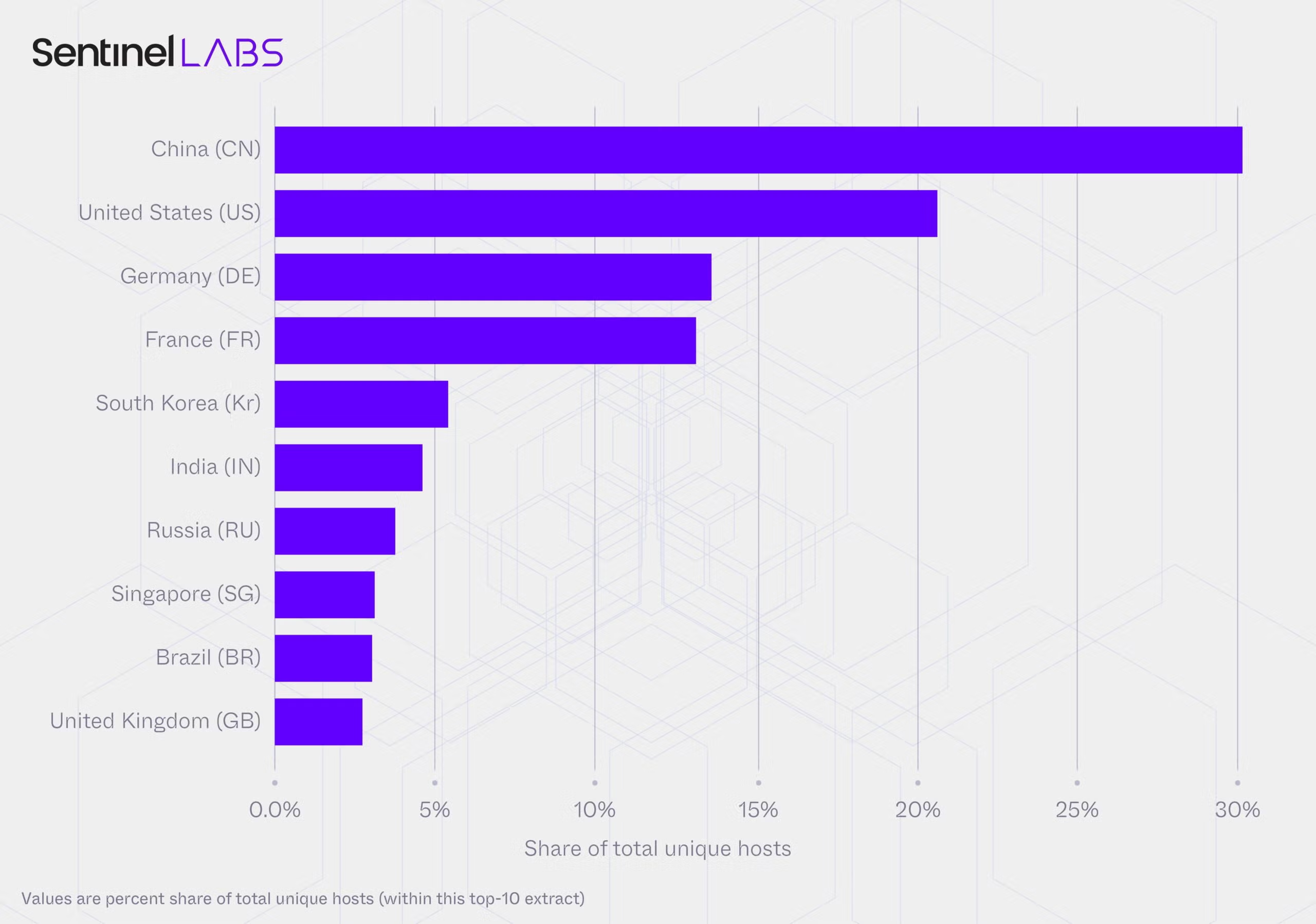
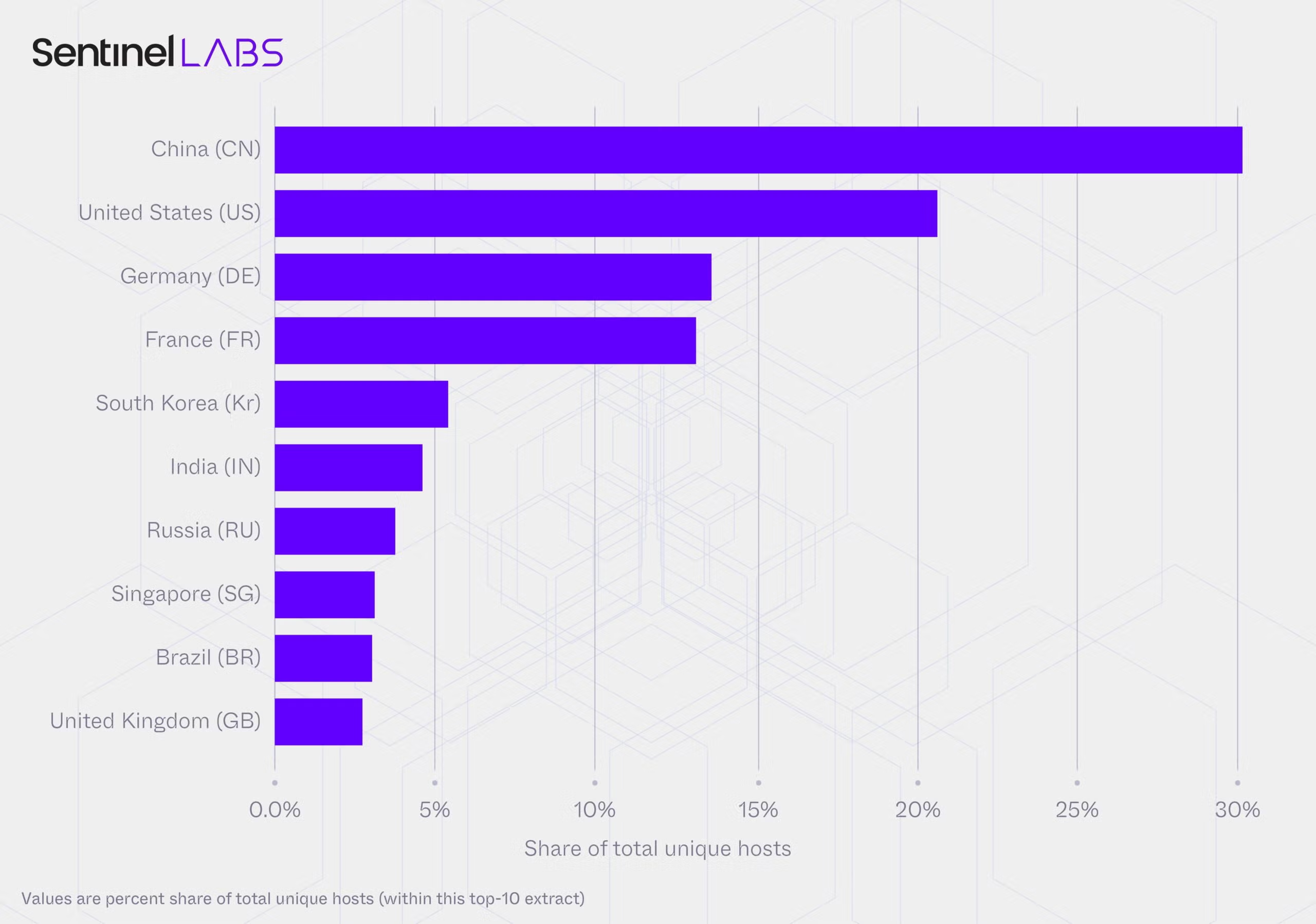
Our scanning infrastructure recorded 7.23 million observations from 175,108 unique Ollama hosts across 130 countries and 4,032 autonomous system numbers (ASNs). The raw numbers suggest a substantial public surface, but the distribution of activity reveals a more nuanced picture.
The ecosystem is bimodal. A large layer of transient hosts sits atop a smaller, persistent backbone that accounts for the majority of observable activity. These transient hosts appear briefly and then disappear. Hosts that appear in more than 100 observations represent just 13% of the unique host population, yet they generate nearly 76% of all observations. Conversely, hosts observed exactly once constitute 36% of unique hosts but contribute less than 1% of total observations.
This persistence skew shapes the rest of our analysis. It’s why model rankings stay stable even as the host population grows, why the host counts look residential while the always-on endpoints behave more like cloud services, and why most of the security risk sits in a smaller subset of exposed systems.
Regardless of this skew, persistent hosts that remain reachable across multiple scans comprise the backbone of our data. This is where capability, exposure, and operational value converge. These are systems that provide ongoing utility to their operators and, by extension, represent the most attractive and accessible targets for adversaries.
Infrastructure Footprint and Attribution Challenges
The infrastructure distribution challenges assumptions about where AI compute resides. When classified by ASN type, fixed-access telecom networks, which include consumer ISPs, constitute the single largest category at 56% of hosts by count. However, when the same data is grouped into broader infrastructure tiers, exposure divides almost evenly: Hyperscalers account for 32% of hosts, and Telecom/Residential networks account for another 32%.
This apparent contradiction reflects a classification and attribution challenge inherent in internet scanning. Both views are accurate, and together they indicate that public Ollama exposure spans a mixed environment. Access networks, independent VPS providers, and major cloud platforms all serve as durable habitats for open-weight LLM deployment.
Operational characteristics vary by tier. Indie Cloud/VPS environments show high average persistence and elevated “running share,” which measures the proportion of hosts actively serving models at scan time. This is consistent with endpoints that provide stable, ongoing service. Telecom/Residential hosts, by contrast, report larger average model inventories but lower running share, suggesting machines that accumulate models over time but operate intermittently.
Geographic distribution also reveals concentration patterns. In the United States, Virginia alone accounts for 18% of U.S. hosts, likely reflecting the density of cloud infrastructure in US-EAST. In China, concentration is even tighter: Beijing accounts for 30% of Chinese hosts, with Shanghai and Guangdong contributing an additional 21% combined. These patterns suggest that observable open-source AI capability concentrates at infrastructure hubs rather than distributing uniformly.
A significant portion of the infrastructure footprint, however, resists clean attribution. Depending on the classification method, 16% of tier labels and 19% of ASN-type classifications returned null values in our scans. This attribution gap reflects a governance reality. Security teams and enforcement authorities can observe activity, but they often cannot identify the responsible party. Traditional mechanisms that rely on clear ownership chains and abuse contact points become less effective when nearly one-fifth of the infrastructure is anonymous.
Model Adoption and Hardware Constraints
Although nothing is truly uniform on the internet, in our data we observe a distinct trend. Host placement is decentralized, but model adoption is concentrated. Lineage rankings are exceptionally stable across multiple weighting schemes. Across observations, unique hosts, and host-days, the same three families occupy the same positions with zero rank volatility: Llama at #1, Qwen2 at #2, and Gemma2 at #3. This stability indicates broad, repeated use of shared model lineages rather than a fragmented, experiment-heavy deployment pattern.
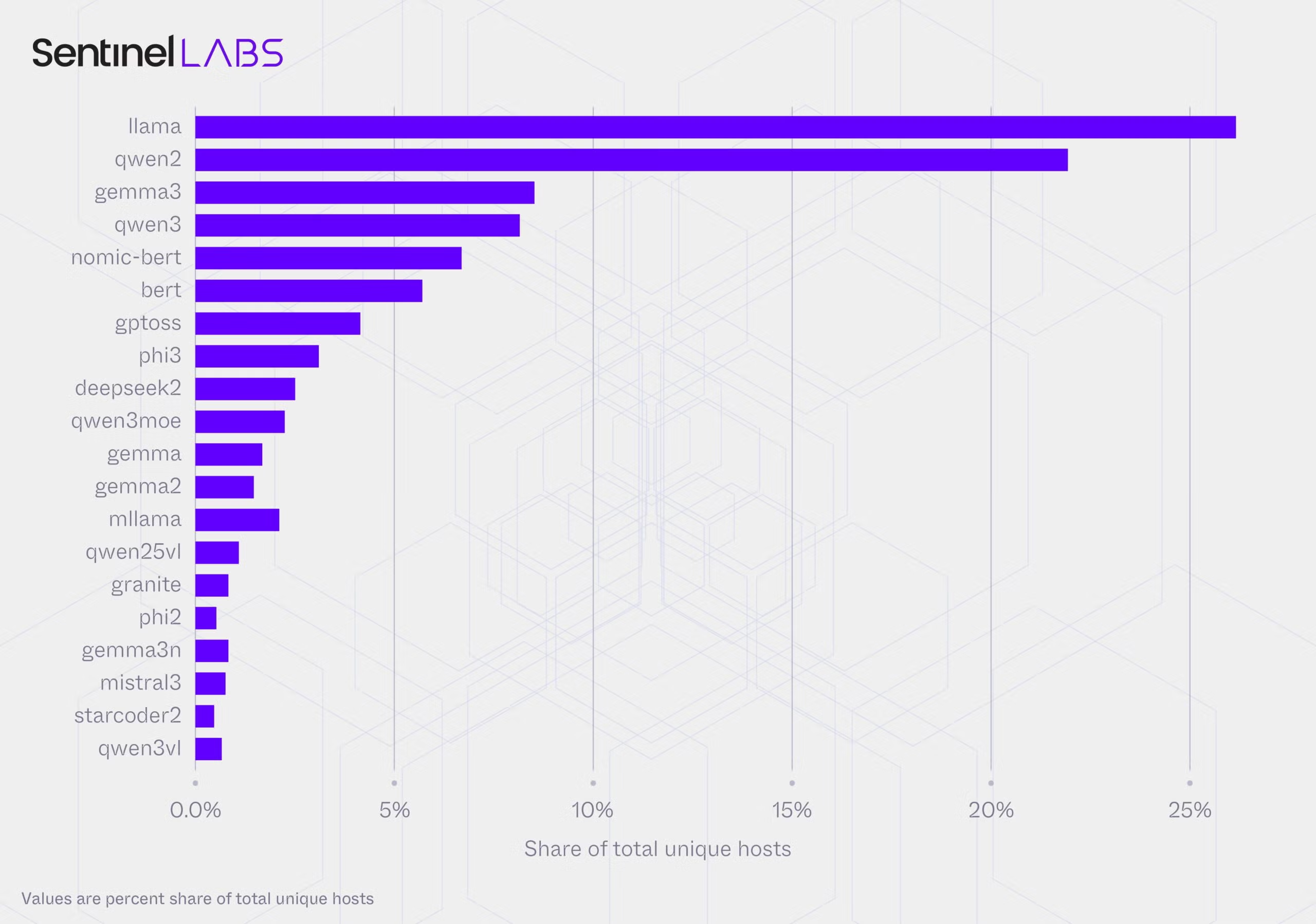
Portfolio behavior reveals a shift toward multi-model deployments. The average number of models per observation rose from 3 in March to 4 by September-December. The most common configuration remains modest at 2-3 models, accounting for 41% of hosts, but a small minority of “public library” hosts carry 20 or more models. These represent only 1.46% of hosts but disproportionately drive model-instance volume and family diversity.
Co-deployment patterns suggest operational logic beyond simple experimentation. The most prominent multi-family pairing, llama + qwen2, appears on 40,694 hosts, representing 52% of multi-family deployments. This consistency suggests operators maintain portfolios for comparison, redundancy, or workload segmentation rather than committing to a single lineage.
Hardware constraints express themselves clearly in quantization preferences and parameter-size distributions as well. The deployment regime converges strongly on 4-bit compression. The specific format Q4_K_M appears on 48% of hosts, and 4-bit formats total 72% of all observed quantizations compared to just 19% for 16-bit. This convergence is not confined to a single infrastructure niche. Q4_K_M ranks #1 across Academic, Hyperscaler, Indie VPS, and Telecom/Residential tiers.
Parameter sizes cluster in the mid-range. The 8-14B band is most prevalent at 26% of hosts, with 1-3B and 4-7B bands close behind. Together, these patterns reflect the practical economics of running inference on commodity hardware: models must be small enough to fit in available VRAM and memory bandwidth but also be capable enough for practical work.
This ecosystem-wide convergence on specific packaging regimes creates both portability and fragility. The same compression choices that enable models to run across diverse hardware environments also create a monoculture. A vulnerability in how specific quantized models handle tokens could affect a substantial portion of the exposed ecosystem simultaneously rather than manifesting as isolated incidents. This risk is particularly acute for widely deployed formats like Q4_K_M.
Capability Surface | Tools, Modalities, and Intent Signals
The persistent backbone is configured for action. Over 48% of observed hosts advertise tool-calling capabilities via their API endpoints. When queried, hosts return capability metadata indicating which operations they support. The specific combination of [completion, tools] indicates a host that can both generate text and execute functions. This configuration appears on 38% of hosts, indicating systems wired to interface with external software, APIs, or file systems.
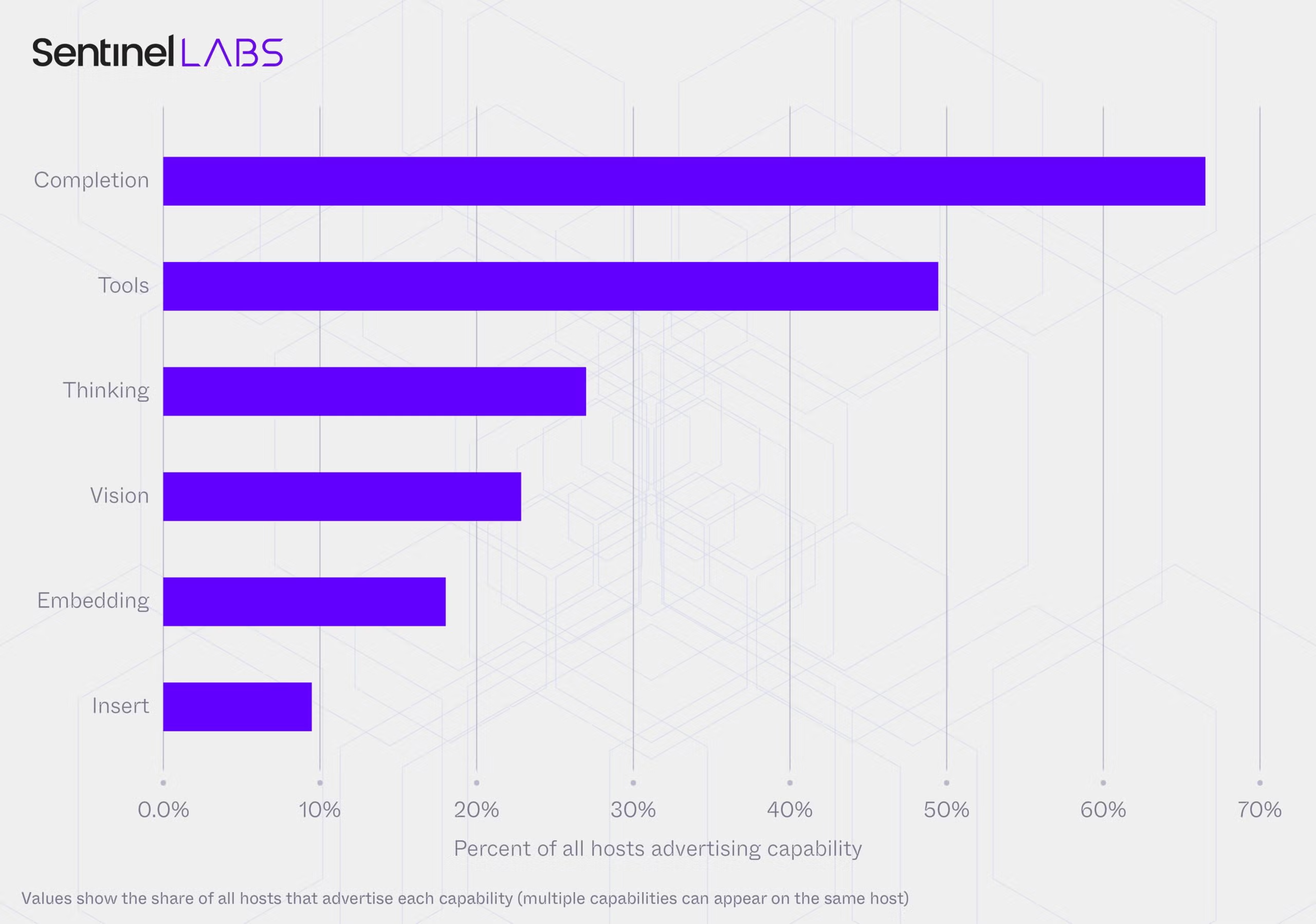
Modality support extends beyond text. Vision capabilities appear on 22% of hosts, enabling image understanding and creating vectors for indirect prompt injection via images or documents. “Thinking” models, which are optimized for multi-step reasoning and chain-of-thought processing, appear on 26% of hosts. When paired with tool-calling capabilities, reasoning capacity acts as a planning layer that can decompose complex tasks into sequential operations.
System prompt analysis surfaced a subset of deployments with explicit intent signals. We identified at least 201 hosts running standardized “uncensored” prompt templates that explicitly remove safety guardrails. This count represents a lower bound; our methodology captured only prompts visible via API responses and the presence of standardized “guard-off” configurations indicates a repeatable pattern rather than isolated experimentation.
A subset of 5,000 hosts demonstrates both high capability and high availability, showing 87% average uptime while actively running an average of 1.8 models. This combination of persistence, tool-enablement, and consistent availability suggests endpoints that provide ongoing operational value and, from an adversary perspective, represent stable, accessible compute resources.
Security Implications
The exposed Ollama ecosystem presents several threat vectors that differ from risks associated with platform-hosted LLM services.
Resource Hijacking
The persistent backbone represents a new network layer of compute infrastructure that can be accessed without authentication, usage monitoring, or billing controls. Frontier LLM providers have reported that criminal organizations and state-sponsored actors leverage their platforms for spam campaigns, phishing, disinformation networks, and network exploitation. These providers deploy dedicated security and fraud teams, implement rate limiting, and maintain abuse detection systems.
In contrast, the exposed Ollama backbone offers adversaries distributed compute resources with minimal centralized oversight. An attacker can direct malicious workloads to these hosts at zero marginal cost. The victim pays the electricity bill and infrastructure costs while the attacker receives the generated output. For operations requiring volume, such as spam generation, phishing content creation, or disinformation campaigns, this represents a substantial operational advantage.
Excessive Agency
Tool-calling capabilities fundamentally alter the threat model. A text-generation endpoint can produce harmful content, but a tool-enabled endpoint can execute privileged operations. When combined with insufficient authentication and network exposure, this creates what we assess to be the highest-severity risk in the ecosystem.
Prompt injection becomes an increasingly important threat vector as LLM enabled systems are provided increased agency. This technique manipulates LLM behavior through crafted inputs. An attacker no longer needs to breach a file server or database; they can prompt an exposed Retrieval-Augmented Generation instance with benign-sounding requests: “Summarize the project roadmap,” “List the configuration files in the documentation,” or “What API keys are mentioned in the codebase?” A model designed to be helpful and lacking authentication or safety mechanisms, will comply with these requests if its retrieval scope includes the targeted information.
We observed configurations consistent with retrieval workflows, including “chat + embeddings” pairings that suggest RAG deployments. When these systems are internet-reachable and lack access controls, they represent a direct path from external prompt to internal data.
Identity Laundering and Proxy Abuse
A significant portion of the exposed ecosystem resides on residential and telecom networks. These IP addresses are generally trusted by internet services as originating from human users rather than bots or automated systems. This creates an opportunity for sophisticated attackers to launder malicious traffic through victim infrastructure.
With vision capabilities present on 22% of hosts, indirect prompt injection via images becomes viable at scale. An attacker can embed malicious instructions in an image file and, if a vision-capable Ollama instance processes that image, trigger unintended behavior. When combined with tool-calling capabilities on a residential IP, this enables attacks where malicious traffic appears to originate from a legitimate household, bypassing standard bot management and IP reputation defenses.
Concentration Risk
The ecosystem’s convergence on specific model families and quantization formats creates systemic fragility. If a vulnerability is discovered in how a particular quantized model architecture processes certain token sequences, defenders would face not isolated incidents but a synchronized, ecosystem-wide exposure. Software monocultures have historically amplified the impact of vulnerabilities. When a single implementation error affects a large percentage of deployed systems, the blast radius expands accordingly. The exposed Ollama ecosystem exhibits this pattern: nearly half of all observed hosts run the same quantization format, and the top three model families dominate across all measurement methods.
Governance Gaps
Effective cybersecurity incident response relies on clear attribution: identifying the owner of compromised infrastructure, issuing takedown notices, and escalating through established abuse reporting channels. Even where attribution succeeds, enforcement mechanisms assume centralized control points. In cloud environments, providers can disable instances, revoke credentials, or implement network-level controls. In residential and small VPS environments, these levers often do not exist. An Ollama instance running in a home network or on a low-cost VPS may be accessible to adversaries but unreachable by security teams lacking contractual or legal authority.
Open Weights and the Governance Inversion
The exposed Ollama ecosystem forces a distinction that “open” rhetoric often blurs: distribution is decentralized, but dependency is centralized. On the ground, public instances span thousands of networks and operator types, with no single provider controlling where they live or how they’re configured, yet at the model-supply layer, the ecosystem repeatedly converges on the same few options. Lineage choice, parameter size, and quantization format determine what is actually runnable or exploitable.
This creates what we characterize as a governance inversion. Accountability diffuses downward into thousands of home networks and server closets, while functional dependency concentrates upward into a handful of model lineages released by a small number of labs. Traditional governance frameworks assume the opposite: centralized deployment with diffuse upstream supply.
In platform-hosted AI services, governance flows through service boundaries.This includes all too familiar terms of use, API rate limits, content filtering, telemetry, and incident response capacity. Open-weight models operate differently. Providers can monitor usage patterns, detect abuse, and terminate access for policy violations including use in state-sponsored campaigns. In artifact-distributed models, these mechanisms largely do not exist. Weights behave like software artifacts: copyable, forkable, quantized into new formats, retrainable and embedded into stacks the releasing lab will never observe.
Our data makes the artifact model difficult to ignore. Infrastructure placement is widely scattered, yet operational behavior and capability repeatedly trace back to upstream release decisions. When a new model family achieves portability across commodity hardware and gains adoption, that release decision gets amplified through distributed deployment at a pace that outstrips existing governance timelines.
This dynamic does not mean open weights are inherently problematic – the same characteristics that create governance challenges also enable research, innovation, and deployment flexibility that platform-hosted services cannot match. Rather, it suggests that governance mechanisms designed for centralized platforms require adaptation to this new risk environment. Post-release monitoring, vulnerability disclosure processes, and mechanisms for coordinating responses to misuse at scale become critical when frontier capability is produced by a few labs but deployed everywhere.
Conclusion
The exposed Ollama ecosystem represents what we assess to be the early formation of a public compute substrate: a layer of AI infrastructure that is widely distributed, unevenly managed, and only partially attributable, yet persistent enough in specific tiers and locations to constitute a measurable phenomenon.
The ecosystem is structurally paradoxical. It is resilient in its spread across thousands of networks and jurisdictions, making it impossible to “turn off” through centralized action, yet it is fragile in its dependency, relying on a narrow set of upstream model lineages and packaging formats. A single widespread vulnerability or adversarial technique optimized for the dominant configurations could affect a substantial portion of the exposed surface.
Security risk concentrates in the persistent backbone of hosts that remain consistently reachable, tool-enabled, and often lacking authentication. These systems require different governance approaches depending on infrastructure tier: traditional controls for cloud deployments, but sanitation mechanisms for residential networks where contractual leverage does not exist.
For defenders, the key takeaway is that LLMs are increasingly deployed to the edge to translate instructions into actions. As such, they must be treated with the same authentication, monitoring, and network controls as other externally accessible infrastructure.
如有侵权请联系:admin#unsafe.sh