嗯,用户让我帮忙总结一篇文章的内容,控制在一百个字以内,而且不需要用“文章内容总结”或者“这篇文章”这样的开头。直接写描述就行。首先,我需要仔细阅读用户提供的文章内容,找出主要的信息和关键点。 文章主要讲的是合规框架的七个关键要素。这些要素包括领导力、治理、风险评估、政策标准、控制措施、培训意识、监控和问题管理。作者还提到结构化框架的重要性,以及如何通过这些要素协同工作来形成一个闭环系统,持续改进合规管理。 接下来,我需要将这些信息浓缩到100字以内。要注意用简洁的语言表达核心内容,同时涵盖所有七个要素和它们的作用。可能的结构是先总述框架的重要性,然后列出关键要素,并说明它们如何协同工作。 最后,检查字数是否符合要求,并确保语言流畅自然,不使用任何复杂的术语或冗长的句子。 </think> 现代合规框架由领导力、治理、风险评估、政策标准、控制措施、培训意识、监控和问题管理七大要素构成。这些要素协同工作,形成闭环系统,确保合规管理持续改进并适应变化。 2026-1-26 23:49:36 Author: securityboulevard.com(查看原文) 阅读量:4 收藏
Key Takeaways
- The core components that make up a modern compliance framework
- The structural role governance plays in managing compliance risk
- How risk assessment shapes compliance priorities
- The role of controls, monitoring, and issue management in keeping the system effective
- What distinguishes a structured compliance system from isolated compliance activity
Regulatory expectations continue to expand. Oversight bodies increasingly look beyond documentation to how organizations manage compliance risk in practice. In this environment, compliance functions best when supported by a structured framework.
While industries and jurisdictions vary, effective, high-quality governance and compliance programs consistently rely on seven foundational elements.
From Requirement Lists to Operating Models
If an organization tried to follow every regulation by reacting to each one separately, it would end up with:
- Overlapping policies
- Duplicate processes
- Confusion about responsibility
- Limited visibility into risk
This used to be common. Compliance focused on tracking compliance obligations and preparing for periodic audits. Teams collected requirements, drafted policies, and assembled documentation when needed. Many organizations relied on a compliance register of sorts to list regulatory requirements.
Today’s environment is different. Organizations operate across regions, rely on complex technology ecosystems, and manage growing volumes of sensitive data. Regulators increasingly assess whether compliance is managed systematically, not only documented.
As a result, compliance frameworks have evolved into an operating model
Why Structure Matters More Than Volume
Picture a library with thousands of books but no catalog system. The information exists, but finding what you need is difficult.
Modern organizations manage extensive compliance material. Yet more documentation does not automatically produce stronger oversight.
Structure provides the differentiator. A framework brings order to complexity by clarifying ownership, aligning priorities, and linking operational activities to risk reduction.
With structure, compliance becomes understandable, measurable, and integrated into how the organization operates.
1. Leadership, Governance, and Accountability
Compliance risk affects strategic decisions, resource allocation, and operational priorities. This is why the framework begins at the leadership level.
Governance establishes:
- Where compliance authority sits
- How regulatory risk is surfaced in leadership discussions
- How decisions involving risk tradeoffs are made
This layer exists because compliance often intersects with competing objectives: speed to market, cost control, innovation, customer experience. When these tensions arise, the organization needs a formal structure to weigh risk alongside business priorities.
Governance also creates escalation pathways. Without them, risks may remain at operational levels without reaching decision-makers. Governance ensures visibility and authority exist to act.
2. Risk Assessment
Risk assessment defines what the framework is trying to control.
Organizations face a wide range of compliance obligations, but regulatory exposure is uneven. Some processes, data types, or activities create disproportionate consequences if mishandled.
Risk assessment identifies:
- Where regulatory failure would have the most severe impact
- Which operational areas generate a higher likelihood of error
- How different exposures interact
This layer introduces prioritization into the system. It prevents compliance from becoming volume-driven and instead makes it consequence-driven.
Risk assessment also provides a rationale. Controls and procedures can be traced back to specific exposures, which supports defensibility and informed leadership oversight.
3. Policies, Standards, and Procedures
Regulations are written externally. Organizations operate internally. This layer bridges that gap.
Policies articulate expectations and intent. Standards define consistent requirements. Procedures guide execution at the task level.
This layer performs a normalization function. It reduces interpretive variability, which is a common source of compliance risk. When different teams interpret expectations differently, outcomes diverge. Translation reduces that divergence.
It also supports continuity. Organizations evolve, personnel change, and processes shift. Documented guidance preserves institutional knowledge and keeps the framework stable across change.
4. Controls
Controls convert intent into repeatable operational behavior.
They embed safeguards into workflows, systems, and decision points. Controls can prevent issues, detect them, or both.
This layer exists because reliance on individual judgment alone produces inconsistency. Controls introduce structural consistency.
Controls also create measurable checkpoints. Their existence enables monitoring, testing, and evidence generation. They make compliance observable, not theoretical.
5. Training and Awareness
Systems are enacted by people. Even automated environments depend on human decisions, configurations, and oversight.
This layer aligns human behavior with system design. It ensures individuals understand:
- Their responsibilities
- The purpose of controls
- How to recognize and escalate issues
Training also shapes culture. When employees understand that compliance is tied to risk management and organizational stability, participation improves.
6. Monitoring
Monitoring evaluates whether the system performs as designed.
Monitoring provides evidence about:
- Control effectiveness
- Emerging risks
- Process deviations
Monitoring transforms the framework into a feedback-driven system. It prevents stagnation and ensures adaptation as conditions change.
This layer supports leadership insight. It converts operational performance into information that governance structures can act upon.
7. Issue Management
No framework eliminates all failure. This layer governs how the system responds when breakdowns occur.
Issue management includes root cause analysis, corrective actions, and structural adjustments. It treats incidents as signals about where the system needs refinement.
This foundation drives resilience. Systems that learn become stronger over time. Systems that ignore issues repeat them.
How the Seven Foundations Work Together
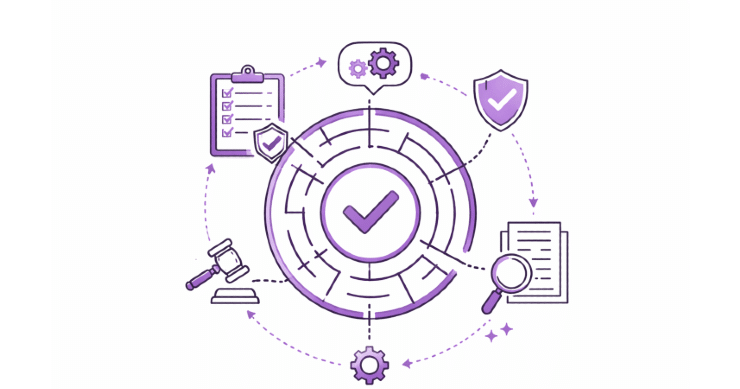
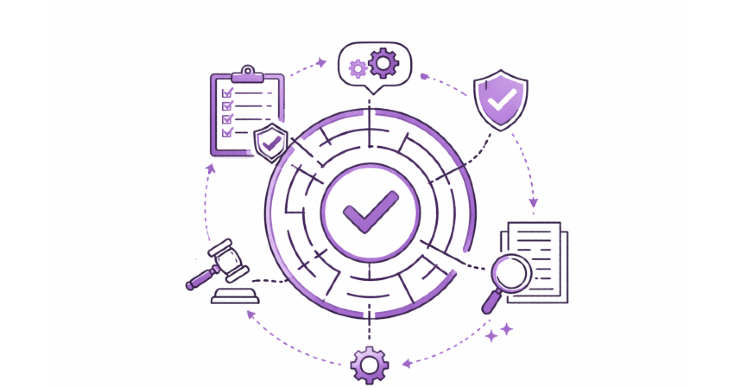
A compliance framework does not operate as seven separate parts. Its value comes from how these elements reinforce each other.
Governance sets direction and authority. Risk assessment defines priorities. Policies translate expectations. Controls embed safeguards into operations. Training aligns people with those safeguards. Monitoring provides evidence of performance. Issue management feeds lessons back into the system.
This creates a closed-loop model in which compliance is continuously guided, executed, evaluated, and refined. The framework becomes a living system rather than static documentation.
What is Framework Maturity?
Organizations often have some of these elements in place without a fully integrated framework. The difference lies in coordination and visibility.
In more mature environments:
- Leadership regularly reviews compliance risk alongside other enterprise risks
- Controls are clearly mapped to identified exposures
- Monitoring produces actionable insight, not just activity reports
- Issues lead to structural improvements, not only short-term fixes
Frequently Asked Questions
What is the purpose of a compliance framework?
A compliance framework provides the structure for managing regulatory and legal risk across the organization. It defines how responsibilities are assigned, how risks are prioritized, how controls are implemented, and how performance is monitored. Rather than responding to requirements individually, the framework enables a coordinated, system-based approach to compliance management frameworks.
How does a compliance framework differ from a set of policies and procedures?
Policies and procedures are components of a compliance program, but they do not constitute a framework on their own. A framework connects governance, risk assessment, controls, monitoring, and issue management into an integrated system. It ensures policies and procedures operate within a structured model that supports accountability, prioritization, and continuous oversight.
Why is risk assessment considered a core foundation of a compliance framework?
Risk assessment determines where regulatory exposure is most significant. It enables organizations to allocate resources and design controls based on potential impact rather than volume of requirements. This ensures compliance efforts are aligned with meaningful risk rather than distributed evenly across all obligations.
Can a single compliance framework support multiple regulations and standards?
Yes. A well-designed framework operates at a structural level, allowing policies, controls, and monitoring processes to address multiple regulatory requirements simultaneously. Specific obligations are mapped to the framework’s control structure, reducing duplication and improving consistency across compliance domains.
What role does leadership play in a compliance framework?
Leadership provides oversight and authority. Governance structures ensure compliance risk is visible in decision-making and that accountability is clearly defined. Without leadership involvement, compliance efforts may lack direction, prioritization, and escalation pathways.
How does monitoring strengthen a compliance framework?
Monitoring provides evidence about how controls perform in practice. It identifies gaps, emerging risks, and areas where processes may have drifted from design. This information supports informed decision-making and enables the framework to adapt over time.
Why is issue management considered part of the framework rather than a separate process?
Issue management supports learning and improvement. By analyzing root causes and implementing corrective actions, organizations strengthen their controls and reduce future exposure. This function ensures the framework evolves and remains aligned with operational realities.
How often should a compliance framework be reviewed?
Frameworks operate continuously and evolve through monitoring and issue management processes. Formal reviews are often conducted annually or when regulatory, operational, or organizational changes occur.
The post The 7 Essential Elements of a Compliance Framework You Need to Know appeared first on Centraleyes.
*** This is a Security Bloggers Network syndicated blog from Centraleyes authored by Rebecca Kappel. Read the original post at: https://www.centraleyes.com/the-7-essential-elements-of-a-compliance-framework-you-need-to-know/
如有侵权请联系:admin#unsafe.sh