
The Invisible Half of the Identity Universe
Identity used to live in one place - an LDAP directory, an HR system, a single IAM portal.
Not anymore. Today, identity is fragmented across SaaS, on-prem, IaaS, PaaS, home-grown, and shadow applications. Each of these environments carries its own accounts, permissions, and authentication flows.
Traditional IAM and IGA tools govern only the nearly managed half of this universe - the users and apps that have been fully onboarded, integrated, and mapped. Everything else remains invisible: the unverified, non-human, unprotected mass of identities we call identity dark matter.
Every new or modernized app demands onboarding - connectors, schema mapping, entitlement catalogs, and role modeling - work that consumes time, money, and expertise. Many applications never make it that far. The result is fragmentation: unmanaged identities and permissions operating outside corporate governance.
And beyond the human layer lies an even larger challenge - non-human identities (NHIs).
APIs, bots, service accounts, and agent-AI processes authenticate, communicate, and act across infrastructure - yet they're often untraceable, created and forgotten without ownership, oversight, or lifecycle controls, even for managed apps. These ungoverned entities form the deepest, most invisible layer of identity dark matter, one that no traditional IAM tool was ever designed to manage.
The Components of Identity Dark Matter
As organizations modernize, the identity landscape fragments into several high-risk categories:
- Unmanaged Shadow Apps: Applications that operate outside corporate governance due to the time and cost of traditional onboarding.
- Non-Human Identities (NHIs): A rapidly expanding layer including APIs, bots, and service accounts that act without oversight.
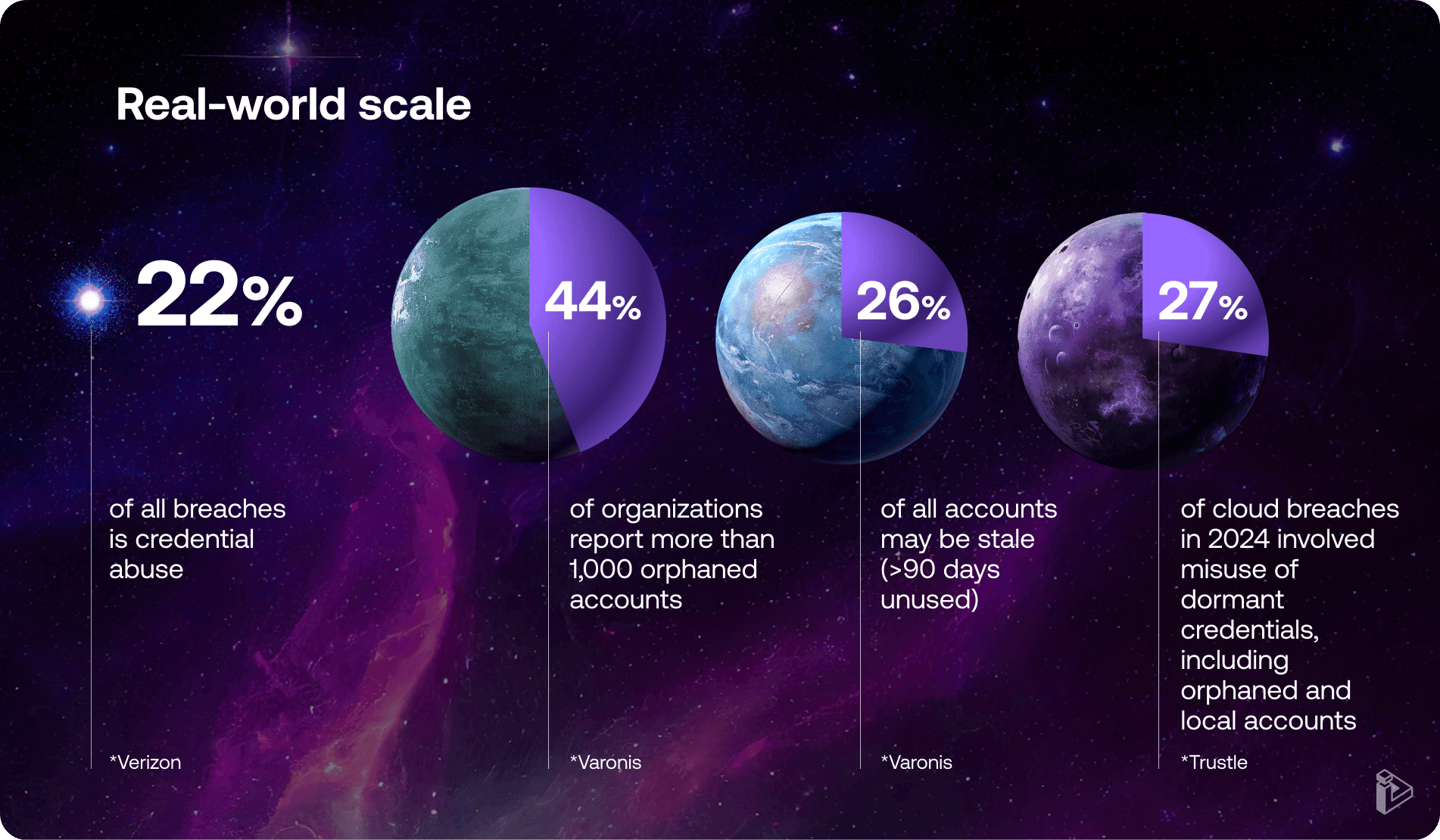
- Orphaned and Stale Accounts: 44% of organizations report over 1,000 orphaned accounts, and 26% of all accounts are considered stale (unused for >90 days).
- Agent-AI Entities: Autonomous agents that perform tasks and grant access independently, breaking traditional identity models.

Why Identity Dark Matter is a Security Crisis
The growth of these ungoverned entities creates significant "blind spots" where cyber risks thrive. In 2024, 27% of cloud breaches involved the misuse of dormant credentials, including orphaned and local accounts.
The primary risks include:
- Credential Abuse: 22% of all breaches are attributed to the exploitation of credentials.
- Visibility Gaps: Enterprises cannot evaluate what they cannot see, leading to an "illusion of control" while risks grow.
- Compliance & Response Failures: Unmanaged identities sit outside audit scopes and slow down incident response times.
- Hidden Threats: Dark matter masks lateral movement, insider threats, and privilege escalation.

Download the Identity Dark Matter Buyer's Guide
To navigate these hidden risks and bridge the gap between IAM and unmanaged systems, download our Identity Dark Matter Buyer's Guide. Learn how to identify critical visibility gaps and select the right tools to secure your entire identity perimeter.
Solving the Problem: From Configuration to Observability
To eliminate identity dark matter, organizations must shift from configuration-based IAM to evidence-based governance. This is achieved through Identity Observability, which provides continuous visibility across every identity.
According to the Orchid Perspective, the future of cyber resilience requires a three-pillar approach:
- See Everything: Collect telemetry directly from every application, not just standard IAM connectors.
- Prove Everything: Build unified audit trails that show who accessed what, when, and why.
- Govern Everywhere: Extend controls across managed, unmanaged, and agent-AI identities.
By unifying telemetry, audit, and orchestration, enterprises can transform identity dark matter into actionable, measurable truth.
The Orchid Security Perspective
At Orchid Security, we believe the future of cyber resilience lies in an identity infrastructure that operates like observability for compliance and security:
seeing how identity is coded, how it's used, and how it behaves.
By unifying telemetry, audit, and orchestration, Orchid enables enterprises to turn hidden identity data into actionable truth - ensuring that governance is not claimed, but proven.
Note: This article was written and contributed by Roy Katmor, CEO of Orchid Security.
Found this article interesting? This article is a contributed piece from one of our valued partners. Follow us on Google News, Twitter and LinkedIn to read more exclusive content we post.