
好的,我现在需要帮用户总结一篇文章的内容,控制在100字以内。用户已经提供了文章的详细内容,所以我得先仔细阅读并理解文章的主要信息。 首先,文章标题是关于MongoDB的一个漏洞,叫做MongoBleed。看起来这是一个内存泄漏的问题。文章提到这个漏洞已经被公开,并且已经有利用代码在GitHub上发布了。这可能意味着攻击者已经开始利用这个漏洞了。 接下来,文章提到受影响的MongoDB版本很多,从3.6到8.2都有涉及。攻击者可以通过这个漏洞获取敏感数据,比如凭证、会话令牌和API密钥。这可能对很多依赖MongoDB的企业来说是个严重的问题。 然后,解决方案部分提到MongoDB已经发布了补丁,并建议用户升级到特定的版本。如果无法立即升级,可以禁用zlib压缩作为临时措施。此外,限制MongoDB实例的网络访问也是推荐的做法。 最后,文章还提到了一些资源和工具,比如Tenable的插件和Censys的数据,帮助用户检测受影响的系统。 现在我需要将这些信息浓缩到100字以内。重点包括:漏洞名称、影响范围、已发布的利用代码、敏感数据泄露风险、建议的补丁和临时措施。 可能的结构是:MongoBleed漏洞影响多个版本的MongoDB,已公开利用代码,可能导致敏感数据泄露。建议立即升级或禁用zlib压缩,并限制访问以降低风险。 检查一下字数是否在限制内,并确保所有关键点都被涵盖。 </think> MongoBleed是一种影响多个版本MongoDB的内存泄漏漏洞,已公开利用代码且可能泄露敏感数据如凭证和API密钥。建议立即升级到修复版本或禁用zlib压缩以降低风险。 2025-12-29 16:9:5 Author: www.tenable.com(查看原文) 阅读量:41 收藏
December 29, 2025
3 Min Read

A recently disclosed vulnerability affecting MongoDB instances has been reportedly exploited in the wild. Exploit code has been released for this flaw dubbed MongoBleed.
Key takeaways:
- MongoBleed is a memory leak vulnerability affecting multiple versions of MongoDB.
- Exploitation of MongoDB has been observed and exploit code is publicly available .
- Immediate patching is recommended as the combination of public exploit code and a high number of potentially affected internet connected instances make this a flaw attackers will be targeting.
Background
On December 19, MongoDB issued a security advisory to address a vulnerability affecting the zlib implementation of MongoDB.
| CVE | Description | CVSSv3 | VPR |
|---|---|---|---|
| CVE-2025-14847 | MongoDB Uninitialized Memory Leak Vulnerability (“MongoBleed”) | 7.5 | 8.0 |
*Please note: Tenable’s Vulnerability Priority Rating (VPR) scores are calculated nightly. This blog post was published on December 29 and reflects VPR at that time.
Analysis
CVE-2025-14847 is a memory leak vulnerability affecting MongoDB instances in which zlib compression is enabled. A flaw in how MongoDB implements zlib decompression could allow unauthenticated attackers to leak uninitialized memory, which can contain sensitive data including credentials, session tokens and API keys. This flaw was dubbed “MongoBleed” by Elastic Security researcher Joe Desimone, who published a proof-of-concept demonstrating the vulnerability. While exploitation does require zlib compression to be enabled and a vulnerable MongoDB version to be internet exposed, reports of in the wild exploitation have already begun.
According to Censys, there are over 87,000 potentially vulnerable instances of MongoDB that have been identified, with the largest concentration being found in the United States.
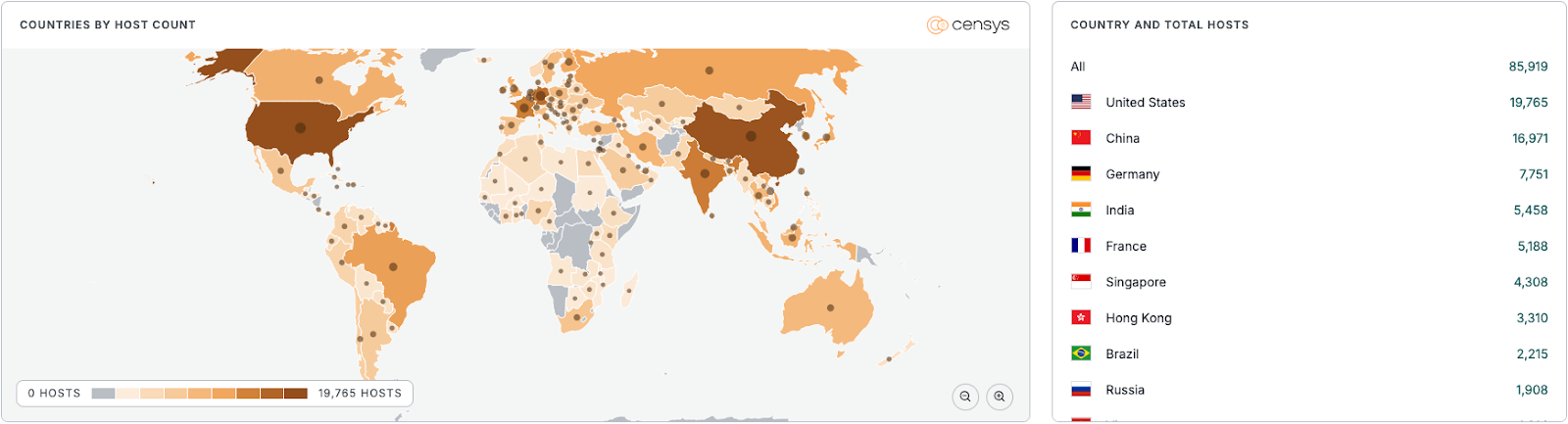
Source: Censys
Proof of concept
On December 25, a public proof-of-concept (PoC) was released on GitHub. This PoC demonstrates how data can be leaked from uninitialized memory. According to the PoC details, the following data could be leaked:
- MongoDB internal logs and state
- WiredTiger storage engine configuration
- System /proc data (meminfo, network stats)
- Docker container paths
- Connection UUIDs and client IPs
Solution
MongoDB has released patches to address this vulnerability as outlined in the table below:
| Affected Version | Fixed Version |
|---|---|
| MongoDB Server v3.6 (All Versions) | Upgrade to MongoDB 8.2.3, 8.0.17, 7.0.28, 6.0.27, 5.0.32, 4.4.30 or later |
| MongoDB Server v4.0 (All Versions) | Upgrade to MongoDB 8.2.3, 8.0.17, 7.0.28, 6.0.27, 5.0.32, 4.4.30 or later |
| MongoDB Server v4.2 (All Versions) | Upgrade to MongoDB 8.2.3, 8.0.17, 7.0.28, 6.0.27, 5.0.32, 4.4.30 or later |
| MongoDB 4.4.0 through 4.4.29 | Upgrade to MongoDB 4.4.30 or later |
| MongoDB 5.0.0 through 5.0.31 | Upgrade to MongoDB 5.0.32 or later |
| MongoDB 6.0.0 through 6.0.26 | Upgrade to MongoDB 6.0.27 or later |
| MongoDB 7.0.0 through 7.0.26 | Upgrade to MongoDB 7.0.28 or later |
| MongoDB 8.0.0 through 8.0.16 | Upgrade to MongoDB 8.0.17 or later |
| MongoDB 8.2.0 through 8.2.2 | Upgrade to MongoDB 8.2.3 or later |
According to the MongoDB security advisory, if immediate patching is not able to be performed, the workaround suggestion is to disable zlib compression. In addition, we recommend that you limit network access to MongoDB instances to trusted IP addresses only. While this step was not outlined in the advisory, it has been recommended as a security best practice by MongoDB.
Identifying affected systems
A list of Tenable plugins for this vulnerability can be found on the individual CVE page for CVE-2025-14847 as they’re released. This link will display all available plugins for this vulnerability, including upcoming plugins in our Plugins Pipeline.
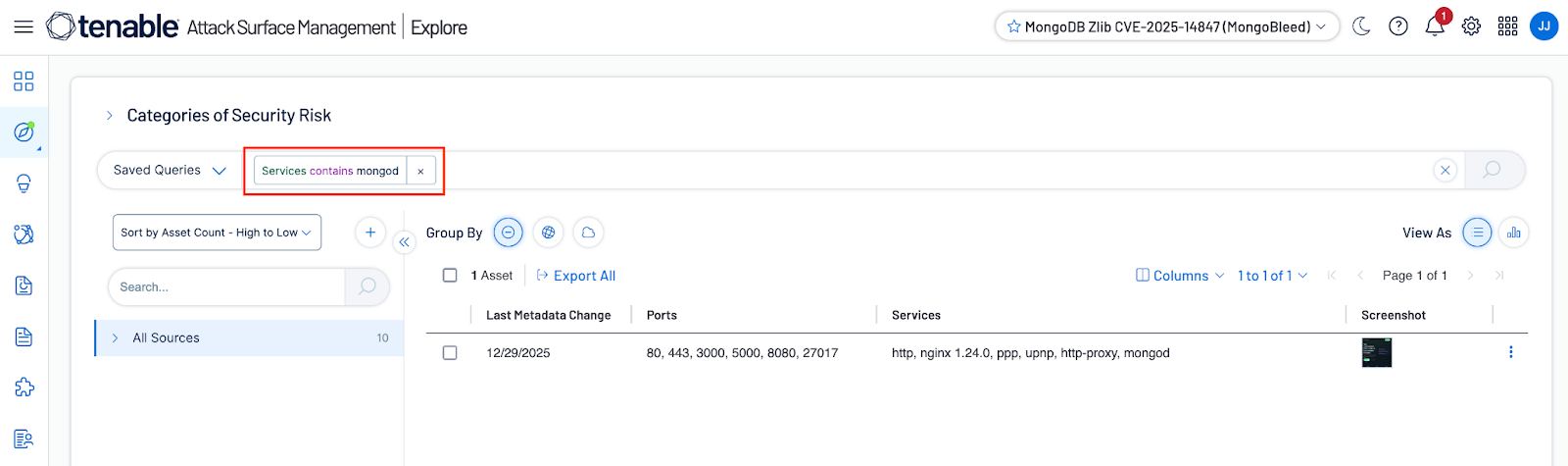
Tenable Attack Surface Management customers are able to identify assets running MongoDB services by using the filter 'Services contains mongod' as shown in the screenshot below:
Get more information
- MongoDB Security Advisory
- Censys: MongoBleed - Critical MongoDB Uninitialized Memory Disclosure Vulnerability [CVE-2025-14847]
Join Tenable's Research Special Operations (RSO) Team on Tenable Connect and engage with us in the Threat Roundtable group for further discussions on the latest cyber threats.
Learn more about Tenable One, the Exposure Management Platform for the modern attack surface.

Scott Caveza
Senior Staff Research Engineer, Research Special Operations
Scott joined Tenable in 2012 as a Research Engineer on the Nessus Plugins team. Over the years, he has written hundreds of plugins for Nessus, and reviewed code for even more from his time being a team lead and manager of the Plugins team. Previously leading the Security Response team and the Zero Day Research team, Scott is currently a member of the Research Special Operations team, helping the research organization respond to the latest threats. He has over a decade of experience in the industry with previous work in the Security Operations Center (SOC) for a major domain registrar and web hosting provider. Scott is a current CISSP and actively maintains his GIAC GWAPT Web Application Penetration Tester certification.
Interests outside of work: Scott enjoys spending time with his family, camping, fishing and being outdoors. He also enjoys finding ways to break web applications and home renovation projects.
- Exposure Management
- Vulnerability Management
Cybersecurity news you can use
Enter your email and never miss timely alerts and security guidance from the experts at Tenable.
如有侵权请联系:admin#unsafe.sh