好的,我现在需要帮用户总结一篇文章的内容,控制在100字以内。用户给的文章是关于NIST CSF 2.0和组织变革管理(OCM)的整合。首先,我得通读文章,抓住主要观点。 文章开头提到NIST CSF 2.0定义了目标,而OCM决定了这些目标是否能实现。接着详细说明了OCM的五个支柱:利益相关者参与、领导力对齐、基于价值的沟通、基于角色的培训以及阻力管理和强化。然后,文章讨论了如何将OCM应用到CSF的六个功能中,并提供了实施步骤和领导行动建议。 用户要求总结控制在100字以内,不需要特定开头。我需要提炼关键点:NIST CSF 2.0的目标、OCM的重要性、五个支柱、应用到六个功能以及实施步骤和领导角色。 可能的结构是:介绍CSF 2.0和OCM的关系,提到五个支柱,说明如何应用到六个功能,并强调领导的作用。这样在100字内能涵盖主要信息。 </think> 文章探讨了如何将组织变革管理(OCM)与NIST网络安全框架(CSF)2.0相结合,以确保安全措施的有效实施。通过明确领导责任、员工培训和沟通机制等OCM方法,企业能够将CSF 2.0的功能转化为可持续的操作习惯,并通过定期评估和改进实现更好的风险管理和文化转变。 2025-12-29 18:53:10 Author: levelblue.com(查看原文) 阅读量:1 收藏
3 Minute Read
Executive Summary NIST CSF 2.0 defines what must be achieved; Organizational Change Management (OCM) determines whether it becomes real. Security programs stall not because the framework is unclear, but because leadership behavior, ownership, and workforce adoption weren’t designed and measured from the start. This article shows how to integrate OCM practices into each CSF 2.0 function: Govern, Identify, Protect, Detect, Respond, and Recover to ensure that control intent converts into repeatable, auditable performance (NIST, 2024). We ground our guidance based on our collective experience and applied research on organizational change and adoption, cybersecurity culture, and executive governance. NIST CSF 2.0 is an outcomes framework: Specifies risk-based outcomes and organizes them into six functions, but does not prescribe execution mechanisms (NIST, 2024; NIST SP 1299). OCM aligns leaders, roles, incentives, communications, and training with improved outcomes to measure and defend. Why OCM is non-optional: Independent research shows a strong, repeatable correlation between change-management quality and program success. Prosci reports that initiatives with effective change management are ~6–7× more likely to meet objectives than those with poor change management (2024). In practice, that translates into faster policy adoption, fewer exceptions, and tighter audit cycles. Effective OCM is not “communications.” It is a controlled transition from current state to target state based on five pillars: ISACA’s guidance on integrating change management with cybersecurity echoes these mechanisms: merge change methodology with cyber procedures and integrate and embed cybersecurity training and awareness into cybersecurity program planning and culture, not as an afterthought (ISACA, 2025). Key point: OCM turns each function into a repeatable operating habit. Without it, “adoption” remains an assumption. Key Point: Practical heuristic: treat behavior as a control. If you can’t measure it, you can’t rely on it in a crisis. Use the steps below to convert your current cybersecurity program plan into an OCM-enabled execution plan without adding bureaucratic overhead. Step 1: Govern - Map Owners and Decisions Step 2: Identify/Protect - Design for Adoption Step 3: Detect/Respond - Practice Under Stress Step 4: Recover - Institutionalize Learning David L. Bevett, PhD ABD, MPH, MAOC, CCSFP, CHQP — vCISO, Change Agent, Sr. Cybersecurity Consultant at LevelBlue specializing in Governance, Risk, and Compliance, Program Leadership, and Organizational Change Management. Carisa Garvalia Brockman, CISSP, CIPM, CDPSE, CCSFP, CCSKv5 — Governance, Risk, and Compliance Practice Leader at LevelBlue; two decades leading enterprise GRC programs aligned to NIST, ISO 27001, CIS, and privacy regulations.1) Bridging the Framework and the Enterprise
2) OCM: A Structured Discipline for Cyber Programs
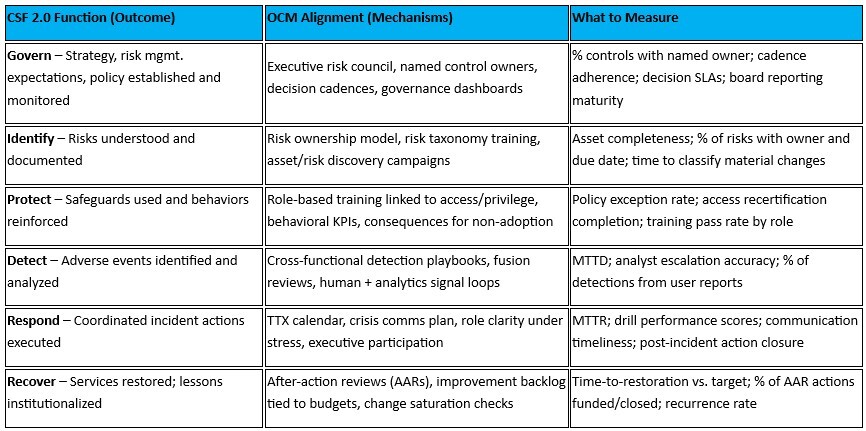
3) OCM Alignment Across the Six NIST CSF 2.0 Functions
4) Case-Based Patterns - What We See in the Field
5) Implementation Guide: Making OCM the “How” of CSF 2.0
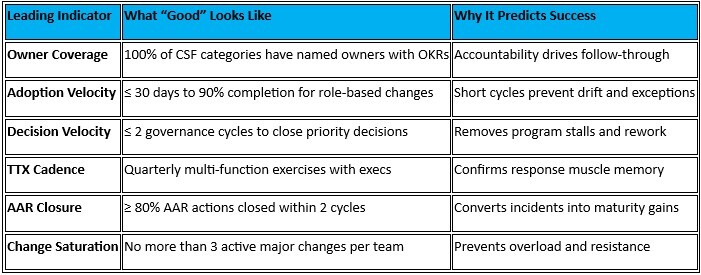
6) Meta-Analysis: OCM Signals That Predict CSF Success
7) Leadership Actions: What CISOs, CIOs, and Boards Should Do Now
Author Profiles
References & Applied Research
如有侵权请联系:admin#unsafe.sh