
好的,我现在需要帮用户总结一篇文章的内容,控制在100字以内,并且不需要特定的开头。首先,我得仔细阅读用户提供的文章内容,理解其主要观点。 文章主要讨论了大型语言模型(LLMs)在快速发展的同时面临的安全问题。政府和监管机构正在制定政策来确保LLMs的安全合规。文章还详细介绍了NSFOCUS提出的四层防御体系,包括合规验证、多维评估、深度防御和标准化运营。 接下来,我需要将这些要点浓缩到100字以内。要确保涵盖关键点:LLMs的广泛应用、安全问题的重要性、四层防御体系以及合规与安全的重要性。 可能的结构是先点出主题,然后简要说明解决方案。例如:“随着大型语言模型(LLMs)的广泛应用,安全问题日益突出。NSFOCUS提出四层防御体系,涵盖合规验证、多维评估、深度防御和标准化运营,以确保AI系统的安全与合规。” 这样既简洁又全面地涵盖了文章的核心内容。 </think> 随着大型语言模型(LLMs)的广泛应用,安全问题日益突出。NSFOCUS提出四层防御体系,涵盖合规验证、多维评估、深度防御和标准化运营,以确保AI系统的安全与合规。 2025-12-17 07:38:22 Author: securityboulevard.com(查看原文) 阅读量:5 收藏
As Artificial Intelligence technology rapidly advances, Large Language Models (LLMs) are being widely adopted across countless domains. However, with this growth comes a critical challenge: LLM security issues are becoming increasingly prominent, posing a major constraint on further development.
Governments and regulatory bodies are responding with policies and regulations to ensure the safety and compliance of LLM development, deployment, and application. Organizations must strengthen their LLM security defenses to ensure application safety.
We offer a robust, multi-layered approach to protect your AI assets:
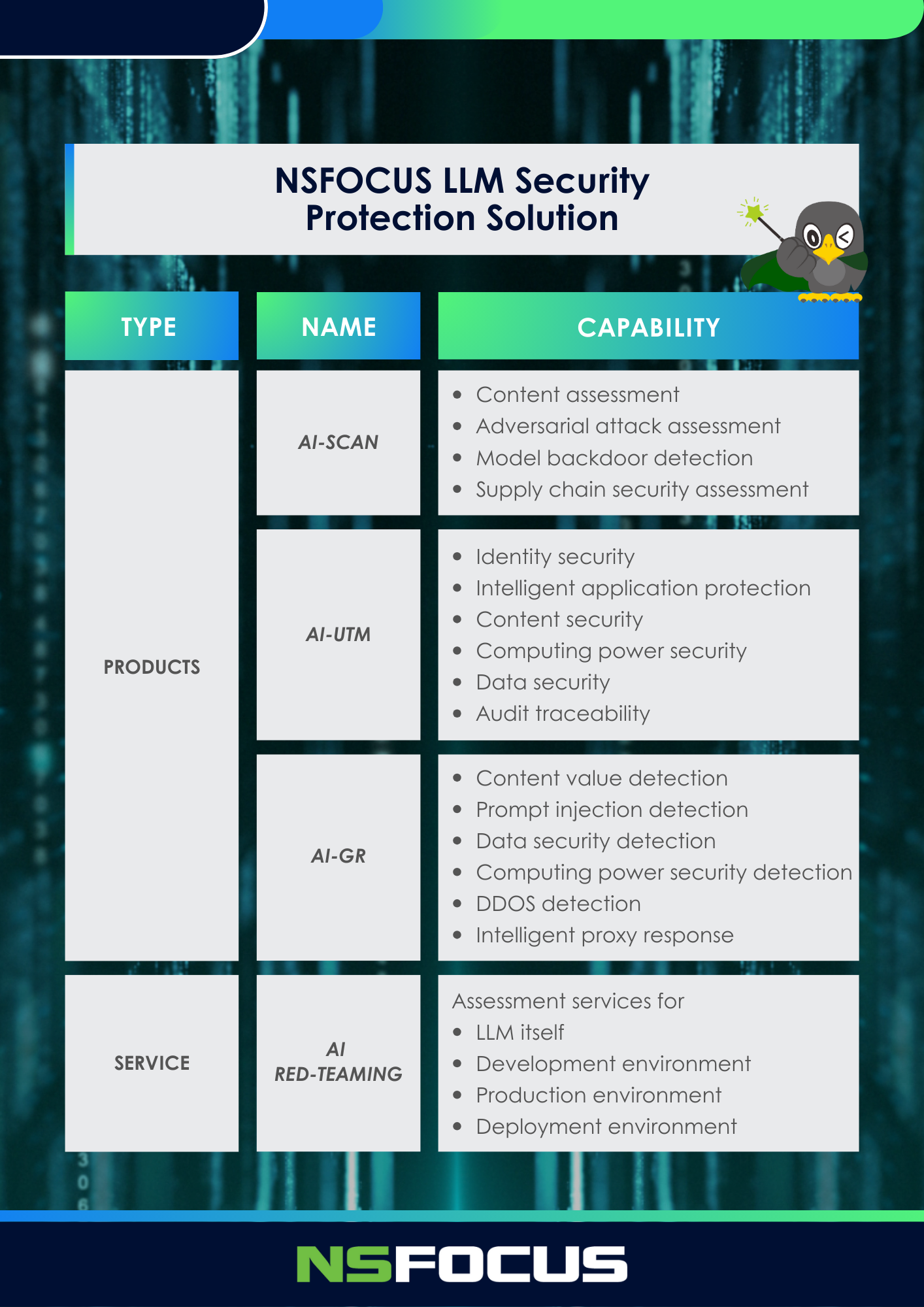
Security is no longer just a “feature”—it is the foundation of the entire ecosystem. By implementing a “Four-Layer Defense” across the three critical stages of the AI lifecycle, we rebuild trust and ensure that every AI inference can withstand rigorous scrutiny.
Layer 1: Compliance & Validation – Safeguarding Model Selection and Development
Model Selection Optimization: Whether procuring commercially licensed LLM services (subject to risk assessment and regulatory filing) or deploying open-source models, comprehensive integrity checks and security testing on model code and components are mandatory.
Building AI-SBOM: Construct a precise AI Software Bill of Materials (SBOM). By conducting deep analysis of all dependencies within the AI system, organizations can identify latent vulnerabilities and provide a solid foundation for secure operation, compliance, and continuous optimization.
Corpus Assurance: Address risks such as data poisoning, privacy leakage, IP infringement, and algorithmic bias. Utilize automated evaluation tools to filter and desensitize training data and RAG (Retrieval-Augmented Generation) knowledge bases, stripping out illegal content and sensitive PII (Personally Identifiable Information).
Layer 2: Multi-Dimensional Evaluation – Ensuring Secure Deployment
Automated Compliance Testing: Deploy LLM risk assessment systems (e.g., AI-SCAN) to evaluate content safety, adversarial robustness, supply chain security, and model backdoors.
Risk Assessment Framework: Conduct high-risk scenario assessments based on the OWASP Top 10 for LLMs, covering model, data, content, application, runtime, and supply chain security.
AI Red-Teaming: Adopt an attacker’s perspective to systematically probe the LLM lifecycle. By identifying structural flaws and defense gaps, Red Teaming provides actionable remediation to ensure LLM applications remain controllable in complex environments.
Layer 3: Defense-in-Depth – Building a Full-Scenario Security Architecture
Infrastructure Protection: Implement centralized security management for LLM applications. This includes continuous monitoring of hardware/software stacks, vulnerability patching, network isolation, and strict access control (disabling non-essential ports and services).
Multi-Level Authentication: Implement robust Identity and Access Management (IAM) for both human users and AI Agents. Enforce the Principle of Least Privilege (PoLP) and rate-limiting to prevent high-risk exploits.
Multi-Tiered Guardrails: Deploy AI-Guardrails products using multi-dimensional detection models, these guardrails intercept toxic content, harmful Q&A, and prompt injections, ensuring the practical implementation of content compliance and data protection.
AI-Native Application Security: Develop precise traffic parsing to identify anomalous access patterns. Monitor application behavior to block malicious operations and implement full-lifecycle API management to prevent data exfiltration.
Data Loss Prevention (DLP): Deploy advanced DLP capabilities to monitor LLM inputs and outputs. This includes blocking prompt injection attacks, intercepting sensitive data, and applying dynamic masking to create a controllable data flow.
Layer 4: Standardized Operations – Sustaining Long-Term AI Security
Security Governance Framework: Establish AI security policies aligned with business goals. Define standard operating procedures (SOPs) for corpus management, application development, and emergency response.
Security Posture Monitoring: Continuously monitor AI assets and runtime behaviors. Enhance audit capabilities and attack path analysis to improve the identification and mitigation of LLM-related risks.
AI Supply Chain Management: Conduct internal and external audits in accordance with regulations. Standardize procurement, implement real-time monitoring/alerting, and conduct regular emergency drills to ensure rapid incident recovery.
Regulatory Alignment: Ensure compliance regarding algorithm filing and service registration. Utilize professional services for compliance auditing and manual content review.
Protecting your LLMs is non-negotiable. Let’s ensure your AI innovation is secure, compliant, and reliable.
The post Securing the AI Revolution: NSFOCUS LLM Security Protection Solution appeared first on NSFOCUS, Inc., a global network and cyber security leader, protects enterprises and carriers from advanced cyber attacks..
*** This is a Security Bloggers Network syndicated blog from NSFOCUS, Inc., a global network and cyber security leader, protects enterprises and carriers from advanced cyber attacks. authored by NSFOCUS. Read the original post at: https://nsfocusglobal.com/securing-the-ai-revolution-nsfocus-llm-security-protection-solution/
如有侵权请联系:admin#unsafe.sh