文章探讨了MSP和MSSP整合趋势及成功要素,指出明确目标客户、标准化安全套餐、服务质量和透明计费是关键。只有少数供应商具备扩展价值,需注重运营细节和客户体验。 2025-12-5 13:33:0 Author: raffy.ch(查看原文) 阅读量:11 收藏

Everyone is suddenly looking at MSP and MSSP rollups. Investors, strategics, even VCs. The logic is obvious. Fragmented market, recurring revenue, sticky customer relationships. But the reality is that only a small subset of providers actually operate at a level worth scaling. The difference between an average MSSP and a good one comes down to a few fundamentals.
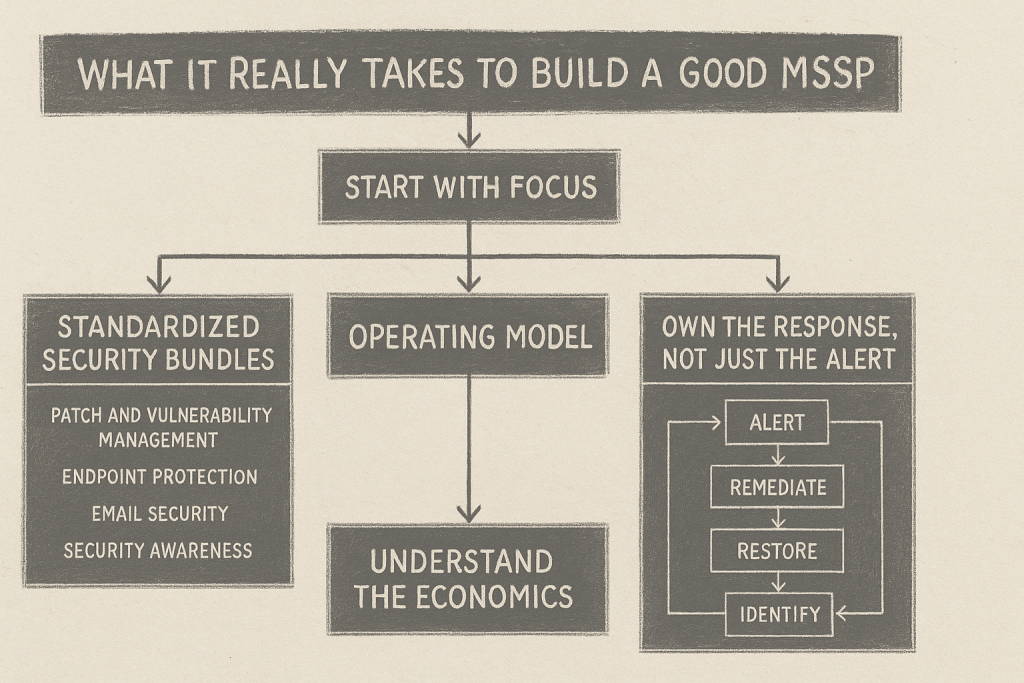
Start With Focus
Most MSPs never defined who they serve. They grew organically, took whatever customer showed up, and built a toolkit around individual fires rather than a repeatable model. A strong MSSP starts with clarity. Who is the ICP. What problem is being solved. What the operating model looks like for that segment. When this is missing, everything becomes random. Different tools. Different service quality. No leverage.
Understand the Economics
Many MSPs think software licensing is their main cost. It is not. Labor dominates the model. At ConnectWise, our Service Leadership dataset showed that roughly 20 percent of MSPs were not profitable because they simply did not understand their own cost structure. The best ones hit around 20 to 25 percent EBITDA. They standardize. They price correctly. They run the business with discipline instead of firefighting.
Standardized Security Bundles Win
The MSSPs that scale do not let customers choose their own adventure. They define a required stack. If you want to be a customer, you adopt their bundle. This gives consistency, predictability, and actual security outcomes. A typical bundle includes:
• Patch and vulnerability management
• Endpoint protection
• Email security
• Security awareness
• Optional SIEM or MDR depending on the segment
Without standardization, you cannot maintain margins or guarantee service quality. You also make incident response dramatically harder because every environment looks different.
Service Quality Is the Product
SMBs want to be secure. They want minimal disruption. And when something goes wrong, they want a real human who knows what they are doing. Not tier 1 scripts. Not delays during an active incident. Good MSSPs prepare the customer during onboarding. They map critical systems, define escalation paths, understand what can be taken offline, and capture credentials and architecture details. They remove the guesswork from the moment the incident starts.
Billing Needs To Be Simple
One of the fastest ways to lose customers is confusing invoices. Customers want to understand what they pay for. Surprises create distrust. The MSSPs that retain well keep billing predictable, transparent, and boring.
Own the Response, Not Just the Alert
An MDR or MSSP that only notifies customers creates frustration. The provider must take the customer through remediation. For SMBs, response often means restoring operations, identifying the entry point, and closing the gap. If the MSSP cannot do this internally, it must have reliable partners.
How Rollups Actually Create Value
Rollups only work when there is a clear thesis. Some focus on platform unification and a single delivery model. Others focus on professionalizing the business with better hiring, benefits, pricing, and operational rigor. Both paths can work. But they require patience and real operating muscle.
Cross border rollups in Europe introduce more complexity. Language and local relationships matter. Regulation varies. Centralizing delivery is possible, but customer interaction often stays local. A standardized platform can still work if the ICP is consistent across regions.
The Microsoft Factor
Many SMBs already own security features through M365. Ignoring this leads to bloated stacks and poor pricing. Smart MSSPs align their offering with what customers already have and fill the real gaps.
The Bottom Line
Building a strong MSSP is not mysterious. It requires a defined ICP, a standardized security bundle, disciplined delivery, true incident readiness, transparent billing, and the ability to take customers all the way to resolution. The providers that do these things consistently are the ones worth scaling. Investors often chase the rollup story, but the real value sits inside the boring operational fundamentals that most of the market never gets right.
No comments yet.
如有侵权请联系:admin#unsafe.sh