React团队披露了影响React Server Components的严重漏洞CVE-2025-55182,允许未认证远程代码执行。该漏洞影响广泛,涉及16.8万个依赖项和超5千万周下载量。攻击者可借此下载恶意软件或控制受影响系统。修复版本已发布,建议立即升级以缓解风险。 2025-12-4 18:1:48 Author: flashpoint.io(查看原文) 阅读量:48 收藏
The React team disclosed a critical vulnerability impacting three products in the React Server Components (RSC) that allows for unauthenticated remote code execution.
Flashpoint’s vulnerability research team assesses significant enterprise and supply chain risk given React’s ubiquity: the impacted JavaScript library underpins modern UIs, with 168,640 dependents and more than 51 million weekly downloads.
How CVE-2025-55182 Works
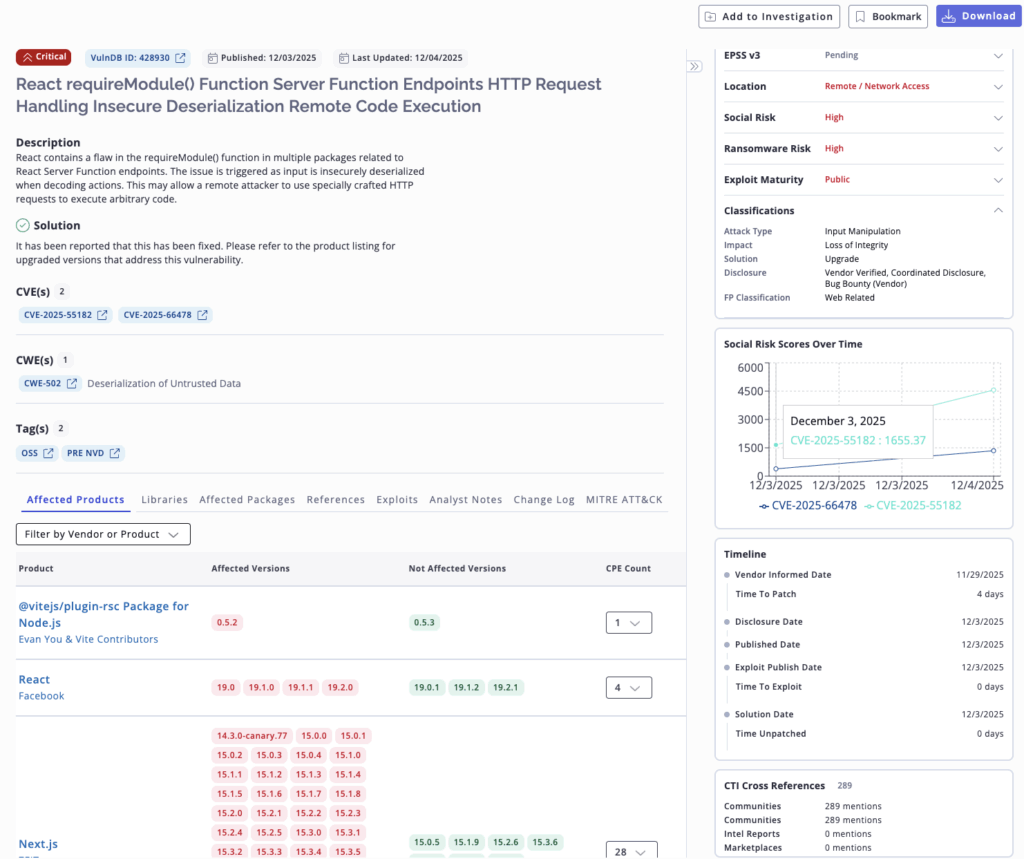
CVE-2025-55182 (VulnDB ID: 428930) impacts all React versions since 19.0.0, meaning that this issue has been potentially exploitable since November 14, 2024. This vulnerability stems from how React handles payloads sent to React Server Function endpoints and deserializes them.

Depending on the implementation of this library, a remote, unauthenticated threat actor could send a crafted payload that would be deserialized in a way that causes remote code execution. This would lead to a total compromise of the system hosting the application, allowing for malware such as infostealers, ransomware, or cryptojackers (cryptocurrency mining) to be downloaded.
Flashpoint notes that attackers are already attempting to widely exploit CVE-2025-55182 in the wild. Our analysts have matched many new signatures with naive PoCs (proof-of-concepts) targeting both new honeypots and production assets.
Understanding the Impact and Scope of CVE-2025-55182
It is critical that security teams fully understand the potential downstream scope and impact so that they can fully focus on mitigation, rather than time-consuming research. While the vendor has provided a full disclosure, there are several important caveats to understand about CVE-2025-55182:
- Applications not implementing any React Server Function endpoints may still be vulnerable as long as it supports React Server Components.
- If an application’s React code does not use a server, it is not affected by this vulnerability.
- Applications that do not use a framework, bundler, or bundler plugins that support React Server Components are unaffected by this vulnerability.
Additionally, several React frameworks and bundlers have been discovered to leverage vulnerable React packages in various ways. The following frameworks and bundlers are known to be affected:
- next
- react-router
- waku
- @parcel/rsc
- @vitejs/plugin-rsc
- rwsdk
NPMJS.com currently shows that the react-dom package, which is effectively part of React, has 168,640 dependents. This means that an incredible number of enterprise applications are likely to be affected. Nearly every commercial application is built on hundreds, sometimes thousands of components and dependencies. Furthermore, applications coded via Vibe and similar technology are also likely to leverage React: potentially amplifying the downstream risk this vulnerability poses.
How to Mitigate CVE-2025-55182
For mitigation, the React library has released versions 19.0.1, 19.1.2, and 19.2.1 that resolve the issue. Flashpoint advises organizations to upgrade their respective libraries urgently. Security teams leveraging dynamic SBOMs (Software Bill of Materials) can drastically increase risk mapping and triage for deployed React versions.
CloudFlare has upgraded their web-application firewall (WAF) to protect against CVE-2025-55182. It is available for both free and paid plans but requires that React application traffic is proxied through the CloudFlare WAF.
Mitigate Critical Vulnerabilities Using Flashpoint
Flashpoint strongly recommends security teams treat this vulnerability with utmost urgency. Our vulnerability research team will continue to monitor this vulnerability and its downstream impacts. All updates will be provided via Flashpoint’s VulnDB.
Request a demo today and gain access to quality vulnerability intelligence that helps address critical threats in a timely manner.
如有侵权请联系:admin#unsafe.sh