杰基·阮在ISC实习期间发现了一次复杂的网络攻击:攻击者通过SSH暴力破解进入其honeypot,并上传了一个伪装成OpenSSH守护进程的恶意软件。该恶意软件具备长期持久性和高级隐蔽性,分析显示其利用多种MITRE ATT&CK技术。事件强调了威胁行为者的复杂性及防范措施的重要性。 2025-12-4 02:34:40 Author: isc.sans.edu(查看原文) 阅读量:39 收藏
[This is a Guest Diary by Jackie Nguyen, an ISC intern as part of the SANS.edu BACS program]
The ISC internship didn't just teach me about security, it changed how I thought about threats entirely. There's something intriguing about watching live attacks materialize on your DShield Honeypot, knowing that somewhere across the world, an attacker just made a move. And the feedback loop of writing detailed attack observations, then having experienced analysts critique and refine your analysis? That's where real learning happens. One attack observation in particular stands out as a perfect example of what makes this internship so powerful. Let me show you what I discovered!
The Beginning…
On November 10, 2025, my honeypot captured very interesting activity that really demonstrates how evolved modern threat actors are getting. What initially appeared to be a simple, but successful SSH brute force attempt quickly revealed itself as something far more concerning, a deployment of an advanced trojan designed for long-term persistence and evasion.
What happened?
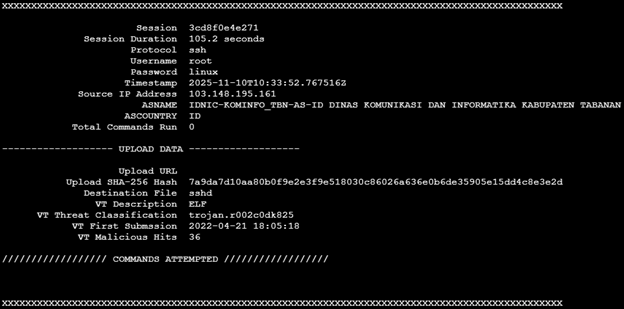
Suspicious activity was detected when the IP address 103[.]148[.]195[.]161 successfully SSH’d into my honeypot using the credentials username “root” and password “linux”. The bad actor maintained access to the honeypot for 1 minute and 45 seconds but ultimately ran no commands. Instead, the attacker uploaded a single file, a trojan binary named “sshd” designed to evade security detections by pretending to be the OpenSSH daemon. It was an Executable and Linkable Format (ELF) binary (7a9da7d10aa80b0f9e2e3f9e518030c86026a636e0b6de35905e15dd4c8e3e2d) that was classified as malicious by VirusTotal and Hybrid-Analysis.
We won’t be able to see what the Trojan did on my honeypot at this time, however, I found the hash on Hybrid-Analysis and got a good idea of what the trojan does.
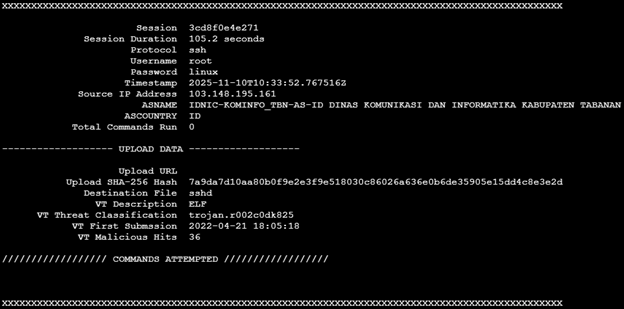
A screenshot of the cowrie output using Jesse La Grew’s cowrieprocessor [4]
Trojan File Analysis

MITRE ATT&CK MAPPING
• T1078 - Valid Accounts
• T1110.001 - Brute Force
• T1204.002 - User Execution
• T1036.005 - Masquerading
• T1554 - Compromise Client Software Binary
• T1548.001 - Abuse Elevation Control Mechanism
• T1027 - Obfuscated Files or Information
• T1497 - Virtualization/Sandbox Evasion
• T1480 - Execution Guardrails
• T1003.008 - OS Credential Dumping
Prevent Similar Attacks
1. Disable Password Authentication and utilize SSH keys instead
2. IP Allowlisting
3. IDS/IPS/EDR
4. Threat Hunting
5. MFA
What does this show?
This really shows how much effort sophisticated attackers would put in for long-term persistence and advanced evasion. Attacks from a government IP address doesn’t always mean it’s the government; it more than likely would mean that they were compromised. If you think about it logically, why would a nation-state threat actor use their actual government IP address to execute attacks?
Importance?
It’s important when working on a high performing security team to not attribute attacks to the wrong threat actor. Politically, this may cause problems, especially if the company you’re working for has a large media presence. Problems including wrongful retaliation and political tension could arise from making this mistake.
This attack also shows how threat actors use legitimate processes to blend in with normal ones. We must remember that the goal of this attacker is most likely long-term so they will do everything they can to evade your defenses.
Actionable Intelligence for Defenders
Threat hunting is a critical part of any security program and having concrete Indicators of Compromise (IOCs) like file hashes, malicious IP addresses, and more would give teams actionable intelligence to use immediately. This observation also helps defenders understand what to look for. Brief sessions without commands can be just as dangerous as those with suspicious activity.
Key Takeaways
This attack really shows how threat actors are getting more sophisticated. By uploading a legitimate looking trojan instead of running commands, the attacker could have avoided the typical red flags most monitoring tools look for. The use of a government IP address also teaches us an important lesson not to immediately jump to conclusions solely based on IP block owner since it might have been compromised. For analysts out there, what seems to be a quiet session can sometimes be the most dangerous.
[1] https://www.virustotal.com/gui/file/7a9da7d10aa80b0f9e2e3f9e518030c86026a636e0b6de35905e15dd4c8e3e2d/detection
[2 ]https://www.abuseipdb.com/whois/103.148.195.161
[3] https://hybridanalysis.com/sample/7a9da7d10aa80b0f9e2e3f9e518030c86026a636e0b6de35905e15dd4c8e3e2d/6542c8b6abeb51c5ee0bbf2a
[4] https://github.com/jslagrew/cowrieprocessor
[5] https://www.sans.edu/cyber-security-programs/bachelors-degree/
-----------
Guy Bruneau IPSS Inc.
My GitHub Page
Twitter: GuyBruneau
gbruneau at isc dot sans dot edu
如有侵权请联系:admin#unsafe.sh