Technical debt slows delivery. Innovation debt stops progress.Most companies understand the fir 2025-11-21 14:21:7 Author: securityboulevard.com(查看原文) 阅读量:13 收藏
Technical debt slows delivery. Innovation debt stops progress.
Most companies understand the first. Few acknowledge the second.
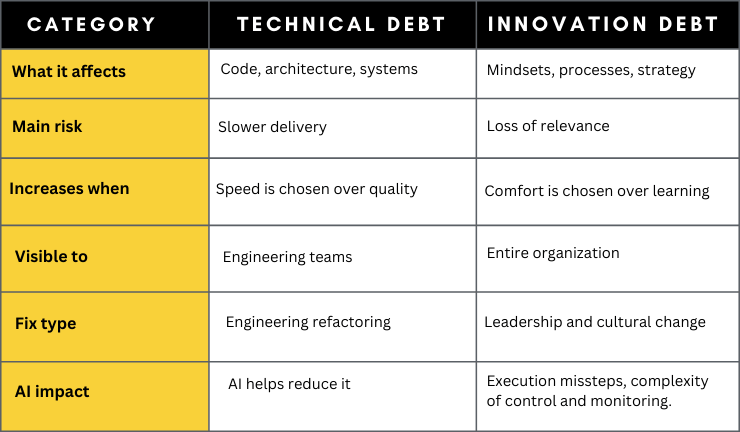
Technical debt shows up when your systems struggle to keep up with product demands. Innovation debt shows up when your thinking, processes, and decision frameworks stay stuck in the past. As AI reshapes how software products are developed, shipped, and scaled, innovation debt becomes the bigger threat.
This breakdown explains the difference, the warning signs, and how leaders can eliminate both to stay competitive.
What is Technical Debt?
Technical debt refers to the extra work created when engineering teams choose faster short-term solutions instead of slower long-term improvements.
Typical examples include:
- Legacy code
- Hard-coded logic
- Poor documentation
- Outdated architecture
- Quick fixes that skip best practices
Technical debt reduces speed, increases bugs, and slows delivery cycles. Managing it keeps development efficient.
What is Innovation Debt?
Innovation debt is the accumulated cost of not evolving how your organization thinks, works, and learns.
Symptoms include:
- Outdated decision models
- Rigid delivery processes
- Slow approval cycles
- No dedicated experimentation time
- A culture that avoids change
- Misalignment between technology teams and business leaders
- No clear AI strategy
Innovation debt grows when teams cling to what worked before while the market, customer expectations, and technology move forward.
Technical debt limits output. Innovation debt limits possibility.
Why Innovation Debt Is More Dangerous in an AI-Driven World
AI is now a core driver of competitive advantage. Companies that embrace AI in product development, customer experience, and internal operations are moving faster than ever.
Innovation debt blocks the ability to:
- Adopt AI-driven workflows
- Experiment with new delivery models
- Shift from solution-first to problem-first thinking
- Modernize teams and talent strategies
- Rethink product processes for speed and learning
- Leverage data to guide decisions
AI rewards organizations with adaptive thinking, flexible execution, and cultures that learn fast. Innovation debt slows all of that down.
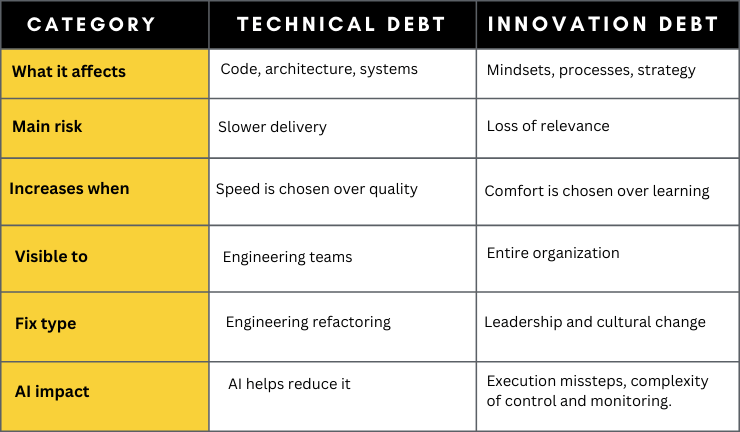
Technical Debt vs Innovation Debt: Key Differences
Signs Your Company Has Innovation Debt
You have innovation debt if these sound familiar:
- “We follow the same process because that’s how it’s always been done.”
- AI feels confusing or disruptive instead of useful.
- Experiments require heavy approvals.
- New ideas are treated as risks rather than opportunities.
- Product teams address symptoms instead of customer pain.
- The org avoids change unless forced by competition.
- Delivery teams work hard but progress feels slow.
- Technology modernization keeps getting delayed.
Innovation debt builds silently. By the time the symptoms show up, the gap is wide.
How Innovation Debt Hurts AI Adoption
Innovation debt is the reason many organizations struggle with AI:
- AI projects never move beyond pilots
- Stakeholders debate “why AI” instead of “where AI fits”
- Teams lack clarity about use cases
- Data is siloed or not trusted
- Engineers try to bolt AI onto old workflows
- Product management lacks experimentation frameworks
- Leaders fear disruption instead of preparing for it
The issue is not AI. The issue is an organization that has not built the muscle for change.
How to Reduce Innovation Debt
Reducing innovation debt requires more than process edits. It requires a reset in how teams think and work.
1. Build a Problem-First Culture
Move teams away from solution-first thinking. Clarify the customer pain before writing a line of code.
2. Run Innovation Acceleration Workshops
Use structured facilitation to define problems, validate assumptions, and design technical plans that eliminate waste.
ISHIR’s Innovation Accelerator gives teams the clarity to move faster and reduce uncertainty.
3. Modernize your delivery model
Adopt agile product team pods, AI-native engineering practices, and cross-functional collaboration.
4. Rewire decision frameworks
Shift from long approval cycles to shorter validation cycles supported by data and customer insight.
5. Invest in AI literacy at all levels
Leaders, product teams, and engineering teams need a shared understanding of where AI adds value.
6. Create space for experiments
Minimal experiments every quarter prevent thinking from going stale.
7. Upgrade talent strategy
Support teams with fractional experts, global talent, and AI-native engineers who bring fresh approaches.
How ISHIR Helps Reduce Technical Debt and Innovation Debt
ISHIR supports companies in eliminating both forms of debt through:
- Innovation Accelerator Workshops: Structured frameworks that uncover real customer problems, validate assumptions, and align teams.
- AI-Native Product Engineering: AI-driven delivery that speeds up development without sacrificing quality.
- Agile Product Team Pods: Cross-functional pods that bring design, engineering, product, and QA together.
- Global Capability Centers and Fractional Talent: Flexible talent models that reduce cost, increase speed, and introduce modern thinking.
- Technical Due Diligence and Architecture Modernization: Clear assessments that identify engineering gaps and modernization paths.
- Vibe Coding Support and Code Repair: Specialized teams who clean up AI-generated code, fix issues, improve architecture, and prepare products for scale.
ISHIR helps leaders move fast without compromising reliability and keeps orgs ready for the next wave of change.
Final Thoughts
Technical debt slows your systems. Innovation debt slows your people. Teams that only fix code stay efficient. Teams that rethink how they work stay relevant. In an AI-driven world, relevance wins.
Ready to eliminate the debt holding your teams back?
Partner with ISHIR to accelerate innovation, modernize delivery, and build AI-ready products
The post Technical Debt vs Innovation Debt: Why Both Slow You Down, but Only One Threatens Your Future in the Age of AI appeared first on ISHIR | Custom Software Development Dallas Texas.
*** This is a Security Bloggers Network syndicated blog from ISHIR | Custom Software Development Dallas Texas authored by Rishi Khanna. Read the original post at: https://www.ishir.com/blog/308753/technical-debt-vs-innovation-debt.htm
如有侵权请联系:admin#unsafe.sh