Is it possible to fulfil the AI-SOC promise beyond autonomous alert triage?Can we predict where 2025-11-21 09:48:18 Author: securityboulevard.com(查看原文) 阅读量:19 收藏
Is it possible to fulfil the AI-SOC promise beyond autonomous alert triage?
Can we predict where the next cyber attack against our organization is coming from
How to make attackers lose time so the defenders can catch them?
Is there a campaign against our customers that we are not aware of?
All these questions are being answered by a new generation of companies. They are delivering solutions that are approaching cybersecurity differently: preempting breaches, augmenting security operations with AI agents and alerting of information operations before they take off.
Discovering and showcasing innovation in cybersecurity is the purpose of Scaling Cyber, the podcast I’ve launched 4 weeks ago, and that I’d like to invite you to subscribe to. You can find a description of each episode below.
The purpose of Scaling Cyber is to provide visibility to cybersecurity leaders and founders that are scaling out of the usual locations, like the US or Israel. The first season is going to cover 8 companies from Europe and Africa.
I’d love to hear your thoughts on our first episodes and guests!
You can subscribe on Substack, Apple Podcasts, Spotify or YouTube.
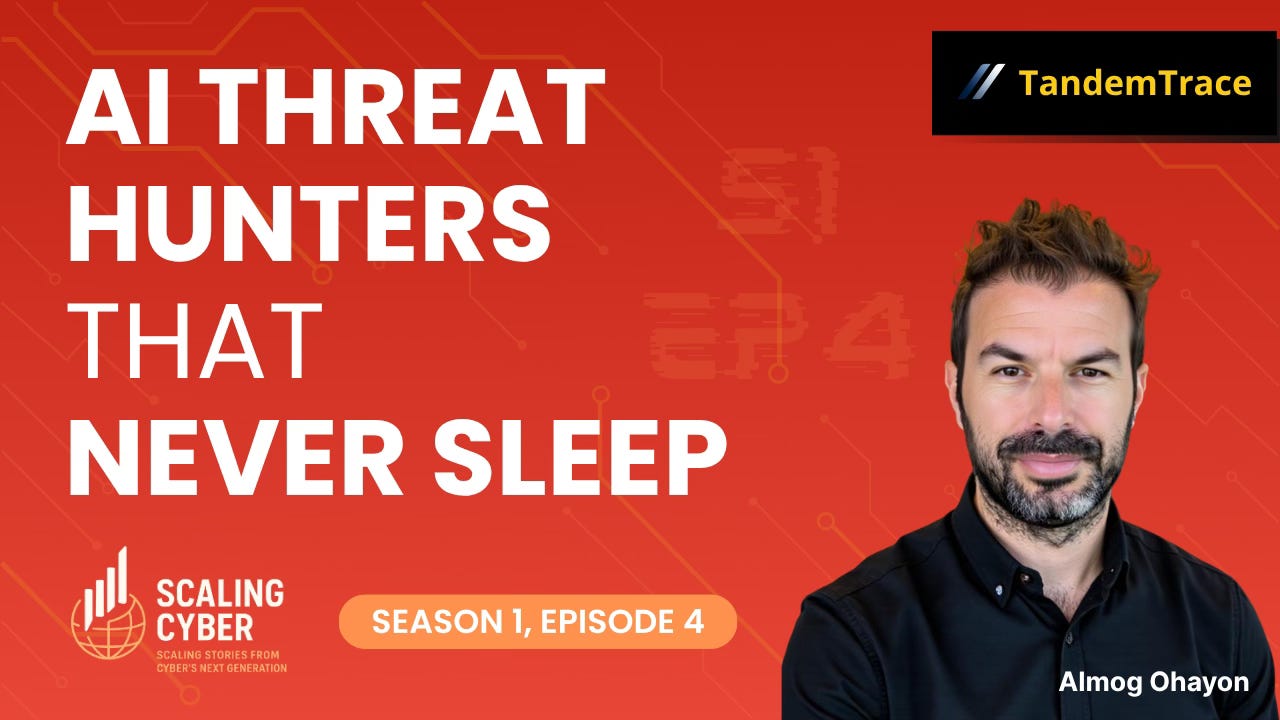
In our latest episode, Almog Ohayon, CEO & Founder of TandemTrace, explains how AI is transforming SecOps at a pace few imagined. He draws a parallel with the early days of cloud adoption: a moment of skepticism that eventually became standard practice. Today, the same shift is happening with AI, but faster and with even bigger implications for security teams.
What makes TandemTrace stand out is its focus on autonomous threat hunting, not just alert triage. Their AI agents generate and test new hypotheses nonstop, examining telemetry far beyond what humans could handle. Almog argues that dashboards were created for human analysts. AI doesn’t need dashboards. It needs clean data.
His message is clear: the future SOC runs on AI as the pilot, with humans guiding strategy.

A previous episode features Andriy Kusyy, CEO & Co-Founder of LetsData, who takes us inside the world of modern information operations. He didn’t plan to build a startup in this space: he simply followed a problem that he was seeing every day. Disinformation campaigns now move in multiple languages, across borders and platforms, making them almost impossible to spot without automation.
LetsData bridges cybersecurity and media intelligence by detecting coordinated manipulation early, before narratives go viral. Their platform monitors millions of posts across dozens of languages and looks for abnormal patterns: bot behavior, sudden surges, or hostile messaging.
Andriy shares how the team has supported organizations around the world, including helping Moldova defend its elections. His takeaway: information operations are now a mainstream cybersecurity threat.

In episode three, Pavel Rybczyk and Anastasiia Dorosh, from Labyrinth, introduce us to the new wave of cyber deception. Labyrinth deploys lightweight decoys — “points” — across a network. Since no real user should ever touch them, any interaction is an instant, high-fidelity alert. In an industry overwhelmed by false positives, this simplicity is refreshing.
Once attackers engage, Labyrinth doesn’t just detect them. It keeps them busy.
Their decoys pull intruders deeper into a controlled maze, buying defenders valuable time. Pavel and Anastasiia also highlight why this is the right moment for deception: environments are more complex, attacks move faster, and companies need a reliable second line of defense. Labyrinth is also part of a growing movement of high-quality European cybersecurity vendors building global-ready solutions.

In our first recorded episode, Luigi Lenguito shares how BforeAI, where he is CEO & Co-Founder, aims to shift cybersecurity back toward prevention. After years in global leadership roles at Dell, Luigi decided to challenge the industry’s assumption that breaches are inevitable. His team focuses on predicting malicious infrastructure before attackers launch their campaigns.
BforeAI’s approach is bold, including a performance guarantee backed by Munich Re. Luigi also talks about scaling a European startup globally by going to the US early and shaping a new security category. His insights reveal what it takes to create trust, earn analyst recognition, and turn a contrarian thesis into a fast-growing company.

There will be four more episodes, released weekly, of the first season of Scaling Cyber.
They will cover new territory: cloud attack simulation, community-driven phishing simulation, preventing email impersonation at scale, and protecting the Internet’s backbone.
Each one brings fresh perspectives and more lessons from founders about cybersecurity as well as their journeys. They are redefining what modern cybersecurity looks like and they are ready to share with us.
Discover the future cybersecurity global leaders in Scaling Cyber.
Subscribe now!
*** This is a Security Bloggers Network syndicated blog from Cybersecurity & Business authored by Ignacio Sbampato. Read the original post at: https://cybersecandbiz.substack.com/p/scaling-cyber-podcast-showcasing-cybersecurity-leaders
如有侵权请联系:admin#unsafe.sh