
A leading banking app was forced into a three-day shutdown after attackers exploited a small cod 2025-11-15 16:19:0 Author: securityboulevard.com(查看原文) 阅读量:17 收藏
A leading banking app was forced into a three-day shutdown after attackers exploited a small coding oversight that granted access to customer accounts. The flaw had quietly existed in the codebase for months, completely slipping past the development team. What made the incident even more frustrating was that a simple peer review could have identified the issue long before release. Scenarios like this are more common than most developers realize. Mobile apps frequently ship with hidden vulnerabilities, not due to negligence, but because no one can catch every flaw alone. When you stare at the same code for too long, your mind tends to overlook mistakes that fresh reviewers would immediately catch. This is why secure code review has emerged as one of the most essential security practices for modern development teams.
It ensures that your mobile app is built on a secure foundation, free from exploitable flaws and hidden vulnerabilities that attackers often rely on. In this blog, we’ll explore how a small bug can turn into a multimillion-dollar disaster and how regular secure code review prevents these risks from becoming reality.

How a Single Bug Can Cost Millions?
It might sound like an exaggeration that one tiny coding oversight can trigger massive financial and operational fallout, but cyber incidents across banking, fintech, healthcare, and e-commerce prove this repeatedly. A misconfigured condition, a weak API implementation, inadequate input validation, or outdated encryption can silently create a direct path for attackers to exploit your mobile application.
Below are the ways a seemingly harmless bug can escalate into a multi-million-dollar crisis:
Unauthorized Transactions
In financial and banking apps, even a minor logic flaw can be catastrophic. Attackers exploit insecure transaction workflows, poorly implemented authentication checks, or predictable session variables to perform fraudulent actions.
Common scenarios include:
- Bypassing multi-factor authentication
- Manipulating API responses to alter transfer amounts
- Replaying or intercepting financial requests
- Exploiting race conditions to duplicate transactions
These are not theoretical risks; breaches have resulted in millions lost within minutes before systems could detect anomalies.
Account Takeovers
Weak session handling, improper token storage, insecure password resets, and insufficient encryption often allow attackers to hijack user accounts. Once inside, they can:
- Access personal and financial information
- Modify linked email or phone numbers
- Lock out legitimate users
- Initiate unauthorized purchases or data exports
Account takeover attacks also severely erode customer confidence. Users blame the brand, not the attacker, for failing to protect their identity.
App Store Delisting
Google Play and the Apple App Store enforce strict security policies. If your app is found to contain critical vulnerabilities, these platforms may:
- Temporarily block your updates
- Display security warnings to users
- Remove your application entirely
Such disruptions can halt revenue streams, interrupt customer experience, and push users toward competitors. Restoring compliance after delisting is costly, time-consuming, and often reputationally damaging.
Join our weekly newsletter and stay updated
Why Secure Code Review Matters for Mobile Apps?
Mobile applications operate in a highly unpredictable environment, with different operating system versions, device models, network conditions, screen sizes, and hardware capabilities. This diversity increases complexity and creates numerous opportunities for bugs to slip through unnoticed. Because mobile apps interact directly with personal, financial, and behavioral data, even one overlooked vulnerability can become a gateway for attackers.
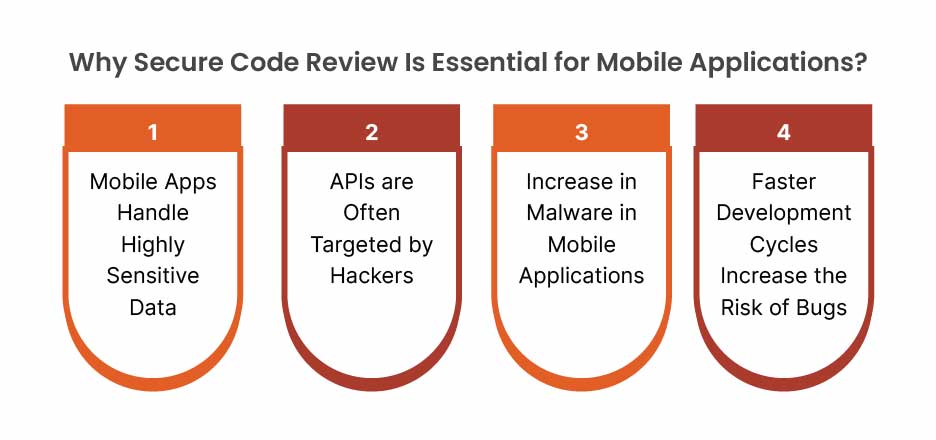
Mobile Apps Handle Highly Sensitive Data
Modern apps collect and process vast amounts of sensitive user information, from exact GPS coordinates and biometric identifiers to saved payment methods, authentication tokens, in-app chats, and corporate data. This makes mobile apps an attractive target for hackers.
If the code contains insecure data storage, improper encryption, weak session handling, or exposed keys, attackers can easily extract sensitive information using malware, reverse engineering, or MITM attacks.
A secure code review ensures:
- Sensitive data is encrypted properly
- Critical values (tokens, keys, secrets) are not hardcoded
- Secure storage mechanisms like Keychain/Keystore are used
- APIs transferring data use secure protocols
The more personal the data, the higher the responsibility, and the greater the impact of a single flaw.
APIs are Often Targeted by Hackers
Mobile apps depend heavily on backend APIs for authentication, payments, data syncing, and core business logic. This makes APIs one of the most exploited attack surfaces.
If the code exposes API endpoints, lacks input validation, or sends insecure requests, attackers can manipulate the app to:
- Retrieve unauthorized data
- Bypass authentication
- Modify server responses
- Abuse business logic
A thorough secure code review helps identify:
- Unprotected endpoints
- Improper authorization checks
- Input validation gaps
- API key exposure in the code
Since APIs form the backbone of mobile applications, securing them is non-negotiable.
Increase in Malware in Mobile Applications
Attackers frequently use automated tools to reverse-engineer mobile apps and extract internal logic. With just an APK file, a hacker can uncover:
- API keys
- Encryption algorithms
- Hardcoded credentials
- Business logic and internal workflows
This information is then used to create clones, inject malware, or exploit weaknesses.
Secure code review helps counter these risks by ensuring:
- Sensitive logic is not exposed
- Security layers such as certificate pinning are implemented
- Secrets are stored securely
As mobile malware continues to evolve, proactive code reviews remain one of the most effective defenses.
Faster Development Cycles Increase the Risk of Bugs
With Agile and DevOps methodologies, development teams push frequent updates and releases. While this accelerates innovation, it also increases the chance of introducing new vulnerabilities, especially when deadlines compress testing time.
Common issues include:
- Unvalidated inputs
- Missed authentication checks
- Debug code left behind
- Outdated third-party libraries
Regular secure code reviews ensure security keeps pace with development speed. They act as a safety net, catching issues before they are shipped to thousands or millions of users.

How Kratikal Can Help You in Secure Code Review As a Service?
At Kratikal, we provide Secure Code Review as a Service to help organizations identify hidden vulnerabilities early in the development lifecycle and strengthen their overall application security posture. Our approach combines deep manual analysis with intelligent automated scanning to ensure no flaw goes unnoticed. We begin by understanding your application architecture, defining clear review objectives, and pinpointing high-risk components. Our security experts then meticulously review your source code to detect issues such as insecure data handling, flawed authentication logic, injection points, and misconfigurations. After identifying vulnerabilities, we deliver detailed remediation guidance and validate fixes to ensure they are properly implemented. With Kratikal as your security partner, you gain a thorough, reliable, and scalable code review process that aligns with compliance standards and keeps your applications secure from evolving threats.
FAQs
- What types of vulnerabilities can secure code review detect?
Secure code review can identify a range of issues, including insecure data handling, missing input validation, improper authentication, weak session management, hardcoded secrets, API misconfigurations, cryptographic flaws, and insecure third-party library usage.
- How does secure code review prevent financial losses?
Secure code review identifies issues such as insecure API calls, weak encryption, faulty authentication logic, or unsafe data storage early in the development cycle. This proactive approach helps organizations avoid fraud, regulatory penalties, operational downtime, and reputational damage, often amounting to millions in losses.
The post A Single Bug in Mobile Apps Can Cost You Millions! Protect with Secure Code Review! appeared first on Kratikal Blogs.
*** This is a Security Bloggers Network syndicated blog from Kratikal Blogs authored by Shikha Dhingra. Read the original post at: https://kratikal.com/blog/a-single-bug-in-mobile-apps-can-cost-you-millions-protect-with-secure-code-review/
如有侵权请联系:admin#unsafe.sh