好的,我现在需要帮用户总结这篇文章的内容。用户的要求是用中文总结,控制在100字以内,不需要特定的开头,直接写描述即可。 首先,我快速浏览文章,发现它主要讲述了Bellingcat调查苏丹城市Al Fashir附近的大规模屠杀事件。RSF(快速支援部队)在围攻和占领这座城市期间,导致超过80人死亡。文章提到了视频证据、卫星图像以及联合国的反应。 接下来,我需要提取关键信息:RSF的行为、死亡人数、证据类型、地理位置以及国际反应。然后将这些信息浓缩成简短的句子,确保不超过100字。 最后,组织语言,确保流畅且包含所有重要细节。例如,“Bellingcat调查揭示苏丹Al Fashir附近大规模屠杀事件,RSF围攻期间致超80人死亡。视频和卫星图像显示平民遇害场景。联合国谴责为战争罪行和反人类罪。”这样既简洁又全面。 </think> Bellingcat调查揭示苏丹Al Fashir附近大规模屠杀事件,RSF围攻期间致超80人死亡。视频和卫星图像显示平民遇害场景。联合国谴责为战争罪行和反人类罪。 2025-11-5 13:35:27 Author: www.bellingcat.com(查看原文) 阅读量:57 收藏
Warning: Contains written descriptions of extreme violence including murder. All graphic footage has been omitted.
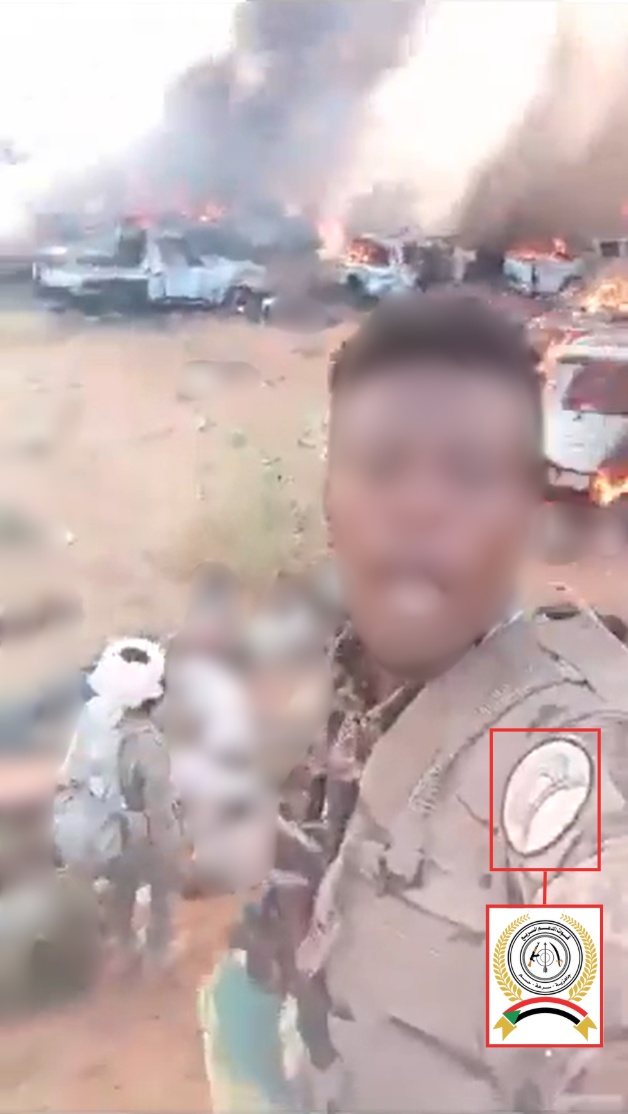
A Bellingcat investigation has identified and verified the exact location of a mass killing of more than 80 people that took place near Al Fashir during the recent siege and takeover of the Sudanese city by the paramilitary Rapid Support Forces (RSF). More than a dozen videos which have emerged online since Oct. 27 were analysed, some filmed by fighters wearing what appears to be RSF insignia, showing the events and their aftermath.

Al Fashir, the capital of North Darfur, was the last major stronghold of the Sudanese military in the region and a refuge for people fleeing nearby villages and towns. The city, considered a strategic military location near the southwestern border leading to Chad and South Sudan, fell last week after more than 500 days under RSF siege. The RSF, which has been fighting Sudan’s military for control over the country, killed at least 1,500 people during the takeover, according to the Sudan Doctors Network.
A Mass Killing Outside the City
Open source evidence reviewed by Bellingcat showed that people attempting to flee Al Fashir were killed by men, some of whom appeared to be wearing RSF uniforms. The RSF had earlier pledged to remain “firmly committed to protect the civilians” and “not tolerate any attempts to exploit their lives or tamper with their security.”
Footage posted on social media showed a mass killing more than seven kilometres outside the city, where the fleeing convoy had encountered an earthen berm encircling Al Fashir. The berm and an accompanying trench were built by the RSF during the siege. Satellite imagery indicates that the section to the north-west of the city, where the mass killing took place, was constructed throughout August.

Bellingcat analysed more than a dozen videos. Given the extreme violence visible in much of the footage, only material that was not explicitly graphic has been included in this report. Some of the videos filmed at this location have also been geolocated by the Centre for Information Resilience and others.
Cross-referencing the different camera angles in the videos made it possible to map the exact location of the killings to a single location: 13.71340, 25.27854. In satellite imagery, clusters of dark shapes around the vehicles north of the berm correspond to the locations of bodies identified in verified videos from the scene.

In total, the video footage showed more than 80 bodies lying beside damaged and burning vehicles along the berm, inside the adjacent trench and across the surrounding area. More than two dozen destroyed vehicles were also identified.

Support Bellingcat
Your donations directly contribute to our ability to publish groundbreaking investigations and uncover wrongdoing around the world.
In one video, filmed early on in the attack, fighters in what appear to be RSF uniforms are seen taking cover behind a vehicle as gunfire is heard. One fighter can be seen closing in on the burning convoy and aiming his weapon.
However, in later videos filmed by the fighters showing the aftermath of the attack, none of the casualties visible appeared to be in possession of weapons; almost all appeared to be dressed in civilian clothing and several were women. Of the more than 80 casualties visible in various videos, a couple can be seen wearing what appears to be dark, military-style clothing, and one can be seen lying next to a belt of ammunition. Although, it is unclear who the belt belonged to.
The arrangement of destroyed vehicles and groups of bodies in the videos matched what was visible in satellite imagery. Moreover, tyre tracks visible in the sand appeared to link the mass killing site with the checkpoints along the sand berm. Fresh marks appeared on satellite images after Oct. 27., the day of the RSF’s complete takeover of Al Fashir.

A RSF commander known as Abu Lulu, identified in the videos by his distinctive white scarf, appeared in at least three videos from the scene. The commander has previously been featured in social media footage from the conflict. On Oct. 31, TikTok removed a profile believed to be linked to him.
In one video, geolocated by Bellingcat to the far side of the berm, the commander can be seen and heard taunting a group of 10 male captives sitting lined up on the ground, forcing them to praise the RSF and denigrate the military before they are shot.

In another video filmed to the west of the convoy, Abu Lulu can be heard questioning a wounded man lying on the ground, threatening sexual violence before shooting him at point-blank range. In a third video filmed meters away, the same commander can be seen standing among a number of motionless bodies as he repeatedly fires into them.
In several other videos, one fleeing vehicle appears to have crossed the berm before becoming stuck in the trench on the far side. In one of these videos, filmed from inside the trench, a fighter can be seen firing into a group of motionless bodies on the ground next to the car, while others film and celebrate.
UN Investigation Points to a Pattern
Morris Tidball-Binz, the UN Special Rapporteur on extrajudicial, summary or arbitrary executions, told Bellingcat that “if the images were genuine”, these were “unlawful killings under International Human Rights Law, International Humanitarian Law (IHL) and International Criminal Law.”
“Under the former they correspond to extrajudicial or arbitrary executions; under IHL they correspond to war crimes and under the latter they may amount to crimes against humanity in view of the number of victims and the seemingly planned and systematic nature of the killings,” he said.
Subscribe to the Bellingcat newsletter
Subscribe to our newsletter for first access to our published content and events that our staff and contributors are involved with, including interviews and training workshops.
Tidball-Binz added that he was not aware of any steps taken by RSF command or relevant authorities to investigate these incidents or hold those responsible accountable. “So far impunity has prevailed,” he stated via email.
Footage from Oct. 30. shows Abu Lulu in RSF custody, being transported under heavy guard and later incarcerated in Shala Prison on the western edge of the city. The RSF announced an investigation into “violations” committed by fighters following the capture of Al Fashir.
Other open source data also documented evidence of atrocities within the city itself. In a chapter of a detailed report entitled “evidence of mass killings”, satellite imagery analysis by Yale’s Humanitarian Research Lab from Oct. 27 found what it said were “objects consistent with the size of human bodies on the ground near RSF vehicles” and “instances of reddish earth discoloration”.
The UN Security Council condemned the assault by the RSF on Al Fashir and “its devastating impact on the civilian population.”
The UN Fact-Finding Mission on Sudan expressed “grave alarm at escalating atrocities” detailing “a devastating pattern of atrocities by both warring parties” that include “war crimes of violence to life and person”. The mission’s initial findings pointed to “a deliberate pattern of ethnically targeted executions of unarmed civilians, assaults, sexual violence, widespread looting and destruction of vital infrastructure, and mass forced displacement”.
The RSF now controls the entire Darfur region.
Carlos Gonzales, Jake Godin and Logan Williams contributed to this report.
Bellingcat is a non-profit and the ability to carry out our work is dependent on the kind support of individual donors. If you would like to support our work, you can do so here. You can also subscribe to our Patreon channel here. Subscribe to our Newsletter and follow us on Bluesky here and Mastodon here.
如有侵权请联系:admin#unsafe.sh