好的,我现在需要帮用户总结一篇文章的内容,控制在100个字以内。用户的要求是直接写描述,不需要开头语。首先,我得仔细阅读文章内容,抓住主要信息。 文章讲的是网络犯罪分子通过恶意链接和邮件攻击货运经纪人和卡车运输公司,安装远程监控管理工具(RMMs),从而劫持货物。攻击手段包括钓鱼邮件、伪造货运信息,利用社会工程学获取信任。攻击者的目标是安装RMMs,控制受害者系统,修改预订信息,拦截货物。 接下来,我需要提取关键点:攻击目标、手段、工具、影响。然后用简洁的语言把这些点连贯起来。确保不超过100字,并且直接描述内容。 可能会遇到的问题是如何在有限的字数内涵盖所有重要信息。我需要优先选择最重要的部分,比如攻击方式、目标和结果。同时避免使用复杂的术语,保持语言通俗易懂。 最后检查一下是否符合用户的要求:中文总结,100字以内,直接描述内容。确保没有遗漏关键信息,并且表达清晰。 </think> 网络犯罪分子通过恶意邮件和链接攻击货运经纪人及卡车运输公司,植入远程监控管理工具(RMMs),以劫持货物并盗窃实物商品。攻击者利用钓鱼邮件、伪造货运信息及社会工程学手段获取信任,并通过合法软件控制受害者系统以拦截高价值货物。此类攻击主要针对北美企业,并已扩展至其他国家和地区。 2025-11-3 17:0:24 Author: www.bleepingcomputer.com(查看原文) 阅读量:37 收藏

Threat actors are targeting freight brokers and trucking carriers with malicious links and emails to deploy remote monitoring and management tools (RMMs) that enable them to hijack cargo and steal physical goods.
Researchers tracked the activity to June, but they found evidence of these types of campaigns delivering NetSupport and ScreenConnect since January.
According to email security firm Proofpoint, these attacks is becoming more popular, with nearly two dozen campaigns recorded since August, each of them sending up to a thousand messages.

The targets are primarily North American entities; however, Proofpoint has also observed similar activity in Brazil, Mexico, India, Germany, Chile, and South Africa.
Digitized cargo theft
Cargo theft involves stealing commercial shipments by hijacking trucks or trailers in transit, by re-routing them, or by impersonating legitimate carriers. The goods are then redirected to fraudulent pickup points.
The National Insurance Crime Bureau (NICB) estimates cargo theft losses in the U.S. to $35 billion annually.
Today, cybercriminals focus on exploiting gaps in the digital segment of the supply chain that helps companies move goods more efficiently.
The attacker’ primary goal is to install RMMs like ScreenConnect, SimpleHelp, PDQ Connect, Fleetdeck, N-able, and LogMeIn Resolve on the target companies’ systems, which give them full remote control, reconnaissance, and credential harvesting capabilities.
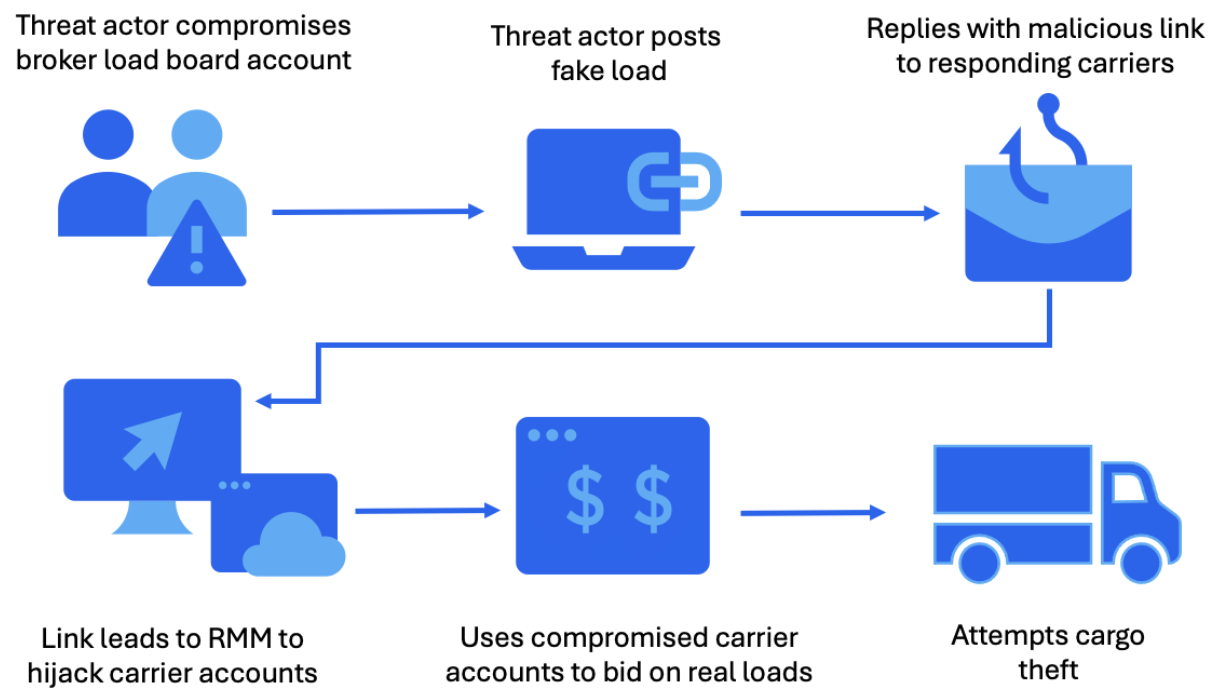
To achieve this goal, they use compromised accounts for load boards to post fraudulent freight listings, or breach broker and dispatcher email accounts, and then hijack email threads to lead victims to a malicious URL.
.jpg)
Source: Proofpoint
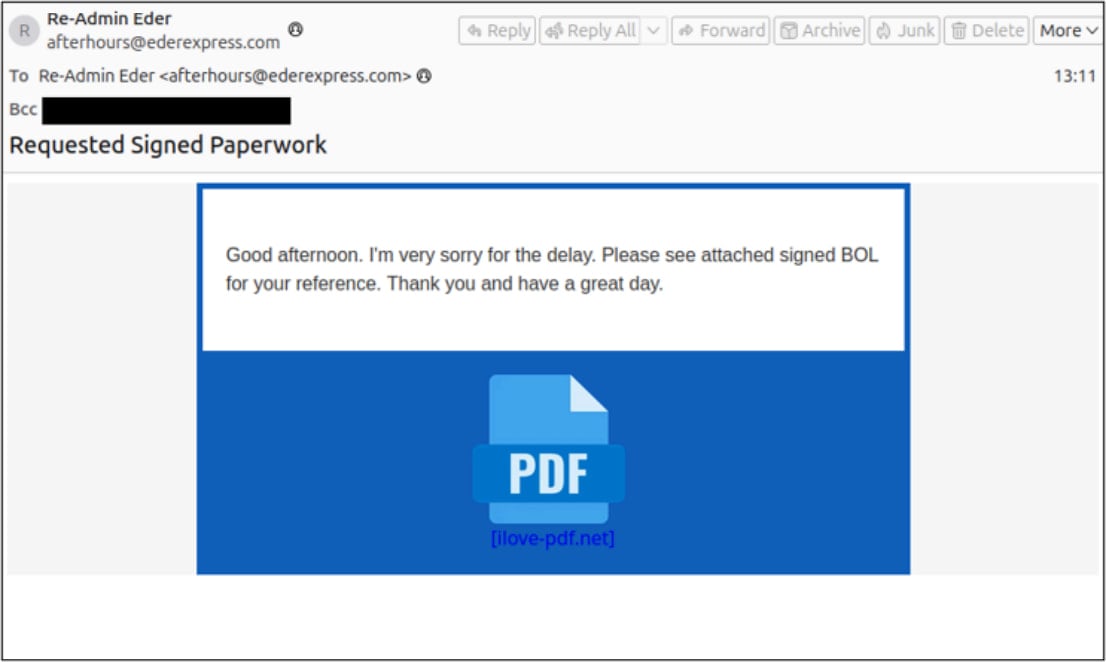
According to the researchers, the threat actor achieves their goal by sending emails directly to asset-based carriers, freight brokerage firms, and integrated supply-chain providers, but this occurred mostly for larger entities.
Source: Proofpoint
At this stage, social engineering plays a key role, where the attackers tailor their messages for urgent load negotiations and exploit trust in load packets, showing knowledge of how the freight industry operates.
The external pages are well crafted and appear legitimate by placing convincing carrier branding, and lead to downloading executables or installer MSI files that install an RMM tool.
By means of these tools, which are legitimate software, the attacker can control the compromised machine and can modify bookings, block dispatcher notifications, add their own devices to dispatcher phone extensions, and book loads under the compromised carrier’s identity.
“These RMMs are often used in tandem; for example, PDQ Connect has been observed downloading and installing both ScreenConnect and SimpleHelp,” Proofpoint explains.
“Once initial access is established, the threat actor conducts system and network reconnaissance and deploys credential harvesting tools such as WebBrowserPassView,” the researchers say.
Reconnaissance and credential harvesting indicate a wider attack purpose that includes pivoting deeper in the compromised environments.
Source: Proofpoint
Proofpoint notes that the attacks suggest insider knowledge of the routes, timing, and high-value cargo types, enabling cybercriminals to select the most profitable shipments to steal.
The researchers believe that the hackers "are working with organized crime groups to compromise entities in the surface transportation industry" and hijack cargo freight.
One carrier company targeted in such attacks explains that the hackers tricked their dispatcher into installing an RMM tool and took control of their account.
The attacker "deleted every booking email and blocked notifications" and added their device to the dispatcher's phone extension. This allowed them to impersonate the victim company and talk directly to brokers.
"When booking loads, he used our official MC email + phone (listed on FMCSA)," a representative of the victim carrier says, adding that "Brokers, Highway, MyCarrierPackets would call our number and email — the hacker answered, verified everything, and got the loads."
Stolen cargo, which includes commodities such as food, beverages, and electronics, is physically intercepted or rerouted and later sold online or shipped overseas.
While Proofpoint has observed RMM tools being used in the attacks, the company notes that information stealers such as NetSupport, DanaBot, Lumma Stealer, and StealC were also deployed in related activities, although attribution to specific clusters was not possible.
Recommended defenses include restricting the installation of unapproved RMM tools, monitoring network activity, and blocking .EXE and .MSI file attachments at the email gateway level.
The 2026 CISO Budget Benchmark
It's budget season! Over 300 CISOs and security leaders have shared how they're planning, spending, and prioritizing for the year ahead. This report compiles their insights, allowing readers to benchmark strategies, identify emerging trends, and compare their priorities as they head into 2026.
Learn how top leaders are turning investment into measurable impact.
如有侵权请联系:admin#unsafe.sh