好的,我现在需要帮用户总结一篇文章的内容,控制在100字以内。首先,我得通读整篇文章,抓住主要信息。 文章讲的是Bellingcat调查发现,在委内瑞拉的一次美军袭击中,一个居民楼被击中,导致至少一名平民死亡。他们找到了AGM-88系列导弹的残骸。导弹本来是用来打击防空系统的,但这次却误伤了民居。美军还在使用这种导弹,并且声称在进行战损评估。 接下来,我需要把这些关键点浓缩成一句话。要包括调查机构、事件地点、结果、导弹类型、目标以及美军的回应。确保不超过100字。 可能的结构是:Bellingcat发现美军导弹残骸在居民楼,导致平民伤亡,导弹本应打击防空系统,美军称在评估战损。 检查一下字数是否合适,有没有遗漏的重要信息。看起来没问题了。 </think> Bellingcat调查发现,在2026年1月3日美国对委内瑞拉的军事行动中,一枚AGM-88系列导弹击中了卡塔亚·拉马尔的一座居民楼,导致至少一名平民死亡和多人受伤。该导弹原本用于打击防空系统,但误中民居。 2026-1-7 19:8:52 Author: www.bellingcat.com(查看原文) 阅读量:15 收藏
A Bellingcat investigation has identified remnants of an AGM-88 series missile inside a three-storey apartment complex that was hit in Catia La Mar during the US military raid on Venezuela on Jan. 3, 2026 that reportedly killed at least one civilian.
According to the Venezuelan independent media outlet, El Pitazo, Rosa Gonzalez, 79, was killed in this airstrike in the city of Catia La Mar in La Guaira State, 30 km north of the capital Caracas. The attack reportedly left a second individual severely wounded.
Bellingcat asked the US Department of Defense to confirm our findings. However, they stated that “a Battle Damage Assessment is ongoing”. We also reached out to the Department of State but they did not respond to our questions at the time of publication.
The Jan. 3 US attack on Venezuela targeted multiple locations across the country, including military installations and areas within and around the capital, Caracas. US military helicopters, jets and drones provided cover for an assault force that landed at Fort Tiuna, the largest military complex in Caracas; captured President Nicolas Maduro and First Lady Cilia Flores, and flew them out of the country.
About 75 people, including civilians, were killed in the operation, US officials familiar with the matter told the Washington Post. Among the military fatalities were 32 Cuban and 21 Venezuelan soldiers, according to various media reports.
According to El Pitazo, a second woman, Yohana Rodríguez Sierra, 45, was killed, and her daughter wounded, in other strikes at a communications station at Cerro El Volcán. Multiple residential houses were also reportedly destroyed in the nearby area of La Boyera.
The military operation in Caracas follows a series of attacks on alleged drug boats which have reportedly killed at least 114 in the Caribbean Sea and the Eastern Pacific Ocean.
Identifying the Munition
Bellingcat has found videos showing the aftermath of the Catia La Mar attack and remnants of the munition filmed at the location. The strike destroyed some exterior walls of one apartment complex and caused extensive damage to at least two apartments.

Bellingcat geolocated the apartment complex to an area in Catia La Mar about 30 km north of Caracas (10.592796, -67.037721) and approximately 500 m east of a targeted air defence storage inside a military facility.


One video also reveals remnants of a munition. According to an analysis of visual evidence by Bellingcat, the remnants appear to show an AGM-88 series missile.
Another remnant of the AGM-88 series missile appears in a video published by Euronews. This remnant is a BSU-60 tail fin, that according to an analyst note on the Open Source Munitions Portal (OSMP), is used exclusively with the AGM-88 series missile.
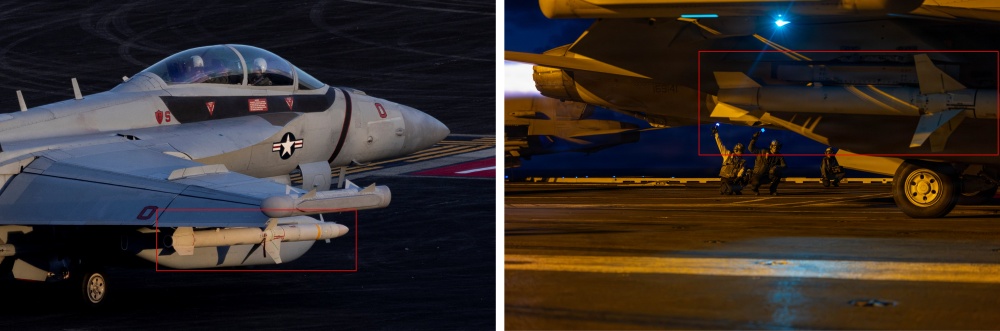
The AGM-88 HARM/AARGM series are American-produced air-to-surface missiles that are designed to hit ground-based radar-emitting targets, such as air defence systems like the Buk-M2E used by Venezuela’s military, with several of them destroyed during the US military raid.
“Venezuela does not operate the AGM-88 HARM. Its F-16 acquisition occurred in 1983, when the US wouldn’t release anti-radiation tech to the region,” Dr Andrei Serbin Pont, International Analyst and President of the Regional Coordinating Centre for Economic and Social Investigations, CRIES, told Bellingcat. Later Israeli upgrades added guided munitions/AAMs, not ARMs, he said.
According to TheWarZone, Venezuela did not receive any precision air-to-surface munitions, such as the AGM-88 series missiles. The Stockholm International Peace Research Institute (SIPRI) Arms Transfer Database does not report any transfers of AGM-88 missiles to Venezuela.
US Navy aircraft were photographed in the region with AGM-88E AARGM missiles in the weeks before the operation. Chairman of the Joint Chiefs of Staff, General Caine, stated that jets of this type, designed to suppress and destroy air defences, took part in the operation.

Air Defence Systems Targeted
The US struck several air defence systems across Venezuela as part of the operation, with Buk-M2E launchers being destroyed at La Guaira Port, and the Higuerote and La Carlota airbases. Satellite imagery from Vantor shows that the area near a BuK-M2E storage building at Fort Guaicaipuro was also struck, but no air defence systems can clearly be seen.

According to satellite imagery, Buk-M2E launchers appear to have been stored at the military base approximately 500m from the residential building that was hit.


Bellingcat was not able to determine what caused the missile to strike the apartment building or if Buk-2ME launchers at Catia La Mar or a different system were the intended target.
The AARGM variant is capable of having designated missile “impact zones” and “avoidance zones” programmed to determine where the missile can or can’t impact when used on missions, a feature added to “prevent collateral damage”.
Bellingcat asked the US Department of Defense if any weapons used in the operation transmitted a weapons impact assessment or other data that indicated they hit an unintended or civilian location. They said that a Battle Damage Assessment is ongoing.
Carlos Gonzales, Giancarlo Fiorella, Jake Godin, Trevor Ball and Youri van der Weide contributed to this report.
Bellingcat is a non-profit and the ability to carry out our work is dependent on the kind support of individual donors. If you would like to support our work, you can do so here. You can also subscribe to our Patreon channel here. Subscribe to our Newsletter and follow us on Twitter here and Mastodon here.
如有侵权请联系:admin#unsafe.sh